1870 G50C BG-1023 (Regular Strike)
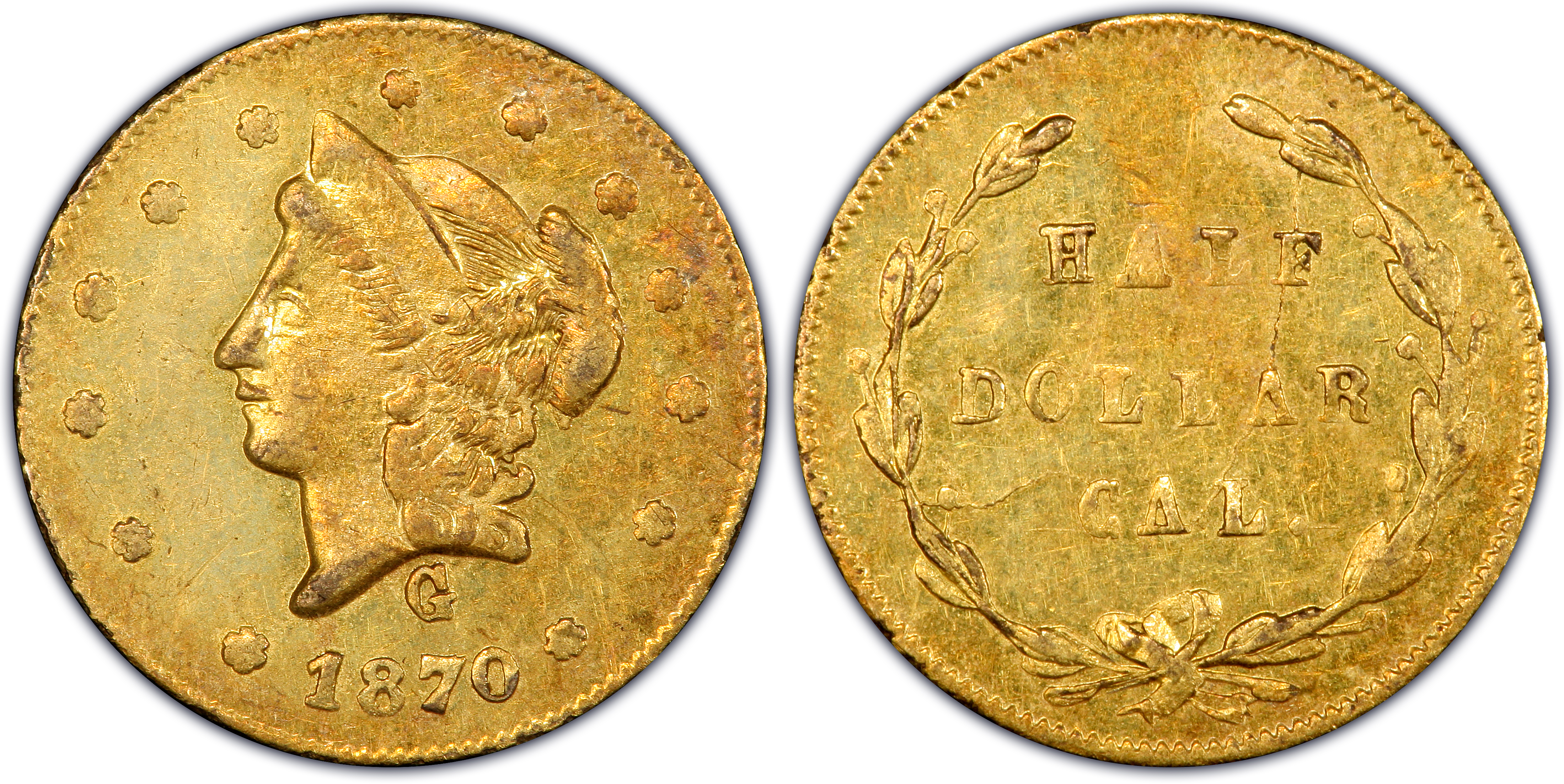
Obverse & Reverse
The 1870 G50C BG-1023 is a numismatic artifact from the second phase of California's fascinating fractional gold series, a period numismatists designate as 'Period Two' (1859-1882). Unlike their 'Period One' predecessors, which were struck with the genuine intent of alleviating a severe shortage of small change during the initial frenzy of the Gold Rush, Period Two pieces were created under a different set of socio-economic circumstances. By 1870, the United States Mint in San Francisco was in full operation, producing ample federal coinage for the region. The dire need for privately minted fractional gold had evaporated. Consequently, the motivation for producing these miniature gold pieces shifted from commerce to keepsake. They became popular souvenirs, mementos of the romanticized Gold Rush era, eagerly purchased by tourists and locals alike. This context is crucial to understanding the BG-1023. It was not a coin meant to be traded for goods and services in a mining camp, but rather a delicate piece of jewelry or a curiosity to be tucked away. The production of these pieces existed in a legal gray area. The Private Coinage Act of April 22, 1864, had made such private minting illegal. However, the law was not strictly enforced by the Secret Service in California until 1883. This lax enforcement allowed numerous San Francisco-based jewelers, whose identities are now mostly lost to history, to continue striking these denominated tokens. They often backdated their creations or used designs that mimicked federal coinage to lend them an air of legitimacy. The BG-1023, with its classic Liberty Head motif, is a prime example of this mimicry. Its existence speaks to a vibrant market for tangible reminders of California's golden identity, long after the initial rush had subsided. The extreme rarity of the BG-1023 variety today suggests its original mintage was minuscule, likely produced in a very small batch by a single artisan die-sinker, and its survival is a matter of pure chance.
Associated EventPost-Gold Rush California Economy
Reason For MintingPrimarily created as a souvenir or collectible item for the tourist trade, capitalizing on the romanticism of the earlier Gold Rush era.
Minter HistoryThe specific minter of BG-1023 is unknown, a common trait for Period Two fractional gold. Production was decentralized among various San Francisco jewelers and artisans who created these pieces for the souvenir market. They operated semi-openly due to lax enforcement of the 1864 private coinage laws, but did not typically apply identifiable mintmarks, leaving a legacy of beautiful but anonymous work.
Historical SignificanceThe BG-1023 is significant not as a circulating coin, but as a representation of the commercialization of the Gold Rush legacy. It marks the transition of fractional gold from a necessary medium of exchange to a nostalgic commodity, reflecting California's evolving identity and the enduring allure of its gold discovery on the public imagination.
N/A
Denomination50 Cents
Minting Period1870
Assayer/MinterUnknown San Francisco Jeweler
Geographic OriginSan Francisco, California
Obverse DescriptionA beaded border surrounds a right-facing portrait of a Liberty Head, modeled after the contemporary designs of federal gold coinage by James B. Longacre. She wears a coronet inscribed LIBERTY, and her hair is tied in a bun at the back. Thirteen stars encircle the portrait, representing the original colonies.
Obverse InscriptionLIBERTY
Reverse DescriptionWithin a beaded border, the denomination '1/2' is central, above the word 'DOLLAR' and the date '1870'. The inscription 'CALIFORNIA GOLD' forms an arc around the upper portion of the wreath.
Reverse InscriptionCALIFORNIA GOLD 1/2 DOLLAR 1870
CompositionGold
Stated Fineness Actual FinenessVaries, but Period Two pieces are often of a lower fineness than their Period One counterparts, ranging from .500 to .850 fine.
Weight0.25 grams
Diameter10.00 mm
EdgePlain
Extremely low, likely less than 100.
Survival EstimateFewer than 10 known, possibly 4-6.
Rarity ScaleR-7 (Low R.7)
The BG-1023's allure lies in its extreme rarity and its connection to the romantic souvenir trade of 1870s San Francisco. As a Period Two issue, it is part of a historically significant series, and this specific variety is a major prize for advanced specialists in California fractional gold, often missing from even the most comprehensive collections.
Key VarietiesNo major varieties of BG-1023 struck during the original period are known, which is expected given its tiny mintage. No special collector issues, patterns, or restrikes have ever been identified for this specific Breen-Gillio number.
Authentication TipsAuthenticity is paramount. Genuine examples exhibit sharp, albeit sometimes uneven, strikes from hand-cut dies. The details of Liberty's hair and the lettering should be consistent with known genuine examples. The planchets are characteristically thin and can show parallel striations from the rolling process. Counterfeits are common in the series; they are often thicker, have a soapy or cast-like appearance, incorrect lettering fonts, and may be made of brass or low-karat gold. A key diagnostic for many fakes is the absence of the word 'DOLLAR' or a valid abbreviation, which this genuine variety possesses.
Shopping ConsiderationsAcquiring a BG-1023 is an event, as they appear at auction only once every several years. A 'premium quality' example would be one that is well-centered, sharply struck for the variety, and free of the common problems that plague these tiny coins, such as bending, jewelry mounting evidence (solder), or harsh cleaning. Look for original, undisturbed luster in the protected areas around the devices. Pay close attention to the sharpness of the stars and the date, as these were often areas of strike weakness. Given the rarity, even a problem-free circulated example is a major acquisition. Third-party certification by PCGS or NGC is absolutely essential for authentication and establishing a market value.
A coin's grade is its condition, rated on a 1-70 scale. For rare coins, this is the most critical factor in determining value, as a tiny difference in preservation can mean a huge difference in price.
Relevant Grade TypesOriginal 1870 BG-1023 issues are considered business strikes, although they were not intended for widespread circulation. They are found in Circulated grades (AU-50 to AU-58 are most common for survivors) and, very rarely, in Mint State (MS, 60-70). No original Proofs from 1870 are known or believed to exist for this variety. Any piece described as a 'Proof' would be a later-date fantasy item or a misattribution of a prooflike business strike.
Mint State CharacteristicsA true Mint State BG-1023 would be exceptionally rare. Quality is defined by the strength of the strike; look for full definition in Liberty's hair details and the numerals of the date. Luster is typically satiny and delicate, not deeply prooflike. Due to the small size and hand-production methods, minor planchet flaws or adjustment marks may be present and should not be overly penalized unless they are distracting. Bag marks are less common than handling marks, given their souvenir nature.
Circulated Wear PatternsWear first appears on the highest points: Liberty's coronet, cheek, and hair above the ear. On the reverse, the numerals of the fraction '1/2' and the leaves in the wreath will show initial friction and loss of detail. In lower grades (VF and below, though few if any may exist), the stars and legends will begin to merge with the fields.
Key Factors For ValueFor the BG-1023, the primary value driver is its sheer existence and authenticity, given its R-7 rarity. Beyond that, a specimen with superior surface quality—meaning minimal marks and no evidence of cleaning, tooling, or jewelry use—will command a massive premium. Strike quality is the next consideration; a sharply struck example is always preferred. Finally, eye appeal, which can be enhanced by attractive original gold toning, plays a significant role. Certification by a top-tier service (PCGS or NGC) is non-negotiable, and a CAC sticker on an already-graded coin would provide the ultimate confirmation of quality for the assigned grade.
PCGS Price Guide
| Grade | Price | Population |
|---|---|---|
| 50 | $950.00 | 1 |
| 50+ | $1,025.00 | N/A |
| 53 | $1,100.00 | N/A |
| 53+ | $1,150.00 | N/A |
| 55 | $1,225.00 | 3 |
| 55+ | $1,300.00 | N/A |
| 58 | $1,450.00 | 3 |
| 58+ | $1,650.00 | N/A |
| 60 | $2,250.00 | N/A |
| 61 | $2,750.00 | 2 |
| 62 | $3,250.00 | 1 |