1873 G25C BG-874 (Regular Strike)
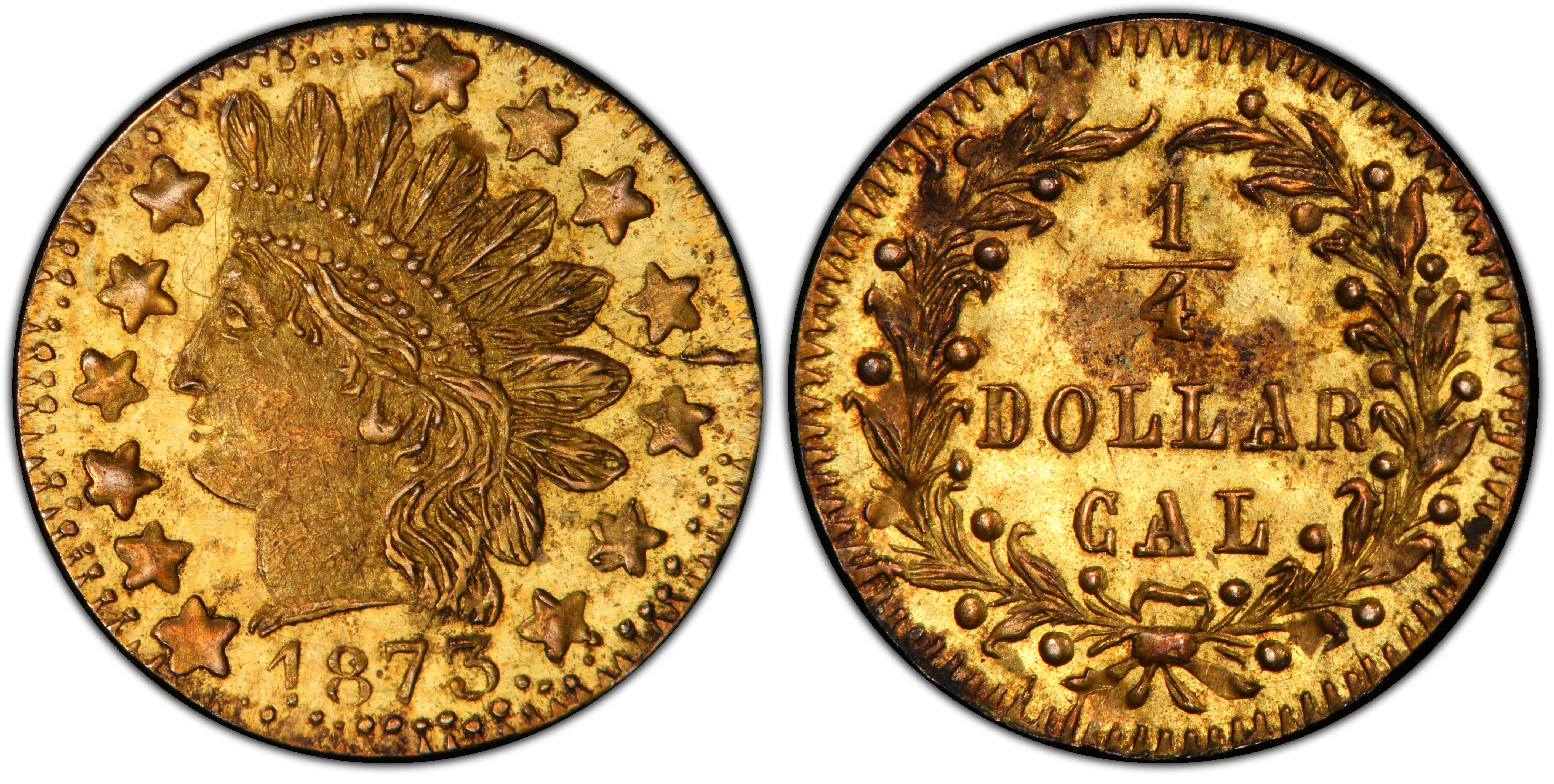
Obverse & Reverse
The 1873 G25C BG-874 is a quintessential example of a 'Period Two' California Fractional Gold piece. The era of these small-denomination coins began in 1852 to alleviate a severe shortage of circulating small change that plagued the booming economy of the California Gold Rush. The initial issues, now termed 'Period One' (1852-1857), were genuinely intended to and did function as currency, filling a vital commercial need. However, by the time the BG-874 was struck in 1873, the landscape had changed dramatically. The San Francisco Mint, opened in 1854, was producing ample federal coinage, rendering the private issues unnecessary for commerce. The Coinage Act of 1864 had officially made private coinage illegal, though enforcement in the West was lax until the early 1880s. Consequently, the motivation for producing fractional gold shifted. The 'Period Two' issues (1859-1882) are broadly categorized as 'jeweler's issues.' These pieces were not intended to satisfy a monetary need but were instead created as souvenirs, keepsakes, and novelty items for tourists and locals nostalgic for the heady days of the Gold Rush. They were often lighter and of lower fineness than their Period One predecessors, valuing their form over their intrinsic content. The BG-874, with its Indian Head motif—a design that became popular in this later period—was likely produced by one of the many jewelers in San Francisco who had the skills and equipment for such work. These minters operated in a legal grey area, carefully denominating their pieces to resemble coinage while primarily selling them as memorabilia. The extreme rarity of varieties like BG-874 today speaks to a very small original production, likely struck to order or in small batches to be sold from a jeweler's shop. Their modern numismatic significance lies in their direct connection to the romantic legacy of the Gold Rush and as artifacts of a unique chapter in American enterprise.
Associated EventCalifornia Gold Rush Aftermath
Reason For MintingPrimarily struck as a souvenir or keepsake for the jewelry trade, not for general circulation, following the era of genuine coinage shortages.
Minter HistoryThe specific minter for the BG-874 die marriage is unrecorded, a common fate for many 'Period Two' jeweler's issues. Prominent minters of this period included firms like Robert B. Gray & Co., but hundreds of die varieties from this era remain unattributed to a specific maker. These producers were typically skilled jewelers and engravers, primarily in San Francisco, who capitalized on the demand for Gold Rush mementos.
Historical SignificanceThis coin is a tangible link to the post-Gold Rush era in California, representing the transition of fractional gold from a circulating medium of necessity to a commercial souvenir. It is a product of the private enterprise that continued to operate on the fringes of federal monetary law and reflects the public's fascination with the iconic imagery of the American West.
N/A
Denomination25 Cents
Minting Period1873
Assayer/MinterUnknown Private Minter
Geographic OriginSan Francisco, California
Obverse DescriptionAn Indian Head portrait facing left, adorned with a feathered headdress. The portrait is encircled by thirteen stars, representing the original colonies. The date '1873' appears below the bust.
Obverse Inscription1873
Reverse DescriptionA wreath composed of two branches tied together with a bow at the bottom. The denomination '1/4' is in the center, and the legend 'CALIFORNIA GOLD' encircles the wreath along the periphery. On some specimens, a small dot or 'center mark' is visible within the wreath, a relic of the manufacturing process.
Reverse InscriptionCALIFORNIA GOLD 1/4
CompositionGold
Stated Fineness Actual FinenessTypically varies for Period Two issues, often between 14k and 22k.
Weight0.25 grams
Diameter9.80 mm
EdgePlain
Unknown, but extremely small.
Survival Estimate25-30
Rarity ScaleLow R-6
The BG-874 is highly prized for its extreme rarity (Low R-6), classic Indian Head design, and status as a 'Period Two' issue. Its appeal lies in the challenge of acquisition and its role in telling the story of the California Gold Rush's enduring legacy.
Key VarietiesThe primary variety is the regular business strike. A known 'Double Struck' mint error exists for the BG-874 die marriage, which is exceedingly rare and commands a significant premium. No proof or special collector restrikes are known to exist from a later period.
Authentication TipsAuthentic examples possess specific die markers. Crucially, look for a diagnostic obverse die crack near the 3 o'clock position. Another key identifier is a repunched uppermost star on the obverse. Counterfeits are rampant in the fractional gold series; many are brass or low-fineness gold and often feature a bear on the reverse, a design element never used on genuine 19th-century issues. The strike on genuine pieces can be uneven, but the details, while small, should be precise and not mushy or tool-marked. Authentication by a major third-party grading service (PCGS or NGC) is highly recommended.
Shopping ConsiderationsA premium quality example for its grade is defined by a sharp strike, especially on the fine details of the headdress feathers and the numbers in the date and denomination. Auction records note that the '4' in the fraction '1/4' is often weakly struck on this variety, so a specimen with a bold '4' would be considered superior. Look for clean, original surfaces with some remaining mint luster; many survivors are cleaned or have been mounted as jewelry. Attractive, undisturbed reddish-gold or olive-gold toning enhances eye appeal and value significantly. Avoid examples with harsh cleaning, scratches, rim damage, or evidence of solder from jewelry mounting.
A coin's grade is its condition, rated on a 1-70 scale. For rare coins, this is the most critical factor in determining value, as a tiny difference in preservation can mean a huge difference in price.
Relevant Grade TypesOriginal 1873 BG-874 issues were business strikes, created for sale as souvenirs rather than circulation, but are graded on the same scale. They are found in both Circulated (1-58) and, more commonly, Mint State (MS, 60-70) grades due to their non-circulating nature. No Proof (PR/PF) examples were struck during the original period of issue, and no later-date official restrikes exist.
Mint State CharacteristicsUncirculated examples of BG-874 are prized. Quality is determined by the sharpness of the strike; look for full detail in the headdress feathers and the word 'CALIFORNIA' on the reverse. As noted from auction records, the '4' in the fraction is often weak, so a sharp strike there is a hallmark of a premium coin. Luster is typically satiny to semi-prooflike. Due to their small size and handling as novelties, even high-grade specimens may exhibit tiny planchet flaws or contact marks. The diagnostic obverse die crack at 3 o'clock should be present and is not considered a flaw but an identifying marker.
Circulated Wear PatternsAlthough most did not circulate extensively, wear on circulated examples will first appear on the highest points of the design. On the obverse, this includes the Indian's cheekbone, the eyebrow, and the upper portions of the feathers. On the reverse, wear is first evident on the high points of the wreath's leaves and the bow. In lower grades (VF and below), the word 'GOLD' and the stars will begin to lose their sharpness.
Key Factors For ValueRarity is the primary driver of value for this variety. Beyond that, the key factors are grade and surface quality. An example with original, lustrous surfaces free of cleaning or damage will command a significant premium. Strike quality is crucial; a sharply struck coin is always preferred over a weakly struck one, especially concerning the date and denomination. Eye appeal, including attractive original toning, plays a major role. A sticker from CAC (Certified Acceptance Corporation) for a high-grade example would add a substantial premium, signifying that the coin is of superior quality for its assigned grade.
PCGS Price Guide
| Grade | Price | Population |
|---|---|---|
| 50 | $800.00 | 1 |
| 50+ | $825.00 | N/A |
| 53 | $850.00 | N/A |
| 53+ | $875.00 | N/A |
| 55 | $900.00 | 1 |
| 55+ | $925.00 | N/A |
| 58 | $950.00 | 1 |
| 58+ | $1,000.00 | N/A |
| 60 | $1,050.00 | N/A |
| 61 | $1,100.00 | 1 |
| 62 | $1,175.00 | 3 |
| 62+ | $1,250.00 | N/A |
| 63 | $1,375.00 | 7 |
| 63+ | $1,500.00 | N/A |
| 64 | $1,750.00 | 9 |
| 64+ | $2,000.00 | N/A |
| 65 | $3,500.00 | 3 |
| 66 | N/A | N/A |