1872 G25C BG-816 (Regular Strike)
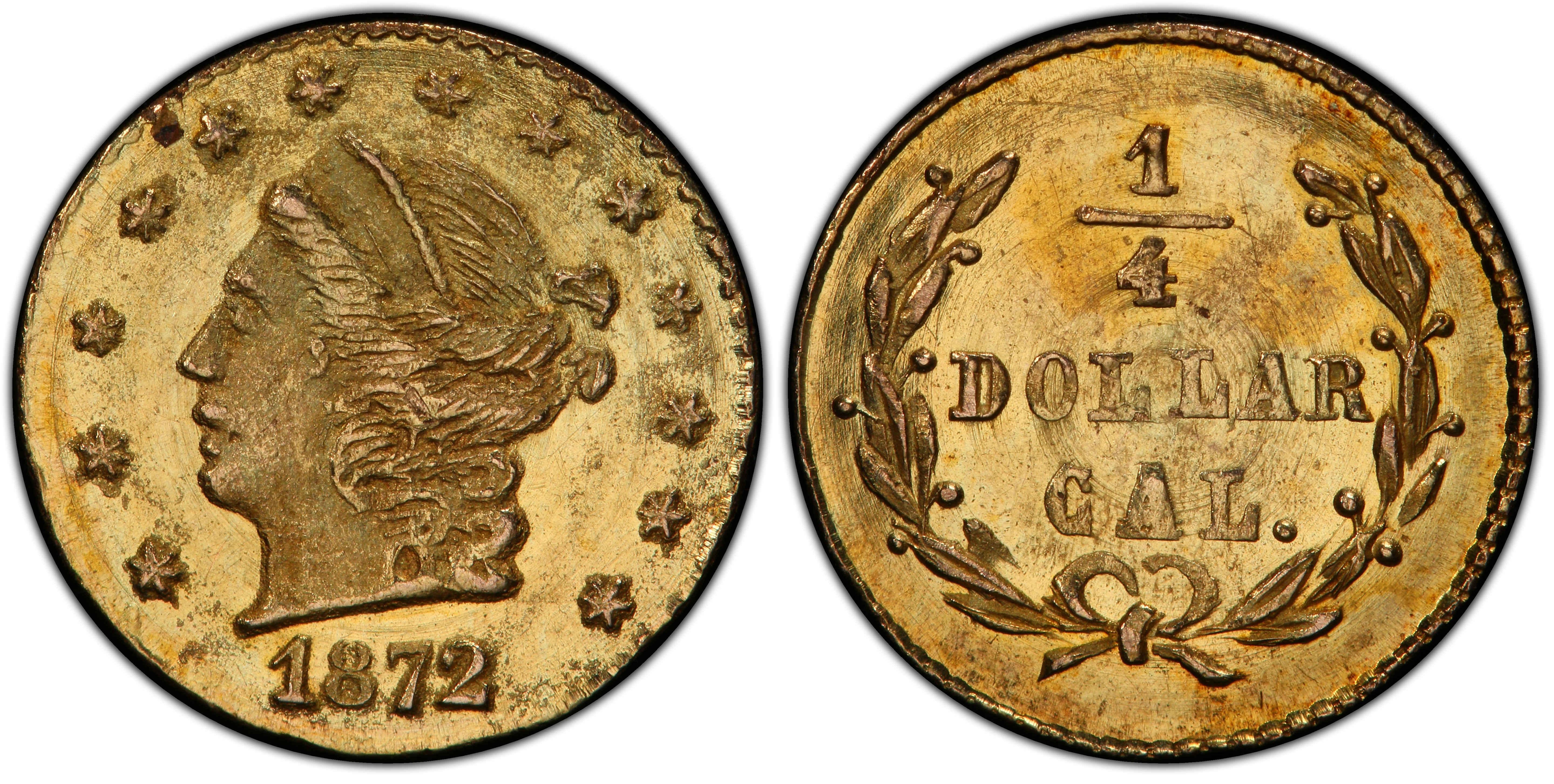
Obverse & Reverse
The 1872 BG-816 25 Cents represents a fascinating chapter in American monetary history, classified as a 'Period Two' or 'Jeweler's Issue' of California Fractional Gold. By 1872, the initial, desperate need for small denomination coinage that characterized the peak Gold Rush years (1852-1857) had largely subsided. The establishment and robust production of the San Francisco Mint had supplied the region with ample federal silver and minor coinage. However, the allure of the Gold Rush and the romance of the West had created a new market: tourism and collectibles. Enterprising jewelers, many of French origin like the firm of Frontier, Deviercy & Co., recognized a burgeoning demand for miniature gold souvenirs that were both affordable and easy to transport. These tiny gold pieces, far too small and underweight to function as practical circulating currency, became cherished mementos for visitors and keepsakes to be mailed to family back East. The Coinage Act of 1864 had explicitly forbidden private coinage, but enforcement was lax, particularly for items not clearly intended to defraud the public or supplant federal money. To navigate this legal grey area, minters of Period Two issues often used dates from earlier in the Gold Rush era, or, as in this case, a contemporary date on a piece so small it could not be mistaken for a federal coin. The BG-816 was struck not to pay for a drink at a saloon, but to capture a piece of the California dream in miniature. Its creation speaks to a maturing West, where the narrative of the Gold Rush was becoming as valuable as the gold itself. These pieces were manufactured with varying degrees of quality, often using screw presses which allowed for sharper detail than the earlier, cruder hammer-struck issues. The survival of BG-816 in high grades today is a testament to its original purpose as a collectible; most were carefully preserved rather than spent, allowing future generations a pristine glimpse into the commercialization of the Gold Rush legend.
Associated EventPost-Gold Rush California Economic Expansion
Reason For MintingPrimarily produced as a souvenir or collectible item for the tourist trade, capitalizing on the romanticism of the Gold Rush.
Minter HistoryFrontier, Deviercy & Co. was a partnership of French jewelers Pierre Frontier and Eugene Deviercy, active in San Francisco. They were prominent producers of California Fractional Gold during both Period One and Period Two. Operating during the 1850s through the 1870s, they employed relatively advanced minting technology for the time, including a screw press, which allowed for consistent quality and well-struck pieces. Their firm was known for producing a variety of denominations and designs, some marked with their 'FD' initials, though many, like the BG-816, were issued anonymously but are attributed to them based on stylistic analysis of the dies, lettering, and overall workmanship.
Historical SignificanceThe BG-816 is an artifact of the shift from necessity-driven private coinage to commercial souvenir production. It represents the commodification of the Gold Rush experience and is a tangible link to the burgeoning tourist economy of 19th-century San Francisco. As a 'Period Two' issue, it is a key component for specialists looking to build a comprehensive collection that tells the complete story of California's private gold mintages, from their utilitarian origins to their later life as popular keepsakes.
N/A
Denomination25 Cents
Minting Period1872
Assayer/MinterFrontier, Deviercy & Co.
Geographic OriginSan Francisco, California
Obverse DescriptionA classic Liberty Head portrait facing left, reminiscent of contemporary federal gold coinage but stylistically unique to the private minter. The portrait is encircled by 13 six-pointed stars, representing the original colonies. The date '1872' is positioned below the truncation of the neck.
Obverse Inscription1872
Reverse DescriptionThe central device is the denomination '1/4' enclosed within a wreath. The wreath is composed of two branches tied together at the bottom with a bow. At the top, the inscription 'CALIFORNIA GOLD' follows the upper curvature of the coin, often abbreviated or stylized.
Reverse Inscription1/4 CALIFORNIA GOLD
CompositionGold
Stated Fineness Actual FinenessVaries, typically 14 to 22 karats. Less than the federal standard.
Weight0.25 grams
Diameter9.50 mm
EdgePlain
Unknown, but very low
Survival Estimate31-75 known specimens
Rarity ScaleR-6
This variety is highly sought after due to its high rarity (R-6), attractive Liberty Head design, and its status as a quintessential 'Period Two' jeweler's issue. Its tiny size is a novelty, and high-grade examples with sharp strikes and prooflike surfaces command significant premiums. It appeals to specialists in California gold, territorial issues, and collectors who appreciate the historical souvenir aspect of these pieces.
Key VarietiesThe BG-816 itself is a specific die marriage. Within the broader series, there are no known major varieties or official restrikes of this specific BG number from the period. All known examples are considered business strikes intended for souvenir sales. Collectors should be aware of the existence of countless modern replicas, often gold-plated or made of brass, which are not considered part of the original series and hold no numismatic value. There are no known original-period Proofs or patterns for this variety.
Authentication TipsGenuine BG-816 coins will exhibit sharp, well-defined details from a screw press, unlike cruder, cast counterfeits. The numerals in the date and the lettering should match the die characteristics known for this variety. Look for a fine granularity on the surfaces, characteristic of genuine gold pieces of the era. Counterfeits are often soapy, have incorrect weights, or may feature a bear on the reverse, which is a fantasy element common on 20th-century replicas. All genuine Period Two issues are denominated (e.g., '1/4', 'DOLLAR', 'CENTS').
Shopping ConsiderationsA premium quality example for its grade will possess a sharp, full strike, particularly on the highest points of Liberty's hair and the details of the wreath. Seek out coins with pristine, original surfaces that exhibit a bright, satiny luster; prooflike or semi-prooflike fields are especially desirable and command a significant premium. Avoid examples that have been harshly cleaned, polished, or show evidence of being mounted in jewelry (solder marks, rim damage). Eye appeal is paramount; coins with a natural, attractive reddish-gold or orange-peel toning are preferred over dull or washed-out specimens. Given the coin's rarity, even problem-free circulated examples in AU grades are highly coveted.
A coin's grade is its condition, rated on a 1-70 scale. For rare coins, this is the most critical factor in determining value, as a tiny difference in preservation can mean a huge difference in price.
Relevant Grade TypesOriginal period issues of BG-816 were business strikes, although intended for souvenir purposes rather than vigorous circulation. They are found in both Circulated (1-58) and, more commonly, Mint State (MS, 60-70) grades due to their collectible nature. No Proof (PR/PF) examples were struck during the original minting period, and there are no known official later-date Proof restrikes.
Mint State CharacteristicsUncirculated examples of BG-816 are characterized by their strike quality and surface preservation. Strikes can vary but are typically sharp due to the use of a screw press. The highest quality pieces will show full detail in Liberty's hair curls and the individual leaves of the wreath. Luster is typically bright and satiny, with deeply mirrored, prooflike (PL) or deep mirror prooflike (DMPL) fields being exceptionally rare and valuable. Due to the softness of the gold and the manufacturing process, it is common to see minor planchet flaws or faint adjustment marks, which should be distinguished from post-strike damage.
Circulated Wear PatternsFor circulated examples, wear first appears on the highest points of the design. On the obverse, this includes Liberty's cheek, the hair above the ear, and the coronet. On the reverse, the high points of the bow and the numbers of the fraction '1/4' will show the first signs of friction. In lower grades (VF and below), the stars and peripheral lettering will begin to soften and merge with the fields.
Key Factors For ValueThe primary drivers of value for an 1872 BG-816 are grade and eye appeal. A sharp strike is fundamental; a weakly struck MS-64 may be less valuable than a sharply struck MS-63. Surface quality is critical: pristine, mark-free surfaces with original, vibrant luster command the highest prices. The presence of prooflike or deep mirror prooflike surfaces can multiply the coin's value. Attractive, original toning also adds a premium. Certification by a top-tier grading service (PCGS or NGC) is essential for market acceptance, and a CAC sticker, indicating premium quality for the grade, adds a significant premium for this series.
PCGS Price Guide
| Grade | Price | Population |
|---|---|---|
| 53 | $285.00 | 1 |
| 53+ | $300.00 | N/A |
| 55 | $315.00 | 1 |
| 55+ | $335.00 | N/A |
| 58 | $360.00 | N/A |
| 58+ | $385.00 | N/A |
| 60 | $425.00 | N/A |
| 61 | $475.00 | 2 |
| 62 | $600.00 | 6 |
| 62+ | $675.00 | N/A |
| 63 | $725.00 | 9 |
| 63+ | $900.00 | N/A |
| 64 | $1,250.00 | 6 |
| 64+ | $2,000.00 | N/A |
| 65 | $3,750.00 | 3 |
| 67 | N/A | N/A |