1869 G50C BG-1020 (Regular Strike)
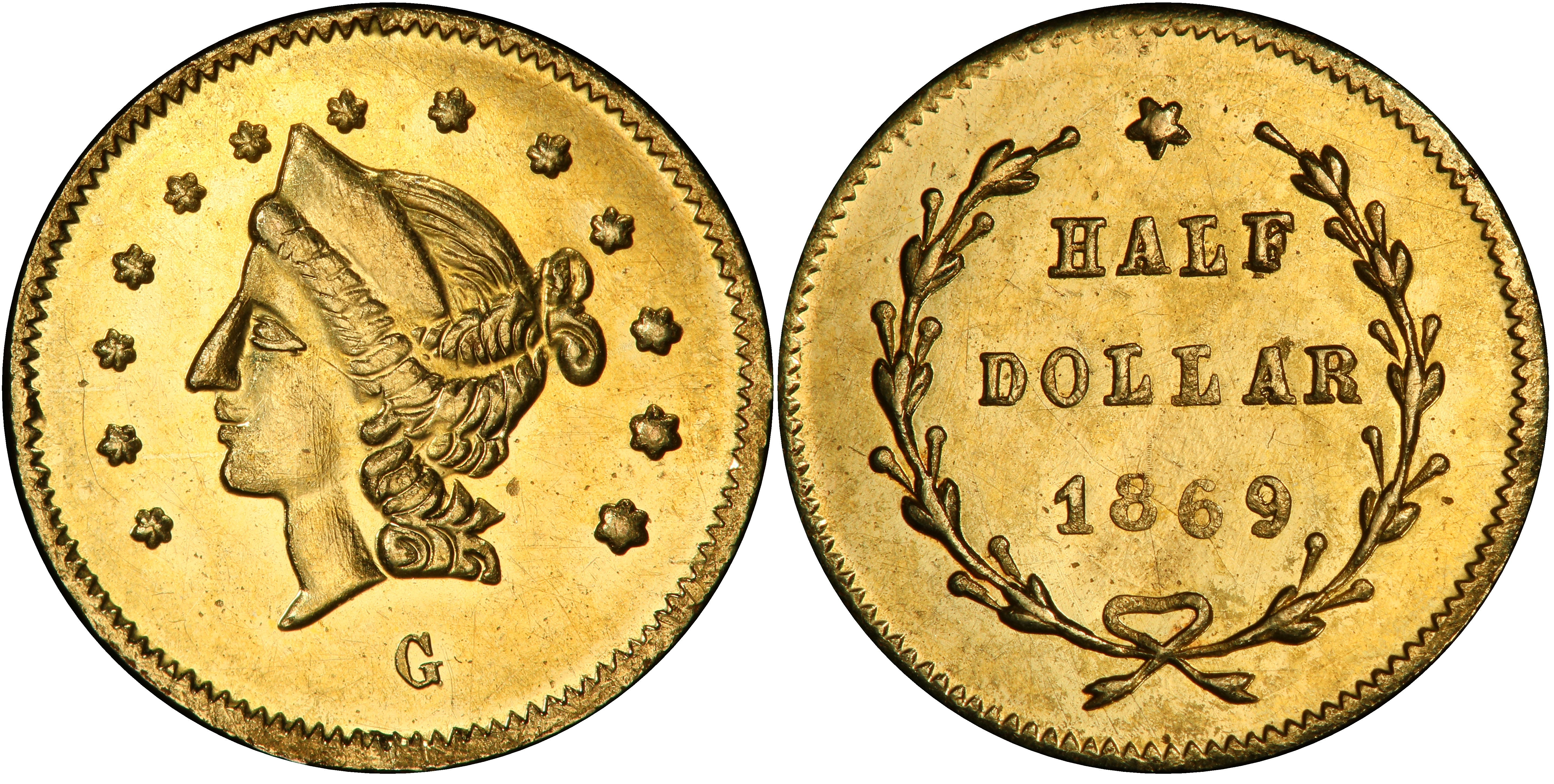
Obverse & Reverse
The 1869 BG-1020 50 Cents is a quintessential example of a 'Period Two' California Fractional Gold piece. By 1869, the initial, frantic phase of the Gold Rush had long subsided, and California's economy had matured significantly. The completion of the Transcontinental Railroad in this very year further integrated the state with the rest of the nation, diminishing the acute coinage shortages that had plagued the region in the early 1850s. Consequently, the purpose of fractional gold coinage shifted dramatically. While the 'Period One' (1852-1857) issues were struck out of genuine commercial necessity to provide small change, the 'Period Two' (1859-1882) pieces were primarily created as souvenirs and keepsakes for tourists, merchants, and citizens captivated by the romanticism of the Gold Rush. These later issues, often called 'jewelers' issues,' were produced by a variety of San Francisco artisans. The legal environment for these pieces was ambiguous; the Private Coinage Act of 1864 had made such minting illegal, but the law was not aggressively enforced by the Secret Service until the early 1880s. This legal gray area allowed for continued, albeit clandestine, production. The BG-1020, like its contemporaries, was not intended to meet a specific weight or fineness standard. Its value was in its novelty as a miniature gold coin, a memento of California's golden identity. Because they were sold as curiosities rather than circulated as money, many have survived in remarkably high grades of preservation, offering a clear window into the design and manufacturing techniques of the era. The production method was typically manual, with dies being struck by a sledgehammer, leading to variability in strike quality even among coins from the same dies. The eventual crackdown by federal authorities in 1883 brought an end to this fascinating chapter of private minting, cementing the status of pieces like the BG-1020 as historical artifacts of a transitional period in American economic history.
Associated EventPost-Gold Rush Economic Development / Souvenir Coinage Era
Reason For MintingPrimarily struck to be sold as a popular souvenir or keepsake of the California Gold Rush, not for general circulation.
Minter HistoryThe specific minter of the BG-1020 variety is unknown, a common trait for many 'Period Two' issues that lack an identifiable mintmark. Production of these pieces was centered among the community of jewelers and artisans in San Francisco, who saw a commercial opportunity in the public's fascination with gold. Firms like Robert B. Gray & Co. and the Levison Brothers (California Jewelry Co.) were prominent makers of fractional gold during this era, but many varieties were produced anonymously. These craftsmen operated with varying degrees of skill, using hand-cut dies and manual presses or hammers, which accounts for the wide range of quality and artistic merit seen across the series.
Historical SignificanceThe BG-1020 is significant not as a circulating coin but as a numismatic artifact representing the commercialization of the Gold Rush legacy. It illustrates a shift from utilitarian private coinage to souvenir tokens, created to satisfy public nostalgia and tourism. Its existence highlights a period of lax federal oversight on private minting and stands as a testament to the continued cultural and economic power of gold in California's identity, decades after the initial discovery.
N/A
Denomination50 Cents
Minting Period1869
Assayer/MinterUnknown San Francisco Jeweler
Geographic OriginSan Francisco, California
Obverse DescriptionFeatures a classic Liberty Head design, facing left. The portrait is adorned with a coronet or tiara inscribed with the word 'LIBERTY'. Thirteen stars, representing the original colonies, encircle the portrait along the rim.
Obverse InscriptionLIBERTY
Reverse DescriptionA wreath of two branches tied with a bow at the bottom encircles the denomination. The date is placed below the wreath. The design is simple and functional, typical for the series.
Reverse Inscription1/2 CALIFORNIA GOLD 1869
CompositionGold
Stated Fineness Actual FinenessVariable, but typically lower than U.S. Mint standards for the period.
Weight0.50 grams
Diameter12.00 mm
EdgePlain
Unknown
Survival Estimate75-125 coins across all grades, based on combined NGC and PCGS population reports and expert analysis.
Rarity ScaleR-4 (Scarce)
This variety appeals to collectors due to its affordability within the scarce R-4 rating, its connection to the post-Gold Rush history of San Francisco, and its status as a tangible piece of the widely collected California Fractional Gold series. Its existence as a 'Period Two' souvenir issue makes it an interesting historical counterpoint to the earlier, circulating 'Period One' coins.
Key VarietiesThe BG-1020 is a specific die marriage and is considered a 'regular strike.' No proof or special collector issues are known to have been intentionally created during the period of issue. The primary variations in the broader 1869 50C series involve octagonal vs. round shapes and different Liberty Head or Indian Head portraits, each cataloged with a unique Breen-Gillio (BG) number.
Authentication TipsAuthentic examples must be denominated; fakes and later charms often omit '1/2' and 'GOLD' or replace it with a bear design. The planchets of genuine pieces are typically very thin. Look for sharp, albeit sometimes uneven, details from a genuine die strike, as opposed to the soft, soapy look of many cast counterfeits. Diagnostics for BG-1020 include the precise positioning of the stars relative to Liberty's profile and the specific shape of the wreath's bow. It is highly recommended to purchase examples certified by major grading services.
Shopping ConsiderationsA premium quality example for its grade will exhibit a sharp strike, particularly on the letters of 'LIBERTY' and the details of the wreath. Many specimens suffer from weak central strikes, so a coin with a bold date and denomination is desirable. Look for original, undisturbed surfaces with attractive luster; prooflike or semi-prooflike surfaces command a significant premium. Avoid examples that have been harshly cleaned, which dulls the surface, or those that have been used in jewelry, evidenced by solder marks, holes, or excessive rim damage. Minor planchet flaws or die rust are sometimes seen and can be acceptable if not distracting.
A coin's grade is its condition, rated on a 1-70 scale. For rare coins, this is the most critical factor in determining value, as a tiny difference in preservation can mean a huge difference in price.
Relevant Grade TypesOriginal period issues were business strikes, although primarily sold as souvenirs rather than for circulation. They are found in both Circulated (1-58) and, more commonly, Mint State (MS, 60-70) grades. No Proof (PR/PF) examples were struck during the original minting period, and no later-date official restrikes exist for this privately-issued piece.
Mint State CharacteristicsUncirculated examples of BG-1020 are characterized by their luster, which is typically frosty or satiny. High-end examples may be prooflike, with reflective fields. The strike is a key determinant of quality; many are softly struck in the center, affecting the wreath and the word 'LIBERTY'. Contact marks are common due to the softness of the gold but should be minimal for higher grades. Small patches of die rust or planchet irregularities are not unusual for the issue and are factored into the overall grade.
Circulated Wear PatternsWear first appears on the highest points of the design. On the obverse, this includes Liberty's cheek, the hair above the eye, and the letters in the coronet. On the reverse, the high points of the wreath's leaves and the numerals of the date will show the first signs of friction. In lower circulated grades (VF and below), the stars will begin to merge with the fields and the finer details of the wreath will be lost.
Key Factors For ValueBeyond the numerical grade, value is driven by several key factors. First is surface quality; an example with original, uncleaned 'skin' is far more valuable than a cleaned or polished one. Second is strike; a sharply struck specimen with full details will command a strong premium over a weakly struck one of the same grade. Third is eye appeal, which includes luster (frosty or prooflike examples are highly prized) and any attractive reddish-gold toning. Finally, certification by a top-tier service (PCGS or NGC) is standard, and a CAC sticker indicating premium quality for the grade adds a significant premium.
PCGS Price Guide
| Grade | Price | Population |
|---|---|---|
| 50 | $205.00 | 4 |
| 50+ | $215.00 | N/A |
| 53 | $230.00 | 3 |
| 53+ | $250.00 | N/A |
| 55 | $275.00 | 17 |
| 55+ | $295.00 | N/A |
| 58 | $315.00 | 20 |
| 58+ | $335.00 | N/A |
| 60 | $360.00 | 2 |
| 61 | $380.00 | 11 |
| 62 | $400.00 | 37 |
| 62+ | $425.00 | N/A |
| 63 | $450.00 | 14 |
| 63+ | $550.00 | N/A |
| 64 | $800.00 | 1 |
| 64+ | $975.00 | N/A |
| 65 | $1,450.00 | 1 |