1881 25C BG-799BB, PL (Regular Strike)
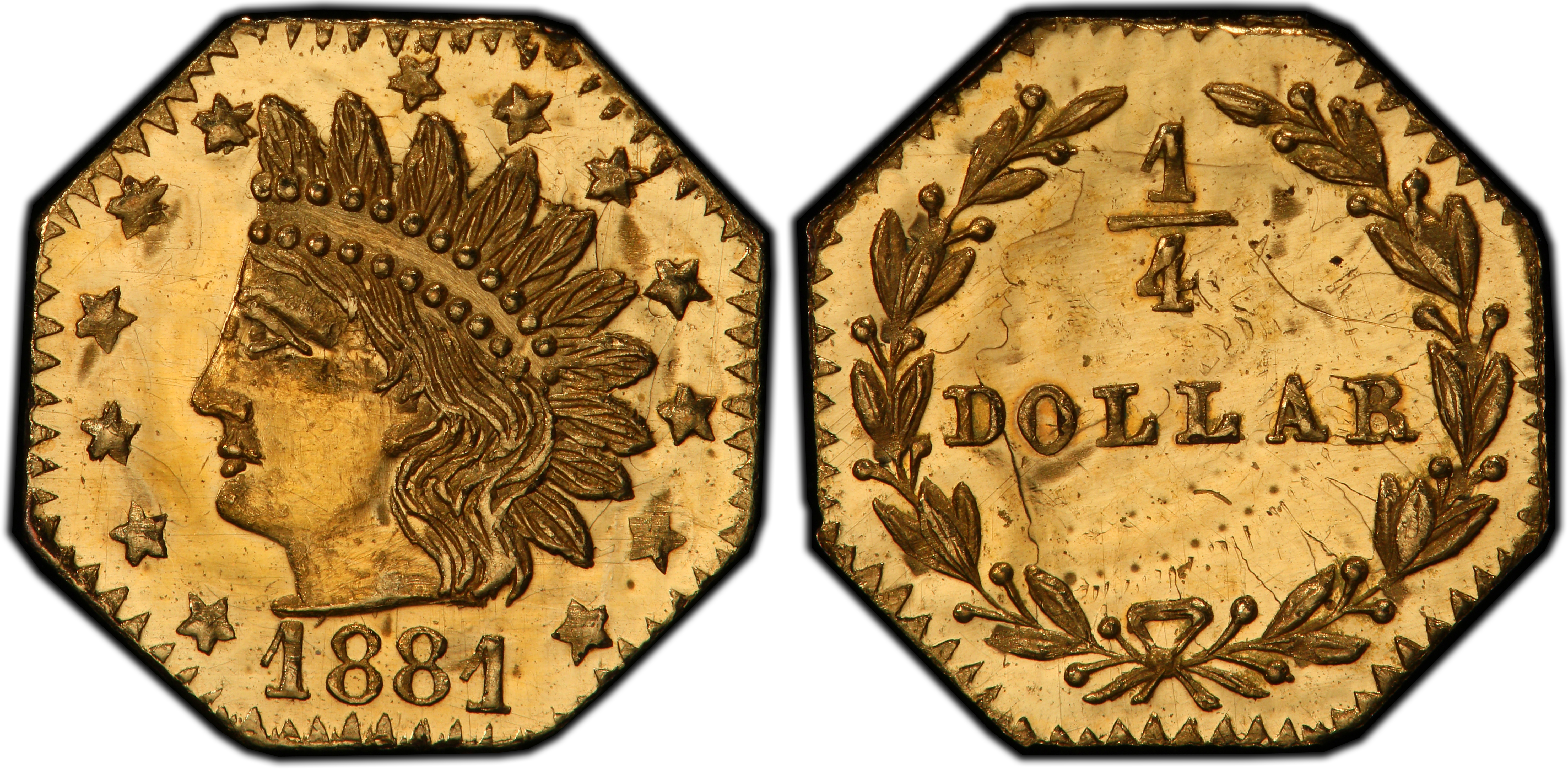
Obverse & Reverse
The 1881 BG-799BB 25-cent piece emerges from the twilight of the California Fractional Gold era, a period numismatists categorize as 'Period Two' (1859-1882). Unlike their 'Period One' predecessors, which were struck out of genuine commercial necessity to alleviate a chronic shortage of small change during the initial Gold Rush, these later issues served a different purpose. By the 1880s, the San Francisco Mint was in full operation, and the wild, chaotic economy of the '49ers had matured. The acute need for privately minted coinage had vanished. Instead, a flourishing tourism industry had taken root, with visitors from the East Coast and Europe eager for mementos of the romanticized Gold Rush. San Francisco jewelers astutely filled this niche, producing vast quantities of small, attractive gold 'coins' in various shapes and designs. These pieces, often called 'jeweler's issues,' were not intended for circulation but were sold as souvenirs, charms, and keepsakes. The BG-799BB is a quintessential example of this phenomenon. Struck in the final years before the U.S. Secret Service cracked down on private minting in 1883, its creation reflects a market driven by nostalgia rather than necessity. These pieces were often made with a lower gold content than their face value would imply and were manufactured using techniques like hammer striking, leading to variability in strike quality. Despite their non-monetary role, they are an integral part of the narrative of the American West, representing the commercialization of the Gold Rush legend and the enduring allure of California gold. The Indian Head motif was a popular, quintessentially American design, adding to its appeal as a souvenir. Today, these pieces are avidly collected for their historical connection, intricate designs, and significant rarity.
Associated EventCalifornia Gold Rush Tourism Era
Reason For MintingTo be sold as a souvenir or charm to tourists and collectors, capitalizing on the nostalgia of the California Gold Rush.
Minter HistoryWhile the specific maker of the BG-799BB die pair is not definitively recorded, the leading attribution for many Period Two issues of this style and quality is Robert B. Gray & Co. of San Francisco. Gray was a prominent jeweler who, around 1859-60, acquired the business of Antoine Nouizillet, another key producer of fractional gold. Gray continued to use Nouizillet's dies while also creating his own, some marked with a 'G'. He was a prolific producer until selling his interests in 1871. However, dies were often used, sold, and muled, making precise attribution for unmarked, later-date pieces like this one challenging. It was certainly the product of one of the specialized San Francisco jewelry firms that dominated this trade.
Historical SignificanceThe BG-799BB is significant not as a coin for commerce, but as a historical artifact representing the transition of the Gold Rush from a frantic event into a romanticized cultural phenomenon. It marks the end of the legal (or at least tolerated) private minting of gold coinage in the United States, a practice that defined the economic landscape of the West for three decades. Its high rarity underscores the limited production of these specific late-period varieties.
N/A
Denomination25C
Minting Period1881
Assayer/MinterUnknown, possibly Robert B. Gray & Co.
Geographic OriginSan Francisco, California
Obverse DescriptionFeatures a large, well-defined bust of an Indian princess facing left, adorned with a feathered headdress. The portrait is encircled by 13 six-pointed stars representing the original colonies. The date '1881' is positioned below the bust.
Obverse Inscription1881
Reverse DescriptionA wreath composed of two olive branches, tied together at the bottom with a bow. The denomination '25 CENTS' is inscribed within the wreath. Some examples are known to be struck from clashed dies, which may show faint impressions of the obverse design on the reverse.
Reverse Inscription25 CENTS
CompositionGold
Stated Fineness Actual FinenessVariable, typical for Period Two jeweler's issues, often ranging from 14 to 22 karats (.583 to .917 fine).
Weight0.25 grams
Diameter9.80 mm
EdgePlain
Unknown
Survival Estimate13-30 coins
Rarity ScaleHigh R-6 to Low R-7
This variety is highly sought after due to its extreme rarity, attractive Indian Head design, and octagonal shape. As a dated 'Period Two' issue from the final years of production, it holds significant historical appeal. The potential for Proof-Like (PL) surfaces adds another layer of desirability for specialists.
Key VarietiesThe BG-799 die marriage itself is the key variety. Within this specific Breen-Gillio number, there are no major recognized sub-varieties from the original minting period. No known special collector issues, patterns, or restrikes of BG-799BB exist. The primary distinction among surviving examples is the quality of the strike and the nature of the planchet surfaces, with Proof-Like (PL) specimens commanding a significant premium.
Authentication TipsAuthentic pieces must match the die characteristics illustrated in the Breen-Gillio reference. Genuine examples often have a slightly crude, handmade feel compared to federal coinage. Look for sharp, distinct letter and number punches. Many counterfeits are cast, showing a soapy or porous texture. A key diagnostic for fakes is the presence of a bear on the reverse, a design element never used on genuine 19th-century issues. Another red flag is the absence of a denomination ('CENTS' or 'DOLLAR'); authentic Period Two pieces were denominated. Weight and size should be very close to the established norms for the type.
Shopping ConsiderationsA premium quality example for this variety will exhibit a sharp, well-centered strike, particularly on the high points of the Indian's hair and the details of the wreath. Many specimens are weakly struck, so a bold impression is a major value-driver. Look for original, uncleaned surfaces; a lustrous, honey-gold or olive-gold skin is highly desirable. Proof-Like (PL) examples are the pinnacle of quality for this issue and are exceptionally rare. Common problems include cleaning, jewelry mounting (look for evidence of solder or rim filing), and bending due to the thinness of the planchet. Evidence of die clashes, while a mint-made characteristic, is neither a premium nor a detriment unless it is unusually severe.
A coin's grade is its condition, rated on a 1-70 scale. For rare coins, this is the most critical factor in determining value, as a tiny difference in preservation can mean a huge difference in price.
Relevant Grade TypesAll original examples of BG-799BB were struck as business strikes, although they were intended for sale to collectors and tourists rather than for circulation. They are found in both Circulated (1-58) and, more commonly, Mint State (MS, 60-70) grades. No true Proofs were struck during the original period. However, due to the use of polished dies on fresh planchets, many examples exhibit mirrored fields and are designated 'Proof-Like' (PL) by grading services. These are not a different type of strike but rather a superior business strike, and they are highly prized.
Mint State CharacteristicsIn Mint State, quality is defined by strike and surface preservation. The strike can be inconsistent; a fully struck piece will show sharp details in the headdress feathers and the bow of the wreath. Luster is typically bright and satiny, but can be deeply reflective and proof-like on PL examples. Due to the hammer-striking process and softness of the gold, even high-grade specimens can have small planchet flaws or minor die cracks. Marks are a key factor; a clean field, free of distracting contact marks, is essential for a top grade.
Circulated Wear PatternsAlthough not intended for circulation, some pieces did see handling. Wear first appears on the highest points: the cheek and feathers of the Indian princess on the obverse, and the leaves and bow on the reverse. In lower grades (VF and below), the stars and legend will show considerable flattening.
Key Factors For ValueFor the BG-799BB, the primary value drivers are rarity and grade. Given its High R-6/Low R-7 status, any example is valuable. The most significant premiums are for: 1) The Proof-Like (PL) designation, which can double the value over a standard MS coin. 2) Surface quality, with clean, original, and unblemished fields being paramount. 3) Strike sharpness; a fully detailed strike is rare and highly desirable. 4) Eye appeal, which is enhanced by attractive original color. A CAC sticker will add a strong premium, confirming the quality for the assigned grade.
PCGS Price Guide
| Grade | Price | Population |
|---|---|---|
| 65 | $3,500.00 | 1 |