1859 G25C BG-801 (Regular Strike)
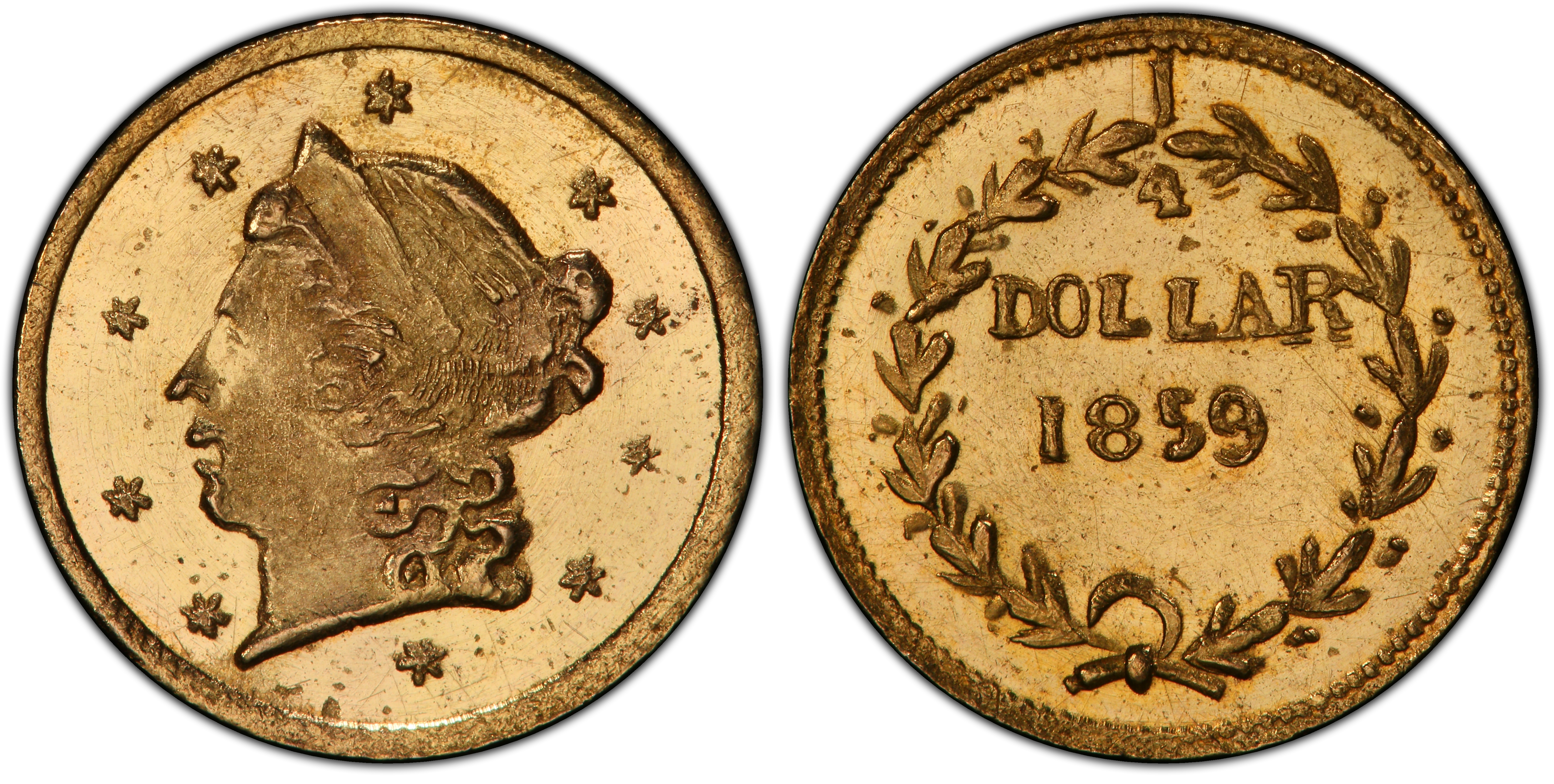
Obverse & Reverse
The 1859 BG-801 25 Cents is a quintessential example of a 'Period Two' California Fractional Gold piece, a fascinating and complex series born from the economic realities of the American West. Following the initial California Gold Rush, an acute shortage of small-denomination coinage plagued daily commerce. While 'Period One' (1852-1857) fractionals were struck to a relatively honest standard to alleviate this, the 'Period Two' issues (1859-1882) represent a different motivation. By 1859, the San Francisco Mint was in full operation, supplying the region with federal coinage. The continued production of fractional gold pieces shifted from a primarily commercial necessity to a response to a burgeoning souvenir and novelty market. These later pieces, often called 'Jeweler's Issues,' were manufactured by various private artisans, many of whom were French jewelers in San Francisco, to be sold as keepsakes, charms, and curiosities for tourists and locals alike. The BG-801, dated 1859, marks the beginning of this prolific second period. Unlike their predecessors, these coins were typically underweight for their face value and varied in gold fineness, confirming their status as tokens rather than true circulating money intended to trade at par. Their production continued until 1882, a year before the U.S. Secret Service finally cracked down on their manufacture, citing a violation of the government's sole authority to coin money. The BG-801's simple Liberty Head design, reminiscent of federal coinage but distinct in its execution, made it an appealing memento of the Gold Rush era. Today, these tiny gold pieces are not just collectibles but historical artifacts that tell the story of California's transition from a frontier economy to a more established society with a demand for romanticized symbols of its recent, wild past.
Associated EventCalifornia Gold Rush Aftermath
Reason For MintingPrimarily created as souvenirs and jewelry items for a public fascinated with the Gold Rush, rather than to fill a circulating coinage need.
Minter HistoryThe specific minter of BG-801 is unknown, a common trait for 'Period Two' issues. This period was characterized by the work of numerous, often anonymous, San Francisco jewelers. Prominent partnerships of the era included Deriberpe & Nouizillet (D.N.) and Frontier & Deviercy (F.D.), but many varieties like BG-801 cannot be attributed to a specific maker. These craftsmen used hubs and dies of their own creation, leading to a wide variety of designs, and often struck the coins by hand, resulting in inconsistent quality and frequent die states.
Historical SignificanceThe BG-801 represents the shift in the purpose of California Fractional Gold from utilitarian commercial coins to souvenir tokens. It is an early example of the 'Jeweler's Issues' that catered to a romanticized memory of the Gold Rush, highlighting a key evolution in the numismatic history of the American West. Its existence demonstrates a continued private defiance of federal coinage laws, lasting until enforcement intensified in the 1880s.
BG-801
Denomination25 Cents
Minting Period1859
Assayer/MinterUnknown Private Minter (Jeweler's Issue)
Geographic OriginSan Francisco, California
Obverse DescriptionA simple, stylized Liberty Head facing left, reminiscent of the federal gold dollar design but cruder in execution. The portrait is surrounded by 13 six-pointed stars arranged in a circle near the denticled rim. The date '1859' appears below the truncation of the neck.
Obverse Inscription1859
Reverse DescriptionA wreath composed of two branches tied together with a bow at the bottom. The wreath encircles the denomination '25 CENTS'. The style of the wreath and lettering is characteristic of the Period Two issues.
Reverse Inscription25 CENTS
CompositionGold
Stated Fineness Actual FinenessVariable; Period Two issues are known to be of lower and inconsistent fineness, often ranging from .500 to .800.
EdgePlain
Unknown
Survival Estimate31-75 (per rarity scale)
Rarity ScaleR-5
BG-801 is highly collectible as a foundational piece of the popular 'Period Two' set of California Fractional Gold. Its appeal lies in its direct connection to the post-Gold Rush souvenir trade, its affordability relative to Period One issues, and the challenge of acquiring a well-struck, high-grade example. The simple, classic Liberty Head design is also a major draw for type collectors.
Key VarietiesThe primary variety is the regular business strike. No proof or special collector issues are known from the original period of minting. As with many fractional gold pieces, minor die states exist due to die wear and polishing, but these are not typically collected as major varieties. Collectors should be aware of modern replicas, which are common for all California Fractionals and are not denominated.
Authentication TipsGenuine BG-801 pieces must have the denomination '25 CENTS' on the reverse; modern souvenir tokens often omit a denomination to avoid legal issues. The style of the Liberty Head and lettering should match known examples; fakes are often crude or have a 'mushy' appearance from being cast rather than struck. Diagnostics include the specific positions of the stars relative to the portrait and the style of the wreath's bow. Third-party certification by PCGS or NGC is highly recommended for authentication.
Shopping ConsiderationsA premium quality example for its grade will exhibit a sharp, well-centered strike, which is uncommon as many were crudely produced. Look for full details on Liberty's hair and the leaves of the wreath. The wreath bow is a key area that is often softly struck. Original, uncleaned surfaces with a hint of reddish-gold or deep golden patina are highly desirable. Many examples are described as 'semi-prooflike,' and coins that retain this reflectivity in the fields command a premium. Avoid examples with harsh cleaning, scratches, or evidence of having been mounted in jewelry, which was a common fate for these pieces.
A coin's grade is its condition, rated on a 1-70 scale. For rare coins, this is the most critical factor in determining value, as a tiny difference in preservation can mean a huge difference in price.
Relevant Grade TypesOriginal period issues of BG-801 were business strikes, created for sale but not for sustained circulation, and are found in both Circulated (1-58) and Mint State (MS, 60-70) grades. No proofs were struck during the original period. Any piece described as a 'Proof' is likely a modern copy or a misattribution of a 'prooflike' business strike which exhibits mirrored fields from polished dies.
Mint State CharacteristicsAn uncirculated BG-801 is defined by its luster. Higher grade examples often have a semi-prooflike or satiny texture. The strike is a critical factor; many were weakly struck, so examples with sharp details on the stars and wreath command significant premiums. Small planchet flaws or die polishing marks are common and should be expected. Contact marks, even on high-grade pieces, are often present due to the softness of the gold and the casual handling these pieces received.
Circulated Wear PatternsWear first appears as friction on the highest points of the design. On the obverse, look for flattening on Liberty's cheek, hair details above the eye, and the coronet. On the reverse, the high points of the wreath leaves and the bow will show the first signs of rubbing. In lower grades (VF and below), the finer details of the hair and wreath will merge, and the legends will begin to weaken.
Key Factors For ValueBeyond the numerical grade, the primary value drivers for an BG-801 are strike quality and surface preservation. A coin with a bold strike, especially on the often-weak wreath bow, will be worth more than a poorly struck coin of the same grade. Original, uncleaned surfaces with attractive reddish-gold toning are prized. The 'eye appeal' of a piece with smooth, semi-prooflike fields is a major factor. A CAC sticker for this issue confirms premium quality for the grade and will add a significant price premium.
PCGS Price Guide
| Grade | Price | Population |
|---|---|---|
| 55 | $200.00 | 4 |
| 55+ | $220.00 | N/A |
| 58 | $230.00 | 4 |
| 58+ | $240.00 | N/A |
| 60 | $275.00 | N/A |
| 61 | $300.00 | 9 |
| 62 | $325.00 | 27 |
| 62+ | $350.00 | N/A |
| 63 | $375.00 | 41 |
| 63+ | $400.00 | N/A |
| 64 | $425.00 | 45 |
| 64+ | $575.00 | N/A |
| 65 | $850.00 | 12 |
| 65+ | $950.00 | N/A |
| 66 | $1,350.00 | 2 |
| 66+ | $2,000.00 | N/A |
| 67 | $3,500.00 | 2 |
| 67+ | $3,750.00 | N/A |
| 68 | $4,500.00 | N/A |