1881 G50C BG-965A (Regular Strike)
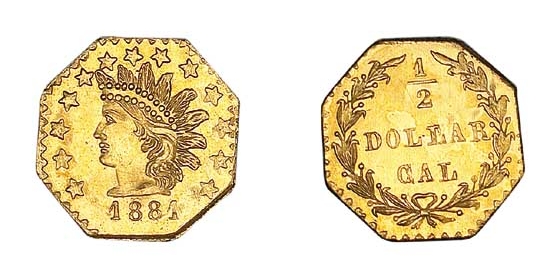
Obverse & Reverse
The 1881 G50C BG-965A is a product of the third and final period of privately issued California Fractional Gold, a fascinating series born from the acute shortage of small change during the California Gold Rush. While the initial gold rush of '49 created a massive influx of gold dust and nuggets, the economy was starved for circulating coinage to facilitate everyday transactions. The U.S. Mint in San Francisco, established in 1854, focused on larger denominations, leaving a void that private minters, often jewelers, began to fill as early as 1852. These tiny gold coins, in 25 cent, 50 cent, and dollar denominations, served a genuine commercial need in their early years. However, by the 1870s and 1880s, their purpose had largely shifted. The Coinage Act of 1864 had explicitly forbidden private coinage, but enforcement by the Secret Service was lax until 1883. In this twilight period, from 1864 to 1882, production continued, but the pieces were increasingly made as souvenirs and curios for tourists and for use in the jewelry trade, rather than as circulating money. Many minters during this era backdated their coins to pre-1864 dates to feign legality. The 1881-dated issues, like BG-965A, represent some of the very last of their kind to be struck with a denomination before federal enforcement halted the practice entirely. Their gold content was often less than their face value, reflecting their new role as keepsakes of the 'Old West' rather than true currency. The rudimentary manufacturing process, often involving hand-striking with a hammer, resulted in coins of varying strike quality. Today, these pieces are collected not for their bullion value, but for their direct connection to the romantic and tumultuous history of the California Gold Rush, representing the final chapter of a uniquely American solution to a regional economic problem.
Associated EventCalifornia Gold Rush
Reason For MintingInitially created to alleviate a severe shortage of small change, later evolving into a souvenir and jewelry item by the 1880s.
Minter HistoryThe specific minter for BG-965A is unknown, which is common for many 'Period Three' (post-1870) California Fractional Gold pieces. Production during this era was dominated by various San Francisco jewelers who created the pieces for the souvenir market. Unlike the earlier period's more established assayers like Moffat & Co. or Kellogg & Co., these later producers were often smaller, anonymous operations catering to a different market. Their work is cataloged and identified by die states and characteristics in the Breen-Gillio reference, rather than by known mintmarks.
Historical SignificanceThis coin represents the end of a numismatic era. It is one of the last privately issued gold coins with a stated denomination made in the United States before federal laws were fully enforced in 1883, marking the final transition of these pieces from quasi-currency to souvenir tokens.
N/A
Denomination50 Cents
Minting Period1881
Assayer/MinterUnknown, likely San Francisco-based jewelers.
Geographic OriginSan Francisco, California
Obverse DescriptionThe obverse features a rendition of an Indian Head, facing left, surrounded by thirteen stars.
Obverse Inscription Reverse DescriptionThe reverse displays the denomination '1/2' and the word 'DOLLAR' within a wreath. The date '1881' is positioned below the wreath.
Reverse Inscription1/2 DOLLAR 1881
CompositionGold
Stated Fineness Actual FinenessVaries, but generally lower fineness than U.S. Mint issues of the period.
Weight0.25 grams
Diameter10.50 mm
EdgePlain
Unknown
Survival EstimateVery few; likely 15-30 pieces.
Rarity ScaleR-6 (13 to 30 known)
This coin is highly sought after due to its status as a late-date, denominated issue from the historic California Fractional Gold series. Its octagonal shape and high rarity (R-6) make it a prized possession for specialists collecting by Breen-Gillio (BG) number or date.
Key VarietiesBG-965A is a specific die marriage. The broader 1881 series includes other BG varieties with different design elements or die characteristics. No known proof restrikes or special collector issues exist for this specific variety; all known examples are business strikes from the original period of issue.
Authentication TipsAuthentication is critical. Genuine pieces should be compared to known examples in auction archives. Look for die markers specific to the BG-965A variety. Common counterfeits and modern replicas often have a soapy, cast-like appearance, incorrect weight, or design details that are too sharp or too crude compared to genuine, hand-struck originals. Many fakes are gold-plated base metal. The Breen-Gillio reference is an essential tool for attribution.
Shopping ConsiderationsA premium quality example for this issue is defined by a sharp, well-centered strike, particularly on the Indian's headdress and the details of the wreath. Surfaces should be free of distracting marks, cleaning, or jewelry mounting evidence (a common problem for this series). Original, unmolested surfaces with some remaining luster command significant premiums. Given the crude striking methods, perfectly struck coins are virtually nonexistent, so a relatively bold strike for the issue is highly desirable. Buyers should avoid examples with harsh cleanings, scratches, or tooling, which severely impact value.
A coin's grade is its condition, rated on a 1-70 scale. For rare coins, this is the most critical factor in determining value, as a tiny difference in preservation can mean a huge difference in price.
Relevant Grade TypesAll original examples of BG-965A are business strikes intended for the souvenir trade, though not for circulation in the traditional sense. They are found in both Circulated (1-58, though rare) and, more commonly, Mint State (MS, 60-70) grades. No Proofs were struck during the original period, and there are no known later-date collector restrikes for this variety.
Mint State CharacteristicsUncirculated examples of BG-965A typically exhibit a soft, satiny luster. The strike is often uneven, with weakness common on the stars or the lower part of the wreath. The tiny size and softness of the gold make these coins susceptible to small planchet flaws and contact marks, even on high-grade specimens. A sharp strike on the central devices (Indian head and denomination) is a key indicator of quality.
Circulated Wear PatternsOn circulated examples, wear first appears on the high points of the Indian's cheek, hair, and headdress feathers. On the reverse, the highest points of the wreath and the fraction '1/2' will show the first signs of friction and flattening. In lower grades, the stars and the date will begin to lose their definition.
Key Factors For ValueThe primary drivers of value for this coin are rarity and grade. Surface quality is paramount; an example with original, undisturbed luster will always be worth more than a cleaned or polished one of the same grade. Strike sharpness is a major consideration, with well-struck pieces fetching strong premiums. Eye appeal, including attractive original gold toning, can also add to the value. A CAC sticker for this issue provides a strong endorsement of quality for the grade and typically results in a higher market price.
PCGS Price Guide
| Grade | Price | Population |
|---|---|---|
| 60 | $875.00 | N/A |
| 61 | $950.00 | N/A |
| 62 | $1,075.00 | 1 |
| 62+ | $1,325.00 | N/A |
| 63 | $1,650.00 | 2 |
| 63+ | $2,000.00 | N/A |
| 64 | $2,500.00 | 2 |
| 65 | N/A | N/A |