1856 G50C BG-434, PL (Regular Strike)
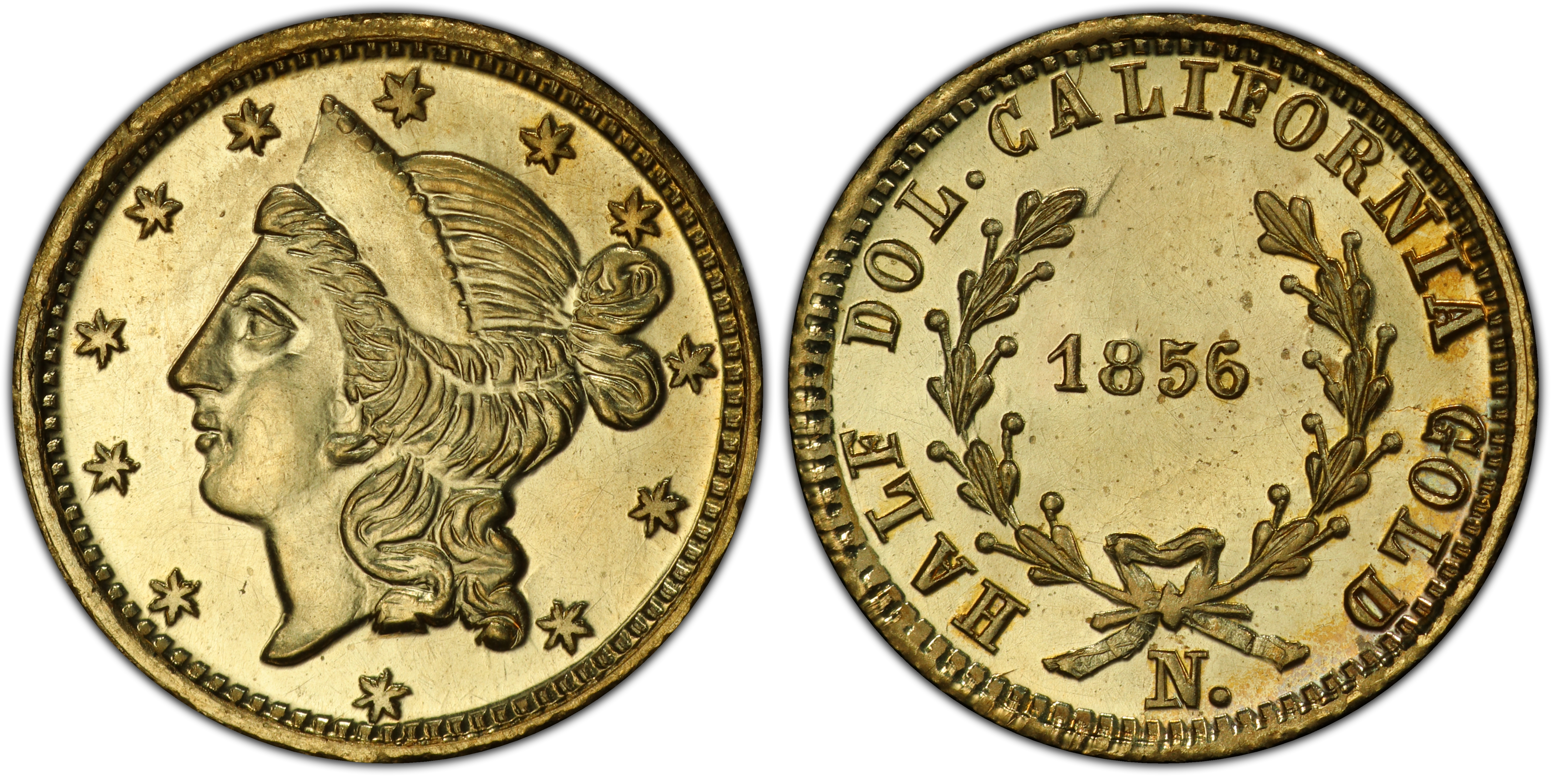
Obverse & Reverse
The 1856 BG-434 Half Dollar is a quintessential artifact from the first period of California's private gold coinage, a fascinating chapter born of necessity and enterprise during the Gold Rush. Following the discovery of gold at Sutter's Mill in 1848, a massive influx of prospectors and merchants descended upon California, creating a vibrant, cash-rich economy that was paradoxically starved for circulating currency. Gold dust and nuggets were cumbersome for daily transactions, and the supply of federal silver and gold coins was woefully inadequate. The smallest denomination federal gold coin was the dollar, leaving a significant gap for small-change transactions. Into this void stepped a number of private minters, primarily jewelers and metallurgists in San Francisco, who began striking their own fractional denomination gold coins in quarter-dollar, half-dollar, and dollar sizes. These 'Period One' issues, struck from 1852 to 1857, were intended to circulate and alleviate the chronic shortage of small change. Unlike later souvenir issues, they were generally made to a higher standard and saw actual use in commerce, though their acceptance was localized and they were often underweight compared to their federal counterparts. The BG-434 was struck in 1856, a pivotal year that marked the decline of this initial period of private minting. By this time, the new San Francisco Mint, which opened in 1854, was ramping up production of official U.S. coinage, gradually saturating the local economy and reducing the need for private issues. Consequently, mintage for many of these late Period One pieces was small. The BG-434, with its classic Liberty Head design mimicking federal gold, represents a final, earnest attempt by private minters to serve a commercial need before the era of circulating fractional gold gave way to the production of souvenir tokens in 'Period Two'.
Associated EventCalifornia Gold Rush
Reason For MintingTo alleviate a severe shortage of small-denomination coinage for everyday commercial transactions in Gold Rush-era California.
Minter HistoryWhile not definitively marked, the BG-434 is stylistically attributed by researchers like Walter Breen and Ronald Gillio to the firm of Frontier, Deviercy & Co. This partnership consisted of French jewelers Pierre Frontier and Eugene Deviercy, who were prominent manufacturers of fractional gold in San Francisco between 1852 and 1856. Their firm was known for producing a variety of Liberty head designs, and die analysis often links their distinct punches and engraving styles to unsigned pieces. They were among the most prolific and skilled of the Period One minters, operating in the heart of San Francisco's burgeoning commercial district before the U.S. Mint's output made their enterprise obsolete.
Historical SignificanceThe BG-434 is significant as a tangible link to the unique economic conditions of the California Gold Rush. It represents a private, free-market solution to a government failure in supplying adequate currency. As a late Period One issue, it also marks the sunset of circulating private coinage in California, a practice that would soon be curtailed by federal law and supplanted by official Mint production. Its existence is a testament to the ingenuity and localized economic realities of the American frontier.
N/A
Denomination$0.50
Minting Period1856
Assayer/MinterAttributed to Frontier, Deviercy & Co.
Geographic OriginSan Francisco, California
Obverse DescriptionA small Liberty Head, facing left, closely modeled on the design of the contemporary U.S. gold dollar by James B. Longacre. The portrait features hair tied in a bun. It is encircled by twelve five-pointed stars.
Obverse Inscription Reverse DescriptionThe denomination 'HALF DOL.' is inscribed in two lines within a delicate wreath of leaves and berries, tied with a bow at the bottom. The date '1856' appears below the wreath. The inscription 'CALIFORNIA GOLD' encircles the upper two-thirds of the wreath along the periphery.
Reverse InscriptionCALIFORNIA GOLD HALF DOL. 1856
CompositionGold
Stated Fineness Actual FinenessTypically .800 to .900, using native California gold which naturally contained silver.
Weight0.75 grams
Diameter11.10 mm
EdgePlain
Unknown
Survival Estimate75-125
Rarity ScaleLow R-4 (Very Scarce)
The BG-434 is highly sought after as a representative of the popular and historically rich California Fractional Gold series. Its appeal lies in its direct connection to the Gold Rush, its status as a circulating 'Period One' issue, and its relative scarcity. The classic Liberty Head design, mimicking federal coinage, makes it attractive to a broad range of collectors. High-grade and Prooflike (PL) examples are particularly prized for their superb eye appeal.
Key VarietiesThe primary variety is the regular business strike BG-434. There is a BG-434A listed in Breen-Gillio, but it is of the highest rarity and is currently unknown in any collection. No special collector restrikes or patterns are known for this specific variety from the period. Collectors should be aware of cast copies, such as the BG-1322, which are cataloged but are not genuine period strikes.
Authentication TipsAuthentic BG-434s were die-struck, not cast, so surfaces should exhibit flow lines and sharp details, not a porous or soft texture. The lettering and stars should be well-defined for the grade. Many modern replicas exist; these are often the wrong weight, have a brassy color, feature incorrect design details (like a bear on the reverse), or lack a denomination like 'DOL.' or 'CENTS'. Genuine Period One pieces almost always state a denomination. Comparison with high-resolution images of certified examples is the best authentication method. Third-party grading is highly recommended.
Shopping ConsiderationsFor a premium quality BG-434, a buyer should seek out a well-centered, sharp strike with minimal distracting marks. Luster is key; original, satiny surfaces command a significant premium over cleaned or dull examples. Prooflike (PL) designated coins are especially desirable, exhibiting mirrored fields from being struck with fresh, polished dies, and these represent the pinnacle of quality for the issue. Check carefully for evidence of cleaning (hairlines), repairs, or removal from jewelry, as many were used as charms. Strong details on Liberty's hair and the leaves of the reverse wreath are indicators of a strong strike and minimal wear.
A coin's grade is its condition, rated on a 1-70 scale. For rare coins, this is the most critical factor in determining value, as a tiny difference in preservation can mean a huge difference in price.
Relevant Grade TypesOriginal period issues of BG-434 were business strikes intended for circulation, and are found in Circulated (1-58) and Mint State (MS, 60-70) grades. The 'PL' (Prooflike) designation is not a separate grade but a descriptor for a business strike that exhibits mirrored surfaces, and it adds significant value. No true Proofs were struck during the original period of issue, and there are no known later-date Proof restrikes for this specific variety.
Mint State CharacteristicsAn uncirculated BG-434 is characterized by unbroken, frosty or satiny luster. High-grade examples can be exceptionally attractive, but many were struck with slight imperfections. It is common to see minor planchet flaws or a slightly weak strike in the center of the devices. Contact marks, even on Mint State coins, are common due to the softness of the gold and rudimentary handling practices of the time. A Prooflike (PL) example will have reflective, mirror-like fields contrasting with frosted devices, a result of being struck by newly polished dies.
Circulated Wear PatternsWear first appears on the highest points of the design. On the obverse, this includes Liberty's cheek, the hair above the ear, and the coronet. On the reverse, the high points of the wreath's leaves and the bow will show the first signs of friction. In lower grades (VF and below), the finer details of the hair and leaves will merge, and the legends will begin to soften.
Key Factors For ValueThe primary drivers of value for a BG-434 are grade and surface quality. An original, uncleaned coin with vibrant luster will always be worth more than a cleaned or damaged one of the same grade. Strike sharpness is critical; a fully struck piece with all details present is highly desirable. Eye appeal, including attractive original gold toning, can add a substantial premium. The Prooflike (PL) designation significantly increases value due to its rarity and beauty. A CAC sticker, indicating premium quality for the grade, will also result in a higher market price for this issue.
PCGS Price Guide
| Grade | Price | Population |
|---|---|---|
| 64 | $3,500.00 | 1 |
| 64+ | $4,000.00 | N/A |
| 65 | $5,000.00 | N/A |
| 65+ | $6,500.00 | N/A |
| 66 | $9,000.00 | 2 |
| 66+ | $11,500.00 | 4 |
| 67 | $13,500.00 | 1 |
| 67+ | $16,500.00 | 1 |