1871 G50C BG-1028 (Regular Strike)
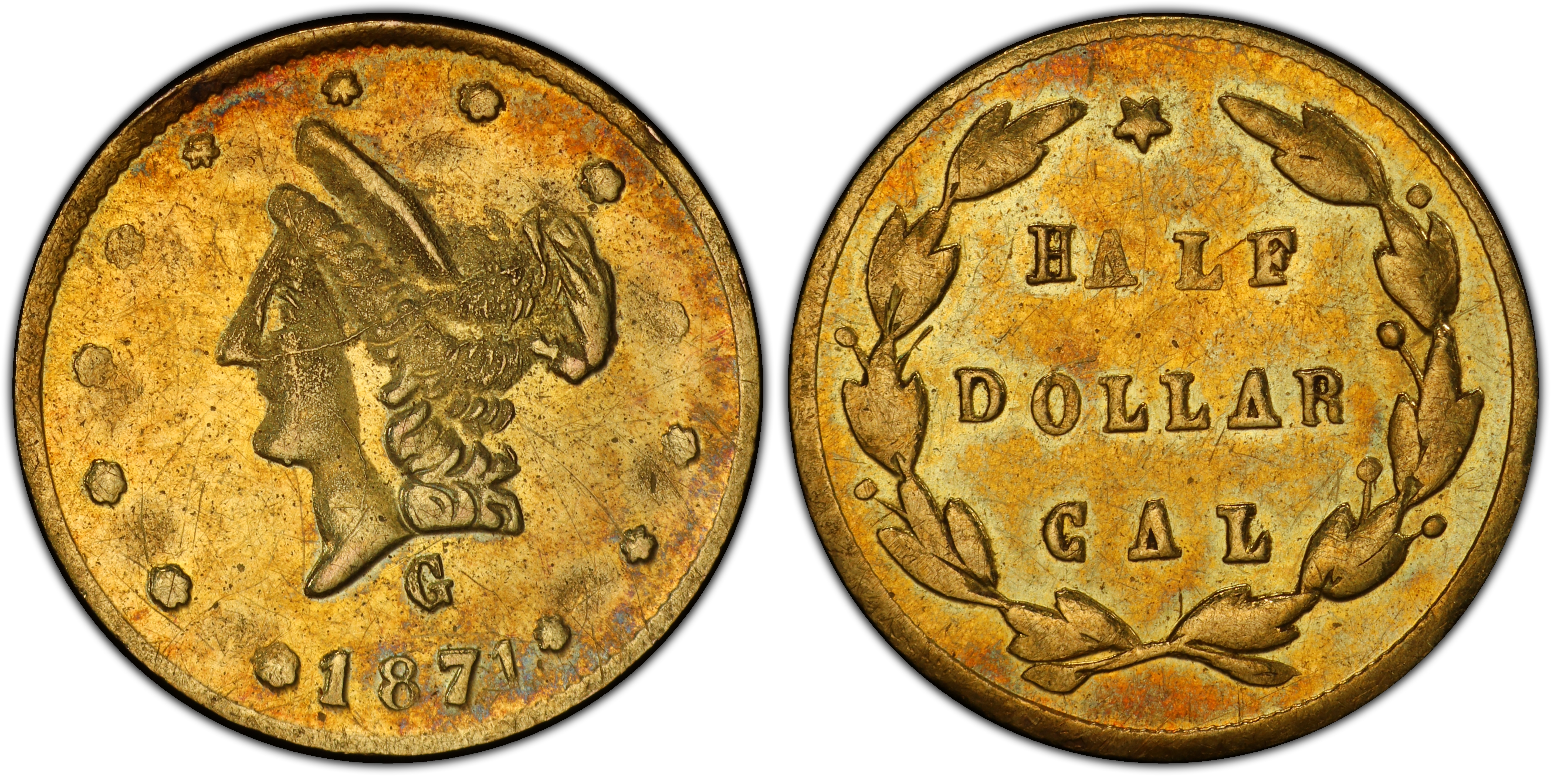
Obverse & Reverse
The 1871 G50C BG-1028 is a fascinating artifact from the twilight years of California's private gold coinage era. By the 1870s, the initial frenzy of the Gold Rush had subsided, but the economic landscape of the American West was still maturing. Standard United States silver coinage remained scarce, a persistent problem that had plagued California since the late 1840s. While the San Francisco Mint, opened in 1854, produced federal gold coins, the need for small-denomination currency for daily transactions was acute. This void was filled by private minters who produced 'California Fractional Gold' pieces in denominations of 25 cents, 50 cents, and one dollar. These were not government issues but privately manufactured tokens whose value was derived from their gold content and public acceptance. Initially, these pieces were a practical solution to the small change shortage. However, by the 1860s and 1870s, the pieces increasingly took on a dual role as both currency and souvenir items for tourists and merchants. The Act of 1864 made private coinage illegal, but production continued clandestinely. The pieces struck after this date, including this 1871 issue, were often backdated or designed ambiguously to circumvent the law. They were sold as 'charms' or 'tokens' but functioned as money in local commerce. The BG-1028 variety, with its classic Indian Head motif, is a prime example of this later period's output. Its production reflects a sophisticated understanding of market demand for beautifully designed, small-denomination gold pieces that evoked the romance of the Gold Rush while still serving a practical, albeit legally gray, purpose. These later issues are often characterized by more refined engraving and a shift towards standardized designs, likely in an attempt to foster wider acceptance and create a more uniform product for the souvenir trade. Their existence is a testament to the persistent economic independence and unique monetary conditions of post-Gold Rush California.
Associated EventPost-California Gold Rush Economic Development
Reason For MintingTo alleviate a chronic shortage of small-denomination federal coinage for everyday commercial transactions in California.
Minter HistoryThe specific minter of BG-1028 is not definitively known, a common trait for post-1864 issues due to their semi-legal status. However, numismatic scholarship, primarily through the work of Breen and Gillio, attributes this and related varieties to the workshop of Robert B. Gray & Co. of San Francisco. Gray was a prominent jeweler and die-sinker active in the city during this period. His firm was known for producing a wide array of tokens, medals, and jewelry, and had the technical expertise required for such fine die work and coining operations. The style of the engraving, particularly the rendering of the Indian Head and the distinctive reverse wreath, is consistent with other pieces attributed to his workshop. These producers operated in a legal gray area, often marketing their products as novelties or jewelry charms to avoid federal prosecution under the Private Coinage Act.
Historical SignificanceThe BG-1028 is significant as a representative of the final phase of private minting in the United States. It showcases the transition of fractional gold from a purely utilitarian currency substitute to a hybrid commercial token and souvenir. Its existence highlights the lingering economic exceptionalism of California and the ingenuity of private entrepreneurs in meeting regional monetary needs long after the federal government began to assert its sole authority over coinage.
N/A
Denomination50 Cents (Half Dollar)
Minting Period1871
Assayer/MinterUnknown private minter, attributed to Robert B. Gray & Co.
Geographic OriginSan Francisco, California
Obverse DescriptionA stylized head of a Liberty or 'Indian Princess' facing left, wearing a feathered headdress. The headdress is adorned with 13 stars along its band. The portrait is sharply rendered, with fine details in the hair and feathers.
Obverse Inscription1871
Reverse DescriptionThe denomination '1/2' is located within a wreath composed of two branches tied together with a bow at the bottom.
Reverse Inscription1/2 DOLLAR CAL
CompositionGold
Stated Fineness Actual FinenessVaries, but typically between .500 and .800 fine gold.
Weight0.25 grams
Diameter10.10 mm
EdgePlain
Unknown
Survival Estimate50-75
Rarity ScaleR-5 (Very Scarce)
This variety is highly sought after for its classic and attractive 'Indian Head' design, its status as a Period Two (1858-1882) issue, and its relative scarcity. It represents a tangible link to the romanticized era of the American West and is a cornerstone piece for specialists in California Fractional Gold.
Key VarietiesThe BG-1028 is a specific die marriage. While there are no major varieties of this exact BG number, the broader 1871 Half Dollar series includes other die pairings with subtle differences in date placement, reverse wreath style, or the shape of the fraction (e.g., BG-1027, BG-1029). No original proof strikings are known. Modern copies and replicas exist, but no legitimate, authorized restrikes were ever produced.
Authentication TipsGenuine examples exhibit sharp, well-defined details, especially in the feathers and stars on the headdress. The numerals of the date and the letters in the legend should be correctly formed and spaced. Many counterfeits are cast, showing a porous or soapy surface texture under magnification, and lack the sharp die-struck details of an original. Pay close attention to the weight and diameter; authentic pieces are tiny and lightweight. The 'CAL' on the reverse is a key diagnostic point; its letter forms should match known genuine examples.
Shopping ConsiderationsA premium quality example for its grade will possess a sharp, full strike, which is not always the case with these small pieces. Look for complete details on the stars in the headband and the leaves of the reverse wreath. Original, uncleaned surfaces are paramount; many have been harshly cleaned or used as jewelry, which drastically reduces their value. A coin with a 'greasy' gold luster and perhaps some gentle, attractive reddish toning commands a significant premium. Avoid specimens with scratches, rim bumps, or evidence of having been mounted in jewelry. Central weakness on the high points of the design is common, but a strong overall strike is highly desirable.
A coin's grade is its condition, rated on a 1-70 scale. For rare coins, this is the most critical factor in determining value, as a tiny difference in preservation can mean a huge difference in price.
Relevant Grade TypesOriginal period issues were business strikes intended for circulation and the souvenir trade, and are found in Circulated (AU-58 and below) and Mint State (MS, 60-70) grades. No Proofs were struck during the original period of issue. Any piece described as a 'Proof' is either a modern fake or a misattribution of a prooflike business strike. The vast majority of surviving examples are in high circulated grades (AU) or lower Mint State grades.
Mint State CharacteristicsAn uncirculated BG-1028 typically exhibits a soft, satiny luster rather than a brilliant, flashy one. Strike quality varies, but a top-tier MS example will show full definition on the stars and the central details of the feathers. Due to the small size and minting process, it is common to see minor planchet flaws or a slight weakness in the strike opposite the highest relief areas. Contact marks, even small ones, are magnified on such a tiny canvas and will significantly impact the grade.
Circulated Wear PatternsWear first appears on the high points of the design. On the obverse, this includes the cheek, the hair just above the ear, and the upper edges of the feathers. On the reverse, the highest points of the wreath's leaves and the bow will show initial friction and flattening. In lower grades (VF and below), the stars on the headdress will begin to merge and become indistinct.
Key Factors For ValueThe primary value drivers for an 1871 G50C BG-1028 are grade and surface quality. An example with original, undisturbed luster and minimal contact marks is exceptionally rare and will command a huge premium. The sharpness of the strike is critical; a well-struck piece with full details is far more desirable than a weakly struck example of the same numerical grade. Eye appeal is also crucial; coins with a pleasing, original reddish-gold hue are preferred over those that are bright, brassy, or have been dipped or cleaned. A CAC sticker for this issue indicates superior quality for the grade and adds a significant premium.
PCGS Price Guide
| Grade | Price | Population |
|---|---|---|
| 40 | $650.00 | 1 |
| 45 | $675.00 | N/A |
| 45+ | $700.00 | N/A |
| 50 | $725.00 | 1 |
| 50+ | $750.00 | N/A |
| 53 | $775.00 | N/A |
| 53+ | $800.00 | N/A |
| 55 | $825.00 | 1 |
| 55+ | $850.00 | N/A |
| 58 | $925.00 | N/A |
| 58+ | $1,000.00 | N/A |
| 60 | $1,350.00 | 1 |
| 61 | $1,750.00 | 1 |
| 62 | $2,250.00 | 5 |