1859 G50C BG-901 (Regular Strike)
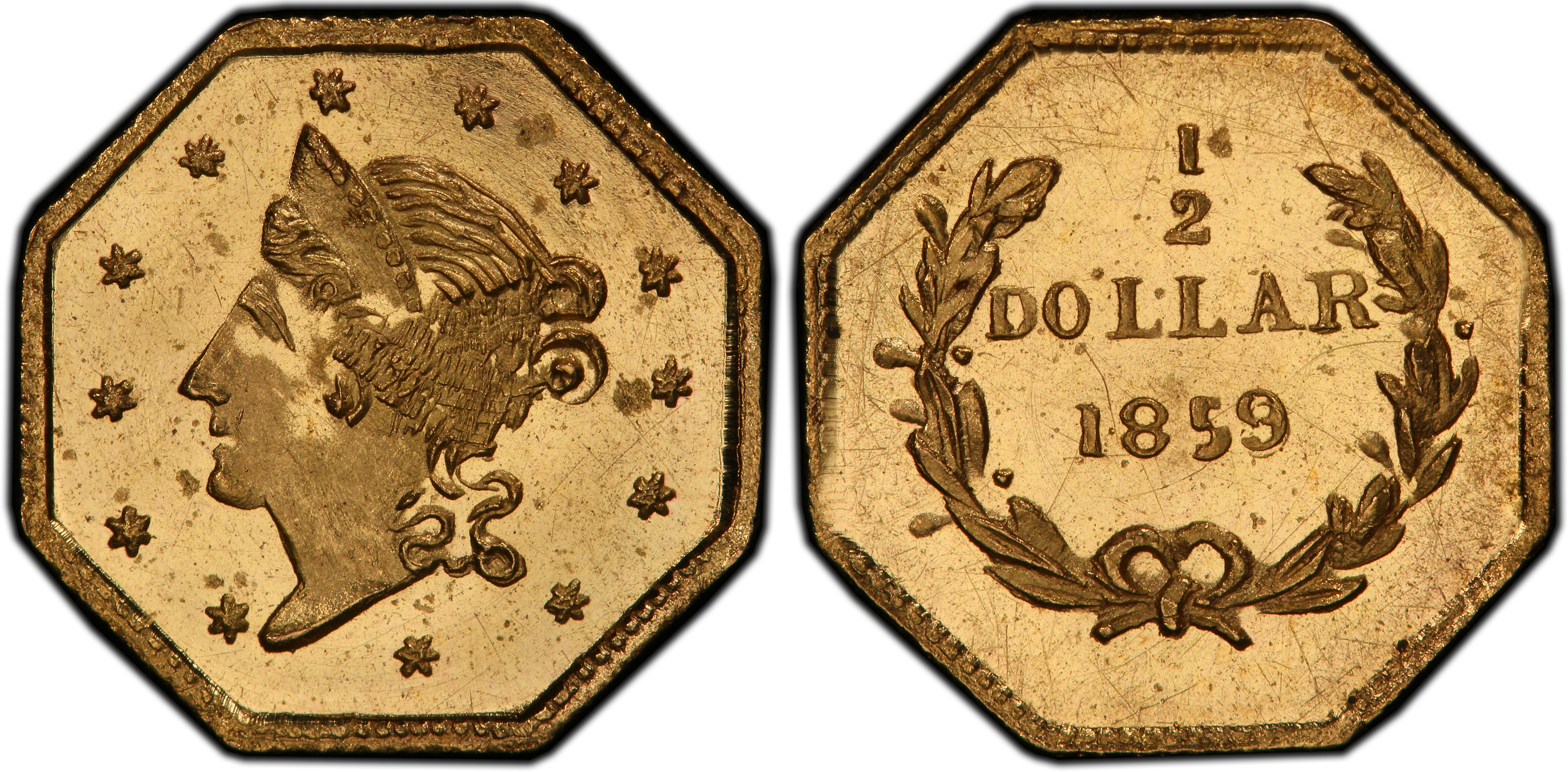
Obverse & Reverse
The 1859 'G50C' BG-901 is a product of California's unique post-Gold Rush economic landscape. Following the initial rush of 1849, the region experienced a chronic shortage of circulating small change. Federal coinage was scarce on the West Coast, and the daily transactions necessary for a booming economy required denominations smaller than the multi-dollar gold pieces being privately minted and the large federal silver coins that rarely appeared. Miners' gold dust, while the basis of the economy, was inconvenient and prone to spillage and fraud. To fill this numismatic vacuum, private jewelers and metallurgists began producing small, denominated gold tokens, typically in 25 cent, 50 cent, and one-dollar sizes. These 'fractional gold' pieces, while not legal tender, were widely accepted in commerce out of sheer necessity. Robert B. Gray, a San Francisco jeweler and die sinker operating at 118 Montgomery Street, was a prolific producer of these tokens. The BG-901 variety, with its Indian Head motif, was a direct response to this need for a reliable medium for small-scale trade. Unlike the often crude earlier issues, by 1859 the manufacturing quality had improved, featuring more standardized designs that mimicked federal coinage to inspire public trust. However, the intrinsic value of these pieces was often significantly less than their face value, a fact that eventually led to public outcry and government suppression. The Secret Service began cracking down on private coinage in the 1860s and 1870s, culminating in an 1883 federal court ruling that effectively ended their production. Today, these pieces are not seen as illicit tokens but as cherished artifacts of a turbulent and fascinating period of American economic improvisation.
Associated EventCalifornia Gold Rush and Post-Rush Economic Expansion
Reason For MintingTo alleviate a severe shortage of small-denomination coinage for everyday commercial transactions in post-Gold Rush California.
Minter HistoryRobert B. Gray & Co. was a prominent San Francisco jewelry firm and a major manufacturer of California fractional gold tokens. Active from the mid-1850s into the 1870s, Gray was a skilled die-sinker who created numerous varieties of fractional gold pieces. His work is characterized by its relatively high quality and standardized designs, often borrowing motifs from contemporary federal coinage, such as the Indian Head, to enhance public acceptance. The 'BG' prefix in the Breen-Gillio catalog system for fractional gold is a direct reference to the research that identified Gray (among others) as a key minter in this specialized field.
Historical SignificanceThe BG-901 is historically significant as a tangible example of private enterprise filling a crucial gap left by the federal government in a remote and rapidly growing economy. It represents the ingenuity and ad-hoc solutions that characterized the American frontier and serves as a key artifact from the final, more refined period of California fractional gold production before federal intervention halted the practice.
N/A
Denomination50 Cents (G50C)
Minting Period1859
Assayer/MinterRobert B. Gray & Co.
Geographic OriginSan Francisco, California
Obverse DescriptionA depiction of a Liberty head facing left, adorned with a feathered headdress in the style of the contemporary Indian Head cent. Thirteen stars encircle the portrait along the rim.
Obverse Inscription(No lettering, only the portrait and 13 stars)
Reverse DescriptionThe denomination '50 CENTS' is displayed in two lines at the center, surrounded by an olive wreath. The date '1859' is positioned below the wreath, near the lower rim. There is an ornamental device or bow at the base of the wreath.
Reverse Inscription50 CENTS 1859
CompositionGold
Stated Fineness Actual FinenessVaries, but typically between .500 and .750 fine.
Weight0.97 grams
Diameter12.70 mm
EdgePlain
Unknown
Survival Estimate200-300
Rarity ScaleR-5
The BG-901 is popular due to its classic 'Indian Head' design, which resonates with collectors of federal coinage. It is one of the more available and affordable 'Period One' (pre-1883) fractional gold issues, making it an excellent entry point into this fascinating series. Its connection to the history of San Francisco and the Gold Rush adds a deep layer of historical allure.
Key VarietiesThe primary distinction for this issue is the 'Regular Strike' intended for circulation. No contemporary proofs or patterns are known to exist for the BG-901. Collectors should be aware of a large number of modern replicas and fantasy pieces that imitate the style of genuine California fractional gold. True BG-901 varieties are distinguished by specific die characteristics cataloged in the Breen-Gillio reference.
Authentication TipsGenuine BG-901 coins have a specific die crack that often runs from the rim through the first star on the left of the obverse. The lettering and date on the reverse should have a sharp, hand-punched look, not the soft, cast appearance of many fakes. The gold color should be consistent with a 14-18 karat alloy, often with a slightly brassy or reddish hue, not the pure yellow of modern .999 gold replicas. Weight and diameter should be close to the published specifications. Any piece with a 'bear' on the reverse or denominations like 'CALIFORNIA GOLD' spelled out is almost certainly a modern souvenir token, not a genuine Period One issue.
Shopping ConsiderationsA premium quality example for its grade will exhibit a sharp strike, particularly on the details of the headdress feathers and the numbers in the date. Look for coins with smooth, lustrous surfaces that have not been harshly cleaned or polished; original 'skin' is paramount. Due to their small size and circulation, many examples are found with minor rim bumps or faint scratches, so problem-free surfaces command a significant premium. Avoid examples that have been used in jewelry, evidenced by solder marks or excessive, localized wear and polishing. A coin with a CAC sticker is highly desirable, as it confirms both authenticity and quality for the assigned grade.
A coin's grade is its condition, rated on a 1-70 scale. For rare coins, this is the most critical factor in determining value, as a tiny difference in preservation can mean a huge difference in price.
Relevant Grade TypesAll original BG-901 issues were business strikes intended for circulation. They are graded on the Circulated scale (AG-3 to AU-58) and the Mint State scale (MS-60 to MS-70). No proofs were struck during the original minting period in 1859. Any piece described as a 'Proof' is either a modern replica or a misattribution. The vast majority of surviving examples are in circulated grades, with Mint State specimens being particularly scarce.
Mint State CharacteristicsAn uncirculated BG-901 will display full, frosty mint luster, though the quality can vary from satiny to slightly prooflike. The strike is typically sharp on the central devices (portrait and denomination) but may show some softness on the peripheral stars and wreath elements. Due to the nature of their production and handling in bags, even high-grade MS examples often show scattered tiny contact marks. A truly 'gem' (MS-65 or higher) example is a major rarity.
Circulated Wear PatternsWear first appears on the highest points of the design: the cheek and the feathers of the headdress on the obverse. On the reverse, the '50' and the bow of the wreath will show the first signs of friction. On a coin graded VF (Very Fine), significant detail will remain in the feathers, and all lettering will be bold. By the time a coin is graded F (Fine) or lower, the feathers will be largely flattened, and the cheek will be smooth.
Key Factors For ValueFor the BG-901, the primary value drivers are grade and surface preservation. An AU-58 coin with original luster and minimal marks can be worth several times more than a cleaned AU-50. Sharpness of strike is a key consideration; well-struck examples with full details are prized. Eye appeal, including attractive original toning (often a deep reddish-gold), significantly enhances value. Finally, certification by a top-tier grading service (PCGS or NGC) is essential for authenticity and liquidity, and the addition of a CAC sticker indicates premium quality for the grade, carrying a substantial market premium.
PCGS Price Guide
| Grade | Price | Population |
|---|---|---|
| 58 | $500.00 | 1 |
| 58+ | $575.00 | N/A |
| 60 | $700.00 | N/A |
| 61 | $800.00 | N/A |
| 62 | $850.00 | 2 |
| 62+ | $900.00 | 1 |
| 63 | $1,800.00 | 2 |
| 63+ | $2,000.00 | N/A |
| 64 | $2,500.00 | 4 |
| 64+ | $3,150.00 | N/A |
| 65 | $3,750.00 | 3 |
| 65+ | $4,500.00 | 1 |
| 66 | $6,250.00 | 2 |