1875 G50C BG-933 (Regular Strike)
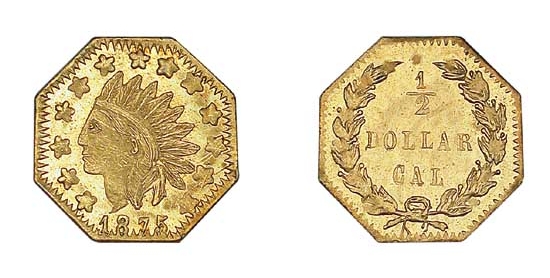
Obverse & Reverse
The 1875 BG-933 fifty-cent piece emerges from the second major phase of California Fractional Gold production, a period numismatists categorize as 'Period Two' (1859-1882). Unlike the initial 'Period One' issues (1852-1856), which were struck out of genuine commercial necessity to alleviate a crippling shortage of small change in the gold fields, these later pieces served a different purpose. By the 1870s, the San Francisco Mint was in full operation, supplying the region with ample federal coinage. The frantic, gold-dust-for-whiskey economy of the early Gold Rush had matured. The impetus for striking these tiny gold pieces had shifted from transactional need to nostalgic and commercial appeal. Enterprising jewelers, many of French origin located in San Francisco, recognized a burgeoning market for souvenirs and keepsakes. The romance of the Gold Rush was a powerful draw for tourists, visitors, and even locals who wanted a tangible piece of the era's allure. These 'jeweler's issues' were lighter and often of lower fineness than their Period One predecessors, containing significantly less gold than their face value implied, making them a form of token coinage. They were produced using the same rudimentary 'hammer method' as the earlier pieces, where dies were struck by hand with a sledgehammer, resulting in inconsistent strike quality. The Coinage Act of 1864 had made the private issuance of coinage illegal, but the law was not strictly enforced in the West until the early 1880s, allowing this cottage industry to flourish for nearly two more decades. The BG-933, with its popular Indian Head motif—a design choice echoing contemporary federal coinage but with a distinct private flair—represents the pinnacle of this souvenir trade. These pieces were never intended to be the lifeblood of commerce like their predecessors but were instead cherished mementos of California's golden age, a role that ironically ensured a higher survival rate in uncirculated condition than many of the earlier, more heavily used issues.
Associated EventPost-California Gold Rush Souvenir Trade
Reason For MintingPrimarily created for sale to tourists and collectors as souvenirs of the California Gold Rush era.
Minter HistoryThe specific minter for the BG-933 variety, like many 'Period Two' issues, is unknown. Production during this time was dominated by various San Francisco-based jewelers who created a wide array of designs to appeal to the souvenir market. These craftsmen were skilled in working with gold on a small scale but were not official assayers or government-sanctioned minters. Their identities are largely lost to history, with their legacy being the diverse and fascinating coin-like tokens they produced.
Historical SignificanceThe BG-933 is significant not as a coin that facilitated commerce, but as a cultural artifact representing the commercialization of the Gold Rush legend itself. It demonstrates the transition of California's economy from a frontier society dependent on private money to a more established state where the memory of the Gold Rush became a powerful marketing tool. These pieces are a key component of the most extensive private coinage series in U.S. history.
N/A
Denomination50 Cents
Minting Period1875
Assayer/MinterUnknown Private Jeweler
Geographic OriginSan Francisco, California
Obverse DescriptionAn Indian Head (Princess) facing left, adorned with a feathered headdress. The portrait is encircled by 13 six-pointed stars, with the date '1875' positioned below the bust.
Obverse Inscription1875
Reverse DescriptionThe denomination '1/2' is located in the center, surrounded by an ornamental wreath of 21 leaves and 14 berries. The inscription 'CALIFORNIA GOLD' encircles the wreath, broken by a star at the bottom.
Reverse InscriptionCALIFORNIA GOLD * 1/2
CompositionGold
Stated Fineness Actual FinenessVariable, often 14 to 22 karats. Generally contained less gold value than its stated 50-cent face value.
Weight0.25 grams
Diameter11.20 mm
EdgePlain
Unknown
Survival Estimate46-60 (for the regular BG-933)
Rarity ScaleR-5
This octagonal Indian Head issue is highly popular due to its classic design, tangible connection to the Gold Rush mystique, and relative affordability compared to Period One issues. Its status as a 'jeweler's issue' makes it an accessible entry point into the fascinating and complex world of California Fractional Gold.
Key VarietiesThe primary variety is the regular strike BG-933 (R-5). A significantly rarer 'Hybrid' variety also exists, identified as BG-933 with a distinct obverse die marriage. This Hybrid is rated LR-6, with an estimated survival of only 13-18 pieces, making it a major rarity sought by specialists. No proof restrikes from a later period are known to exist for this specific variety.
Authentication TipsAuthentication is critical. Genuine pieces often show a softness of strike in certain areas due to hand hammering. The stars and letters should match known die states. Counterfeits are common and may appear soapy, have incorrect details in the wreath or headdress, or be made of brass or other gold-plated base metals. It is strongly advised to only purchase examples certified by major grading services like PCGS or NGC, who attribute them by their Breen-Gillio (BG) number.
Shopping ConsiderationsA premium quality example for its grade will exhibit a sharp strike, especially on the high points of the Indian's cheek, the details of the headdress, and the leaves of the wreath. Look for original, undisturbed surfaces with some remaining luster; many have been cleaned or used as jewelry. Proof-like (PL) or Deep Mirror Proof-like (DMPL) examples command a significant premium and are highly desirable. Avoid specimens with significant scratches, rim bumps, or signs of having been mounted in jewelry, as these issues dramatically reduce value.
A coin's grade is its condition, rated on a 1-70 scale. For rare coins, this is the most critical factor in determining value, as a tiny difference in preservation can mean a huge difference in price.
Relevant Grade TypesOriginal issues were business strikes produced for commercial sale as souvenirs, not for circulation in the traditional sense. They are found in Circulated grades (AU-58 and below, often from mishandling or jewelry use) and, more commonly, in Mint State (MS, 60-70) grades. No proofs were struck during the original period of issue. The term 'Proof-like' (PL) is a designation added to Mint State coins that exhibit mirrored surfaces from polished dies, and these are particularly sought after for this variety.
Mint State CharacteristicsUncirculated examples of BG-933 often have a decent, if not always full, strike due to the hand-hammering process. Luster is typically satiny, though highly reflective, proof-like surfaces are seen on premium examples struck from fresh, polished dies. Common marks include minor planchet flaws or die polishing lines. The strike can be weak on the centermost details of the wreath or the highest points of the portrait, even on high-grade specimens.
Circulated Wear PatternsFor pieces that did see handling or wear, the first signs appear on the high points of the design. On the obverse, check the Indian's cheekbone, the brow, and the tips of the feathers in the headdress. On the reverse, wear is first evident on the leaves and berries of the wreath. In lower grades, the date and the fine details of the feathers will become indistinct.
Key Factors For ValueBeyond the numerical grade, value is driven by several key factors. Surface quality is paramount; an example with original, lustrous 'skin' is far more valuable than a cleaned or polished one. Strike sharpness is critical, with well-defined details on the portrait and wreath commanding strong premiums. Eye appeal, encompassing attractive toning and the presence of proof-like surfaces, significantly enhances value. Finally, a CAC sticker on a certified coin provides third-party verification of quality for the grade and can add a substantial premium for this popular issue.
PCGS Price Guide
| Grade | Price | Population |
|---|---|---|
| 50 | $245.00 | 1 |
| 50+ | $250.00 | N/A |
| 53 | $255.00 | 1 |
| 53+ | $265.00 | N/A |
| 55 | $275.00 | N/A |
| 55+ | $290.00 | N/A |
| 58 | $330.00 | 5 |
| 58+ | $345.00 | N/A |
| 60 | $375.00 | N/A |
| 61 | $415.00 | 1 |
| 62 | $450.00 | 10 |
| 62+ | $475.00 | N/A |
| 63 | $575.00 | 8 |
| 63+ | $750.00 | N/A |
| 64 | $1,500.00 | 7 |
| 64+ | $1,750.00 | N/A |
| 65 | $2,250.00 | 1 |
| 65+ | $2,650.00 | N/A |
| 66 | $3,250.00 | N/A |