1872 G50C BG-1013 (Regular Strike)
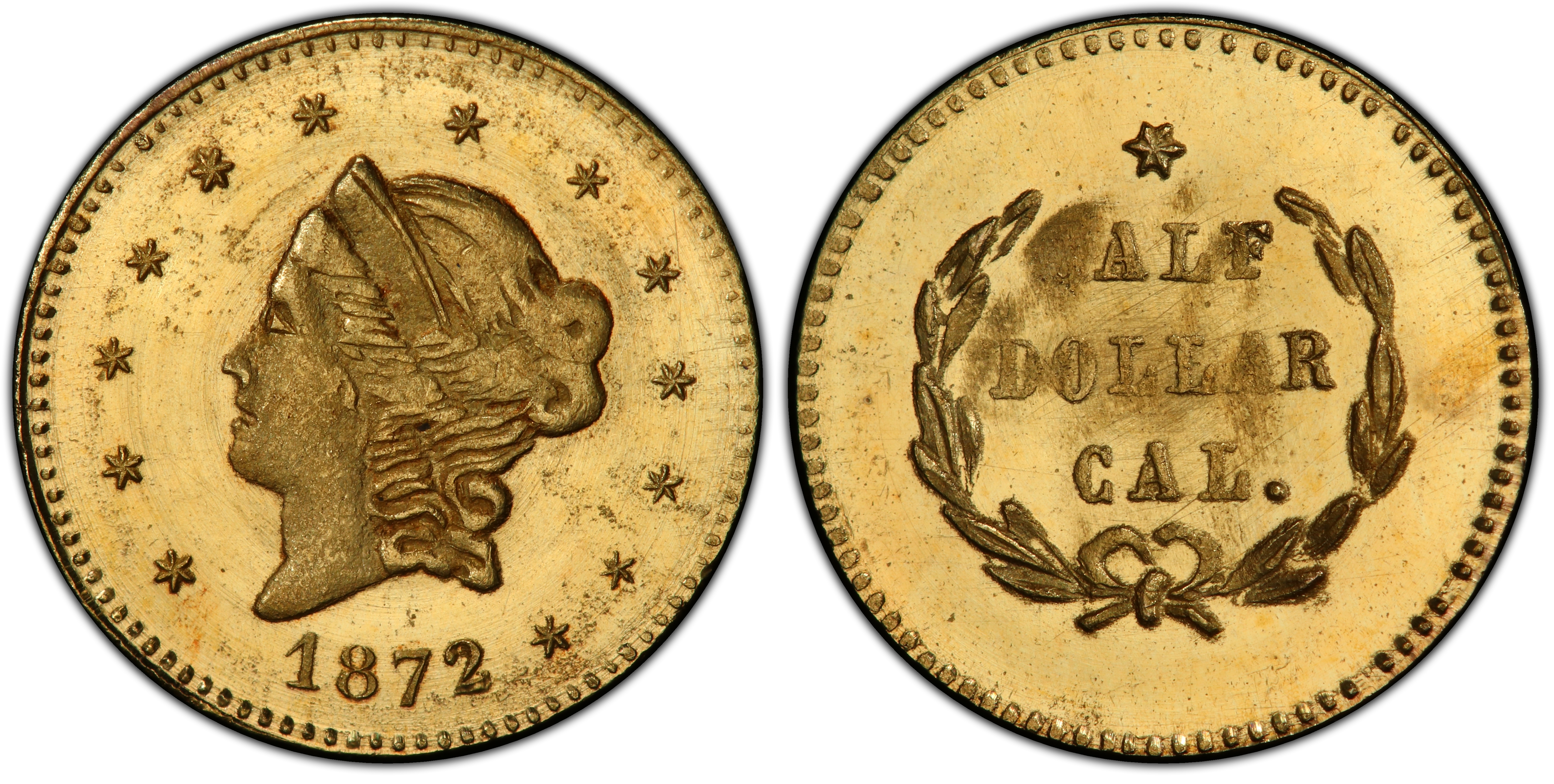
Obverse & Reverse
The 1872 BG-1013 50 Cents is a quintessential example of 'Period Two' California Fractional Gold. By the 1870s, the initial, desperate need for small circulating coinage that characterized the Gold Rush's peak in the early 1850s had long since subsided. The establishment of the San Francisco Mint in 1854 had supplied the region with ample federal coinage, rendering the original purpose of private fractional gold obsolete. However, the allure of California and its goldfields had not faded from the national consciousness. This created a robust secondary market for jewelers and private minters to produce small gold tokens as souvenirs and keepsakes. These 'jeweler's issues' were not intended to, and did not, circulate as money in the traditional sense. Instead, they were purchased by tourists, sent back East to relatives, or incorporated into jewelry as tangible mementos of the West. The BG-1013 was struck by the firm of Frontier & Bellemere, one of many such partnerships of jewelers operating in San Francisco during this era. Unlike the earlier 'Period One' issues, which often contained a reasonable, albeit still deficient, amount of gold relative to their face value, Period Two pieces were significantly lighter and often of a lower fineness. Their legality was dubious; the Coinage Act of 1864 explicitly forbade private coinage, but enforcement on the remote West Coast was lax, especially for pieces clearly intended as novelties rather than competitors to federal money. Makers often backdated their issues or omitted any mark of value, though this piece boldly states 'HALF DOL.'. The production method for these tiny coins was crude, typically involving hand-cut dies and a hammer strike. This resulted in significant variation in strike quality, with many specimens appearing weakly struck in areas, having misaligned dies, or exhibiting other minor planchet flaws. The BG-1013 is exceptionally rare today, a testament to its likely very low original production number. It serves not as a relic of Gold Rush commerce, but as a numismatic artifact from the era of romanticized memory of the Gold Rush, representing the transition of these fascinating pieces from necessity to nostalgia.
Associated EventPost-Gold Rush California Commerce and Tourism
Reason For MintingPrimarily created as a souvenir or keepsake for the tourist trade, not for general circulation.
Minter HistoryFrontier & Bellemere was a partnership of jewelers and die sinkers active in San Francisco during the 'Period Two' era of fractional gold production. Like many of their contemporaries, their business catered to the demand for gold-based novelties and souvenirs. Their work is characterized by distinctive, if somewhat crude, renditions of the classic Liberty head motif. Little is recorded about their specific business operations, but their name is preserved in numismatic history through the rare Breen-Gillio varieties attributed to their workshop.
Historical SignificanceThe BG-1013 represents the later phase of private gold minting in California, where the focus shifted from fulfilling a monetary need to capitalizing on the region's fame by producing souvenirs. It is a tangible link to the burgeoning tourist trade of 19th-century San Francisco and the romantic legacy of the Gold Rush.
BG-1013
Denomination50 Cents
Minting Period1872
Assayer/MinterFrontier & Bellemere
Geographic OriginSan Francisco, California
Obverse DescriptionA distinctive Liberty Head facing left, described by numismatists as having a 'pert-nosed' profile. The head is taller than on previous versions by these makers. It is surrounded by 13 six-pointed stars, with the date '1872' below the truncation of the neck.
Obverse Inscription1872
Reverse DescriptionThe denomination 'HALF DOL.' is inscribed in two lines within a simple wreath. A single five-pointed star is located above the denomination. This variety is specifically noted for having no berries in the wreath.
Reverse InscriptionHALF DOL.
CompositionGold
Stated Fineness Actual Fineness EdgePlain
Extremely Low; Likely fewer than 100
Survival Estimate13-30 (Basis for R-6 rating)
Rarity ScaleR-6
As a high R-6 variety, the BG-1013 is a significant rarity sought by advanced specialists in the California Fractional Gold series. Its appeal lies in its scarcity, its attribution to a known but obscure maker, and its distinctive 'pert-nosed' Liberty portrait.
Key VarietiesThis is a single, specific die marriage (BG-1013). No major varieties from the original minting period are known. No known restrikes, patterns, or trial pieces exist; all known examples are considered original business strikes from the period.
Authentication TipsGenuine examples must match the known die characteristics of BG-1013, particularly the 'pert-nosed' Liberty and the reverse wreath with no berries and a star above 'HALF DOL.'. The surfaces should show the texture of a genuine strike, not the porous or soapy look of a cast counterfeit. Replicas often have incorrect details, are gold-plated base metal (check weight and magnetism), and lack the sharp, albeit sometimes crude, die work of originals. All Period One and Two fractionals must be denominated; fakes sometimes have a bear on the reverse or lack a value statement.
Shopping ConsiderationsFor a premium quality BG-1013, a buyer should seek an example with a bold strike, particularly on Liberty's hair details, the date, and the reverse legend. Due to the manufacturing process, perfectly centered strikes are rare. Look for original, undisturbed surfaces with some remaining luster; prooflike or semi-prooflike fields are sometimes encountered on this variety and command a premium. Avoid examples that have been harshly cleaned, polished, or used as jewelry, as evidenced by solder marks, excessive scratching, or smoothing of details. Given the coin's rarity, even a problem-free circulated example is a major acquisition.
A coin's grade is its condition, rated on a 1-70 scale. For rare coins, this is the most critical factor in determining value, as a tiny difference in preservation can mean a huge difference in price.
Relevant Grade TypesOriginal period issues were business strikes produced for souvenir purposes, though not intended for circulation. They are found in Circulated (AU-50 to AU-58 are most common) and Mint State (MS, 60-70) grades. No proofs were struck during the original period of issue, and no later-date proof restrikes are known to exist for this variety.
Mint State CharacteristicsUncirculated examples of BG-1013 often exhibit a soft, satiny luster, though some possess partially prooflike fields. Strike weakness is common, especially on the stars and the finer details of the wreath. The quality of the planchet can vary, with minor inherent flaws being acceptable. Bag marks are less common than on larger coins, but small handling marks or 'flyspecks' (tiny carbon spots) may be present without significantly detracting from the grade.
Circulated Wear PatternsWear first appears on the highest points: Liberty's cheek, the hair above her eye and ear, and the highest leaves of the wreath on the reverse. On moderately circulated examples (VF-XF), the finer hair strands will merge, and the date will show some softness. In lower grades, much of the legend and finer details will be considerably worn, though the basic outlines remain visible.
Key Factors For ValueRarity is the primary driver of value for this variety. Beyond that, a sharp strike is paramount, as many examples are softly impressed. Surface quality is critical; coins with original, uncleaned 'skin' and attractive luster are prized. Eye appeal is highly subjective but important; an example with a bold, well-centered strike and pleasing original color will always command a premium. Certification by PCGS or NGC is standard for this series and essential for guaranteeing authenticity and grade. A CAC sticker would indicate premium quality for the assigned grade and adds significant value.
PCGS Price Guide
| Grade | Price | Population |
|---|---|---|
| 50 | $250.00 | N/A |
| 50+ | $255.00 | N/A |
| 53 | $260.00 | 1 |
| 53+ | $265.00 | N/A |
| 55 | $270.00 | 1 |
| 55+ | $275.00 | N/A |
| 58 | $285.00 | 3 |
| 58+ | $290.00 | N/A |
| 60 | $300.00 | 1 |
| 61 | $325.00 | 1 |
| 62 | $375.00 | 4 |
| 62+ | $425.00 | N/A |
| 63 | $525.00 | 4 |
| 63+ | $600.00 | N/A |
| 64 | $850.00 | 2 |
| 64+ | $1,050.00 | N/A |
| 65 | $1,500.00 | 2 |
| 65+ | $2,250.00 | N/A |
| 66 | $4,000.00 | 1 |