1871 G25C BG-864 (Regular Strike)
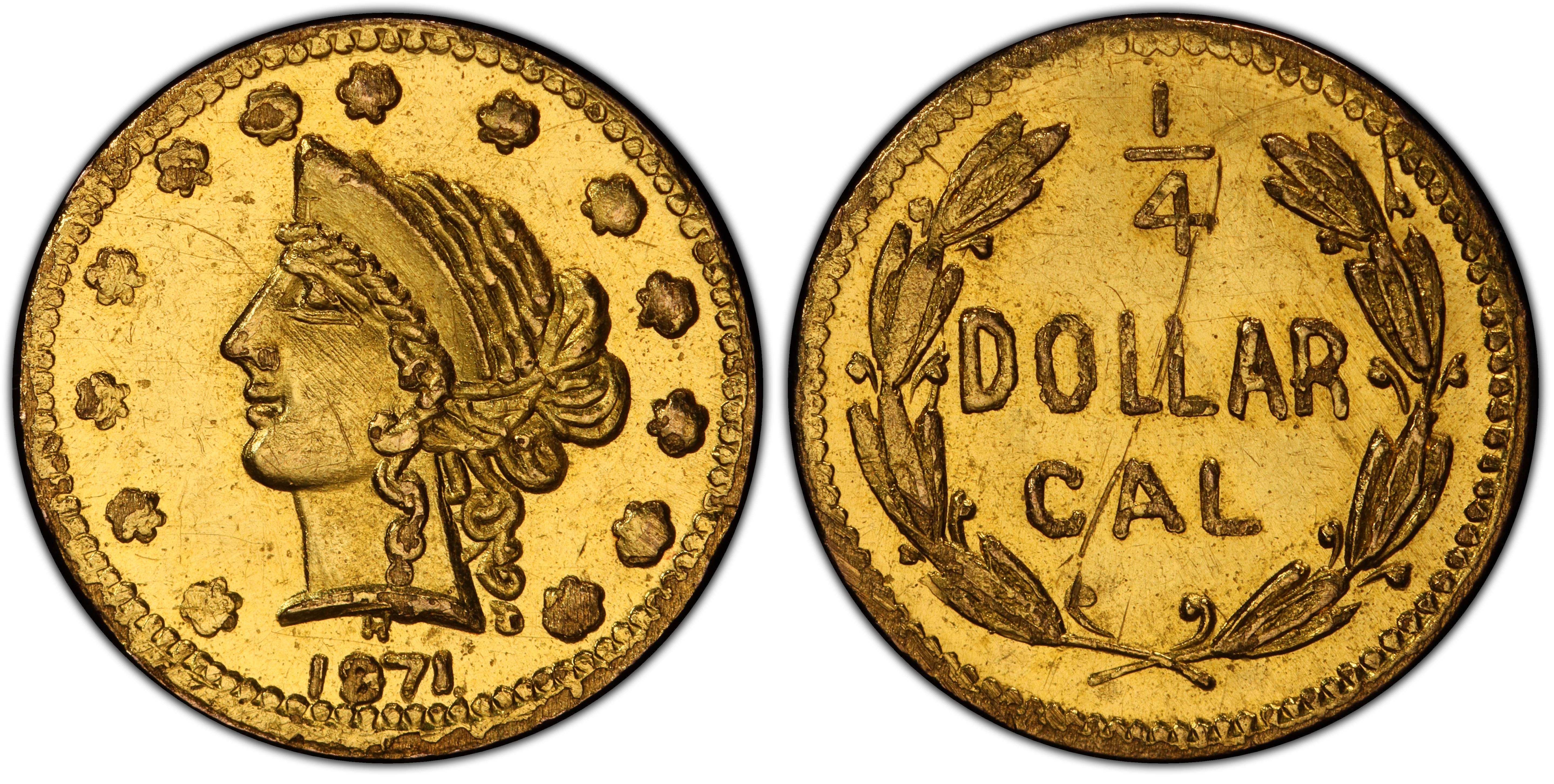
Obverse & Reverse
The 1871 G25C BG-864 is a fascinating artifact from the second period (1859-1882) of California Fractional Gold production, a series born out of the initial chaos and subsequent economic development of the California Gold Rush. Unlike the earlier Period One issues, which were struck in California to alleviate a shortage of small change, many Period Two pieces were 'jeweler's issues' of lighter weight and dubious monetary purpose. The BG-864 is a prime example of this later phenomenon, notable for having been produced not in California, but in Leavenworth, Kansas, by the ambitious jewelry firm of Reuben N. Hershfield and Noah Mitchell. Hershfield, a Russian immigrant and Civil War veteran, saw a business opportunity in the popular gold pieces. After analyzing originals from San Francisco, he determined his firm could manufacture them more profitably themselves. He hired a local die-cutter, a Mr. Fredenburg, to create dies for 25-cent and 50-cent pieces, distinguished by a small 'H' for Hershfield on the truncation of the Liberty bust. This production ran afoul of the Private Coinage Act of 1864. The U.S. Secret Service, under its zealous chief James J. Brooks, investigated private minting operations, viewing them as illegal competition to federal coinage. In August 1871, agents raided Hershfield and Mitchell's establishment, seizing their production and arresting the partners, abruptly ending their brief but prolific career in private minting. Because their intrinsic gold value was substantially less than their face value, these pieces are technically tokens. They did not circulate widely as money but were sold as souvenirs, keepsakes, and curiosities, capitalizing on the mystique of the California Gold Rush. Today, their non-California origin and the dramatic story of their suppression by federal authorities make the Hershfield issues, including BG-864, particularly compelling to numismatists.
Associated EventPost-Gold Rush Economic Expansion & Federal Coinage Law Enforcement
Reason For MintingProduced as a commercial venture to be sold as popular souvenirs and keepsakes, rather than to alleviate a coin shortage.
Minter HistoryReuben N. Hershfield and Noah Mitchell operated a large and successful jewelry manufacturing and sales business in Leavenworth, Kansas. Hershfield was a prominent local citizen and Civil War veteran. Their venture into fractional gold production in 1871 was an attempt to profit from the popular souvenir trade but was quickly shut down by the U.S. Secret Service for violating the 1864 Private Coinage Act, making their issues one-year types.
Historical SignificanceThe BG-864 is significant as a 'Period Two' California Fractional Gold piece, representing the shift from utilitarian coinage to commercial souvenirs. Its manufacture in Kansas by Hershfield & Mitchell, identified by the 'H' on the obverse, and its subsequent seizure by the Secret Service, provides a distinct and well-documented narrative that sets it apart from its anonymous California-made counterparts.
BG-864
DenominationG25C (25 Cents)
Minting Period1871
Assayer/MinterReuben N. Hershfield and Noah Mitchell
Geographic OriginLeavenworth, Kansas
Obverse DescriptionA head of Liberty facing left, her hair tied in a bun. She wears a coronet, and the truncation of her neck bears a small initial 'H'. The field is surrounded by thirteen stars, often described as 'Large Stars' for this variety.
Obverse Inscription Reverse DescriptionThe denomination '1/4 DOLLAR' with 'CAL' below it are enclosed within a simple wreath of two olive branches tied with a bow at the bottom. The date, 1871, appears below the bow.
Reverse Inscription1/4 DOLLAR CAL 1871
CompositionGold
Stated Fineness Actual FinenessVaries, but generally lower-karat gold, consistent with jeweler's issues of the period.
EdgePlain
Unknown
Survival EstimateApproximately 76-150 coins are believed to exist across all grades.
Rarity ScaleR-5
The BG-864 is highly sought after for its specific, well-documented history involving jewelers Hershfield & Mitchell, its unusual Kansas origin, and the dramatic 1871 Secret Service raid that makes it a one-year issue. The presence of the 'H' mintmark provides a tangible link to its makers, which is rare for Period Two fractionals.
Key VarietiesThe primary regular strike is BG-864. A significant and very rare variety is the BG-864A, which is a mule created by pairing the BG-864 obverse (with the 'H' initial) with the reverse die of BG-859. This creates an unlisted die combination that is highly prized by specialists. No known later-date restrikes exist, as the operation was terminated abruptly.
Authentication TipsAuthentic examples must have the small 'H' on the neck truncation. The strike is often uneven due to the manual hammering process; perfectly struck, uniform coins should be viewed with suspicion. Genuine pieces have a specific die diagnostic known as the 'Large Stars' variant. Counterfeits from this era are numerous; many are gold-plated brass tokens often lacking the word 'DOLLAR' or 'CENTS'. Any piece depicting a bear is a modern fantasy piece. Comparison with high-resolution images from PCGS or NGC archives is essential.
Shopping ConsiderationsA premium quality example for its grade will exhibit a bold strike on Liberty's portrait and the stars, as these areas can be weak. The tiny 'H' initial should be discernible, even on circulated examples. Look for original, undisturbed surfaces with a pleasing reddish-gold or lemon-gold luster. These tiny coins are prone to being damaged, bent, or used in jewelry, so avoid examples with evidence of solder, tooling, or harsh cleaning. A well-centered strike adds to the eye appeal, as many are off-center.
A coin's grade is its condition, rated on a 1-70 scale. For rare coins, this is the most critical factor in determining value, as a tiny difference in preservation can mean a huge difference in price.
Relevant Grade TypesOriginal 1871 BG-864 issues were business strikes intended for sale as souvenirs, not circulation, but are graded along the same scale. They are found in Circulated grades (AG-3 to AU-58) and, more commonly, in Mint State (MS-60 to 70). No proofs were struck during the original period of issue, and there are no known later-date proof restrikes.
Mint State CharacteristicsUncirculated examples often display a soft, satiny luster rather than a hard, frosty one. The strike is a key factor; many were made with a single hammer blow, resulting in weakness on one side or part of the periphery. A well-struck MS example will have full detail in Liberty's hair and the wreath's leaves. Due to the softness of the gold and minimal handling, contact marks are common but should not be overly distracting. Examples with prooflike or semi-prooflike fields are rare and command a significant premium.
Circulated Wear PatternsWear first appears on the highest points: Liberty's cheek, the hair above the ear, and the coronet. On the reverse, the high points of the wreath leaves and the bow will show friction first. In lower grades (VF and below), the stars will begin to lose their definition, and the delicate letters of the denomination and date will become soft and start to merge with the fields.
Key Factors For ValueFor the BG-864, value is driven by several key factors. Firstly, the grade and surface preservation are paramount; an example with original, uncleaned skin is far more valuable than a cleaned one of the same grade. Secondly, strike quality is crucial; a sharply struck coin with full details, especially the 'H' initial and stars, is highly desirable. Eye appeal, including attractive original toning and centering, plays a major role. Finally, certification by PCGS or NGC is standard for the market, and a CAC sticker indicating premium quality for the grade will add a significant premium.
PCGS Price Guide
| Grade | Price | Population |
|---|---|---|
| 53 | $300.00 | 1 |
| 53+ | $315.00 | N/A |
| 55 | $325.00 | 3 |
| 55+ | $340.00 | N/A |
| 58 | $360.00 | 6 |
| 58+ | $375.00 | N/A |
| 60 | $400.00 | N/A |
| 61 | $425.00 | 1 |
| 62 | $450.00 | 11 |
| 62+ | $475.00 | N/A |
| 63 | $500.00 | 16 |
| 63+ | $575.00 | N/A |
| 64 | $725.00 | 10 |
| 64+ | $875.00 | N/A |
| 65 | $3,250.00 | 3 |
| 66 | N/A | N/A |