1868 G25C BG-806 (Regular Strike)
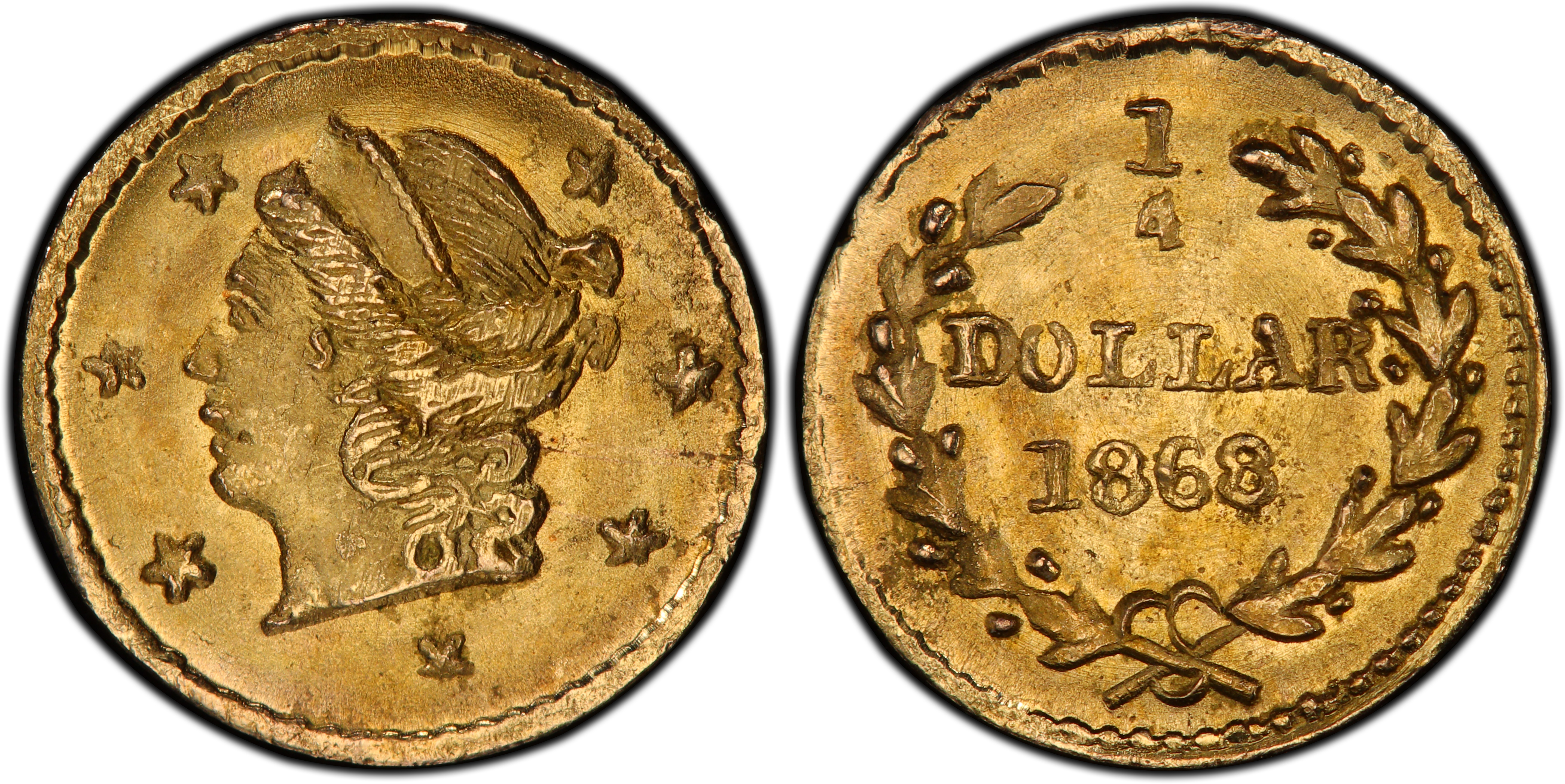
Obverse & Reverse
The 1868 BG-806 25-cent piece emerges from the second period of California's private gold coinage, a fascinating era that followed the initial chaos of the Gold Rush. By the late 1860s, the frenzy of the 'forty-niners' had subsided, but California's economy remained distinct from the rest of the Union. A chronic shortage of small-denomination coinage continued to plague daily commerce. While federal silver coins were scarce on the West Coast, gold dust and nuggets were still abundant, creating an awkward economic environment where buying a loaf of bread or a drink might involve weighing out a 'pinch' of gold. This impracticality fueled a market for private minters to produce their own small-value coins. These 'fractional gold' pieces, in denominations of 25 cents, 50 cents, and one dollar, were not federal legal tender but were widely accepted due to necessity. The BG-806 is classified as a 'Period Two' issue (1859-1882), often called 'jewelers' issues.' These were typically struck by jewelers and metallurgists in San Francisco, such as Frontier & Deviercy, the makers of this coin. Unlike the earlier, cruder issues of Period One, the coins of this later period often exhibited more refined designs, though they were still produced with manual screw presses, leading to significant variation in strike quality. The passage of the Coinage Act of April 22, 1864, technically outlawed private coinage, but enforcement was lax on the remote West Coast, allowing production to continue for nearly two more decades. These pieces served a vital role in local economies until the increased circulation of federal coinage and eventual enforcement of the law rendered them obsolete in the early 1880s. Today, they are cherished as tangible relics of the enduring economic legacy of the California Gold Rush.
Associated EventPost-California Gold Rush Economic Development
Reason For MintingTo alleviate a persistent shortage of small denomination circulating coinage for daily commerce in post-Gold Rush California.
Minter HistoryFrontier & Deviercy was a San Francisco-based firm of jewelers and die sinkers active during the second period of California fractional gold production. Like many of their contemporaries, they were skilled artisans who leveraged their metallurgical and engraving expertise to meet the regional demand for small change. Their mintmark, 'F.D.', is not present on this particular variety, but their work is identified by diagnostic design elements and die characteristics documented in the Breen-Gillio reference. These 'jewelers' issues' are a key part of the California fractional gold story, representing a more established phase of production compared to the initial, cruder gold rush coins.
Historical SignificanceThe BG-806 is a prime example of a 'jeweler's issue,' representing the adaptation of private enterprise to solve a circulating currency shortage long after the initial Gold Rush peak. Its existence highlights the economic isolation of the American West in the mid-19th century and the resourcefulness of its artisans. These tiny gold coins are a direct link to the day-to-day transactions of the era, filling a crucial monetary gap left by the federal government.
BG-806
Denomination25 Cents
Minting Period1868
Assayer/MinterFrontier & Deviercy
Geographic OriginSan Francisco, California
Obverse DescriptionA Liberty Head, facing left, with 13 stars surrounding the portrait in a complete circle. The portrait style is often described as having a broad head, and the stars are typically well-defined beads.
Obverse Inscription[No Inscription]
Reverse DescriptionThe denomination '1/4' is enclosed within a wreath of two olive branches tied with a ribbon at the bottom. Above the wreath is the date '1868'. Below the wreath, the word 'DOLLAR' appears. A notable diagnostic for the BG-806 variety is a small, somewhat crudely engraved '4' in the fraction.
Reverse Inscription1868 1/4 DOLLAR
CompositionGold
Stated Fineness Actual Fineness EdgePlain
Unknown
Survival Estimate201-500
Rarity ScaleR-3
The BG-806 is a popular and relatively attainable variety for collectors starting a set of California Fractional Gold. Its classic Liberty Head design, clear date, and status as a product of the fascinating 'jewelers' period' make it highly collectible. As one of the more common varieties, examples can be found with relative ease, yet high-grade, problem-free specimens remain a challenge.
Key VarietiesThe primary variety is the Regular Strike as described. There are no known major variations, patterns, or restrikes from the original minting period for the BG-806 die pair. Collectors focus on die states, with early strikes (Die State I) showing a clean, unbroken die. Later states may show minute cracks or other signs of die wear. No special collector or proof issues are known.
Authentication TipsGenuine examples have a specific 'soft' luster characteristic of real gold. The strike is often uneven, with weakness in some areas and sharpness in others, a hallmark of manual press operation. The style of the Liberty head and the numerals, particularly the small and crude '4' in the fraction, are key diagnostics. Counterfeits are common and may appear brassy, have incorrect design details, or exhibit a soapy, cast-like surface. Weight and specific gravity tests are useful, although precise specifications for this variety are not standardized.
Shopping ConsiderationsA premium quality BG-806 will exhibit a sharp strike on the Liberty portrait, especially the hair details, and on the wreath on the reverse. Seek out examples with smooth, lustrous surfaces free from distracting marks, cleaning, or tooling. The natural color of the gold can range from a light yellow to a deeper reddish or olive-gold patina; original, attractive toning is highly desirable. Weakness on the peripheral stars or the date is common and should be evaluated in the context of the overall strike. Avoid examples that have been harshly cleaned, which imparts a bright, unnatural shine and diminishes value, or those with evidence of being mounted in jewelry, such as solder marks or rim damage.
A coin's grade is its condition, rated on a 1-70 scale. For rare coins, this is the most critical factor in determining value, as a tiny difference in preservation can mean a huge difference in price.
Relevant Grade TypesAll original BG-806 issues are business strikes intended for circulation and are found in Circulated (1-58) and Mint State (MS, 60-70) grades. Due to their novelty and small size, many were saved as keepsakes, so Mint State examples are more available than for larger circulating coins of the era. No proofs were struck during the original period of issue, and there are no known later-date collector restrikes.
Mint State CharacteristicsUncirculated examples of BG-806 typically display a soft, satiny luster. The quality of the strike is a key determinant of grade; high-end examples will show sharp details in Liberty's hair and the individual leaves of the wreath. However, some inherent weakness, often on the stars or the date, is common even on Gem examples due to the nature of the manual screw presses used. Contact marks are common due to the softness of the gold and handling over the years; a premium MS coin will have minimal and well-hidden marks.
Circulated Wear PatternsWear first appears on the highest points of the design. On the obverse, this includes Liberty's cheek, the hair just above the ear, and the eyebrow ridge. On the reverse, the high points of the wreath's leaves and the bow of the ribbon will show the first signs of friction. In lower grades (VF and below), the finer details of the hair and wreath will merge, and the legends and date will begin to soften.
Key Factors For ValueFor the BG-806, the primary value drivers are grade and surface quality. A sharply struck coin with minimal marks and original, undisturbed luster will command a significant premium. Eye appeal is crucial; examples with a pleasing, original color are favored over those that are overly bright from cleaning. While a common variety (R-3), Gem Mint State (MS-65 and above) examples are genuinely scarce and highly sought after. A CAC sticker for this issue confirms premium quality for the grade and will add a substantial price premium.
PCGS Price Guide
| Grade | Price | Population |
|---|---|---|
| 58 | $210.00 | 1 |
| 58+ | $225.00 | N/A |
| 60 | $240.00 | N/A |
| 61 | $250.00 | 4 |
| 62 | $260.00 | 10 |
| 62+ | $275.00 | N/A |
| 63 | $300.00 | 23 |
| 63+ | $375.00 | N/A |
| 64 | $550.00 | 50 |
| 64+ | $600.00 | N/A |
| 65 | $750.00 | 59 |
| 65+ | $800.00 | N/A |
| 66 | $850.00 | 28 |
| 66+ | $1,100.00 | N/A |
| 67 | $3,000.00 | 5 |
| 67+ | $4,000.00 | 1 |