1870 G50C BG-1010 (Regular Strike)
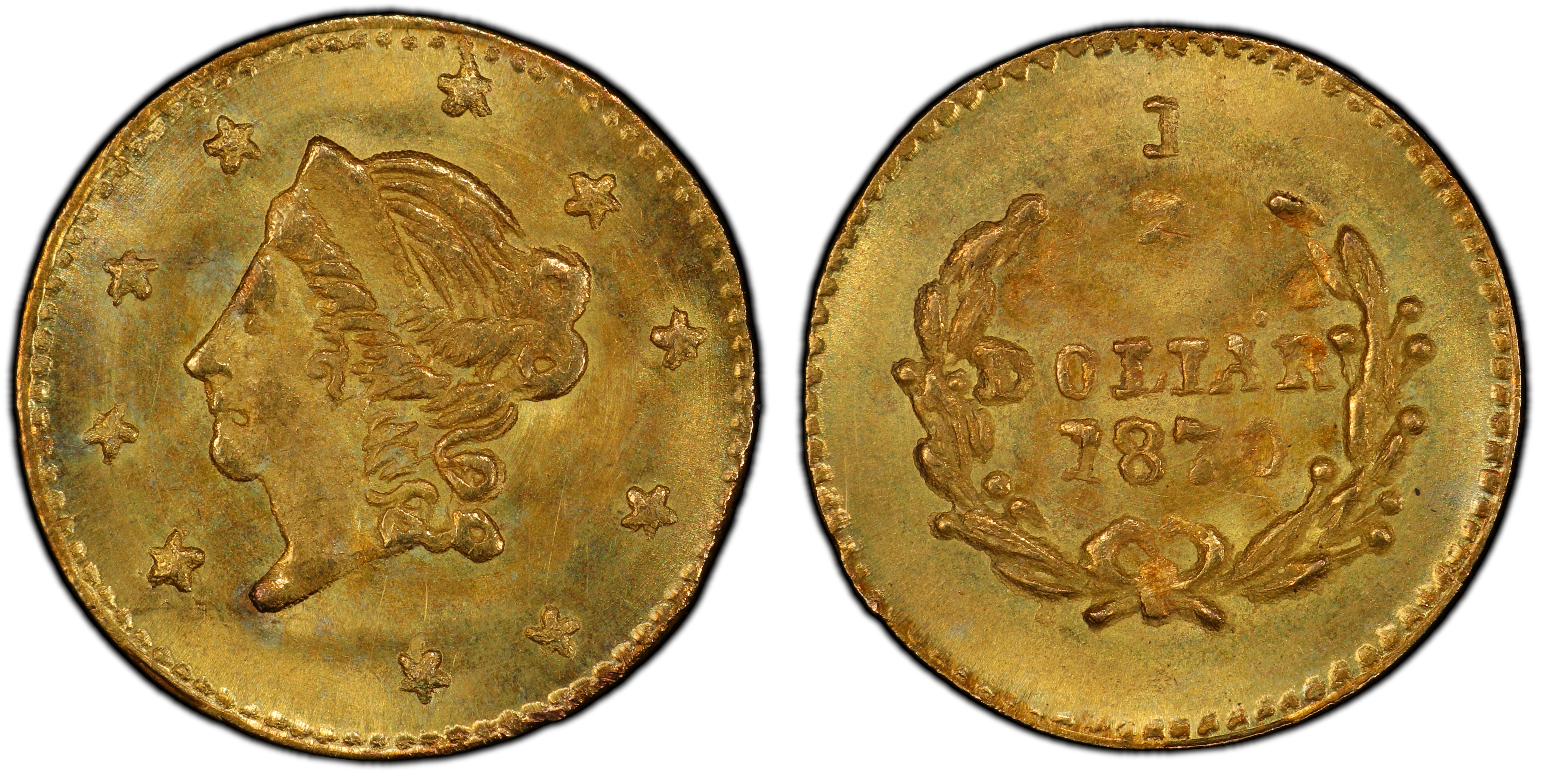
Obverse & Reverse
The 1870 Gold 50 Cents, cataloged as Breen-Gillio 1010, is a product of the second major phase of California Fractional Gold production (1859-1882). Unlike the 'Period One' issues which arose from a genuine and severe shortage of small change during the initial Gold Rush, these later 'Period Two' pieces were created in a different economic climate. By 1870, the San Francisco Mint was in full operation, and the acute need for privately minted circulating coinage had subsided. Instead, these small gold pieces were primarily manufactured by jewelers as souvenirs and novelty items for tourists and locals captivated by the romance of the Gold Rush. These 'jeweler's issues' were often lighter and sometimes of lower purity than their stated value would imply, a fact that was generally understood at the time. The firm of Frontier & Co., a successor to Frontier, Deviercy & Co., is believed to have produced this variety. These French jewelers were among the most prolific makers of such souvenir coins. The Coinage Act of 1864 had technically forbidden private coinage, but the law was not strictly enforced against these small, low-value pieces until 1883. This legal gray area allowed for a vibrant cottage industry. The BG-1010, with its distinctive 'Broad Head' and crude reverse lettering, is a quintessential example of this era's production. Hand-struck and often showing imperfections, these coins were not meant for the rigors of daily commerce but as tangible mementos of California's unique gold-based economy. Their continued existence provides a direct link to the post-Gold Rush era of San Francisco, a time of burgeoning tourism and a city keen on marketing its adventurous recent past.
Associated EventCalifornia Gold Rush Aftermath
Reason For MintingPrimarily created to be sold as souvenirs and keepsakes for a growing tourist trade in San Francisco, not to alleviate a currency shortage.
Minter HistoryFrontier & Co. was a San Francisco-based jewelry firm active from approximately 1864 to 1872. It was the successor to Frontier, Deviercy & Co. and was part of a network of French immigrant jewelers who were the primary producers of 'Period Two' California Fractional Gold. These minters utilized common die punches and stylistic elements, creating a large and complex series of souvenir coinage characterized by often crude but charming engraving.
Historical SignificanceThe BG-1010 represents a shift in the purpose of private gold coinage from a necessary medium of exchange to a commercial souvenir. It is an artifact of California's burgeoning tourism industry and the romantic mythology that grew around the Gold Rush, demonstrating how the state's identity was marketed and sold long after the initial frenzy had passed.
BG-1010
Denomination50 Cents
Minting Period1870
Assayer/MinterFrontier & Co.
Geographic OriginSan Francisco, California
Obverse DescriptionFeatures a large, crudely rendered Liberty Head facing left, often referred to as the 'Broad Head' variety. Thirteen stars encircle the portrait along the rim. The date 1870 is below the bust truncation.
Obverse Inscription1870
Reverse DescriptionA simple wreath surrounds the denomination. The fraction '1/2' is depicted with a crude '1' and '2' that lack a fraction bar between them. The denomination below the wreath is often crudely engraved and misspelled, a key diagnostic of the variety.
Reverse Inscription1/2 DOLLAR CAL.
CompositionGold
Stated Fineness Actual FinenessTypically around .900, though jeweler's issues of this period can vary.
Weight0.25 grams
Diameter10.00 mm
EdgePlain
Unknown
Survival Estimate75-125
Rarity ScaleR-5
Sought after for its distinctive 'Broad Head' design, the famous 'DOLIAR' misspelling diagnostic on some examples, and its status as a representative 'jeweler's issue' from the romantic post-Gold Rush era. It is a relatively attainable variety within a highly popular collecting field.
Key VarietiesThe primary variety is the regular business strike. A key diagnostic for some BG-1010 dies is the misspelling of 'DOLLAR' as 'DOLIAR'. Another diagnostic is a small, displaced berry appearing above the 'AR' of 'DOLLAR'. No known proof restrikes or patterns exist for this variety.
Authentication TipsAuthentic examples must have a denomination; fakes and modern replicas often feature a bear and lack the word 'DOLLAR' or 'CENTS'. The engraving on genuine pieces is characteristically crude but sharp, not mushy or tool-marked. Look for the specific reverse diagnostic of a crude '1' and '2' with no fraction bar. The weight and diameter should be close to the specified 0.25 grams and 10mm. Replicas are often gold-plated base metal and will have an incorrect weight and specific gravity.
Shopping ConsiderationsA premium quality example for its grade will exhibit a sharp strike, especially on Liberty's hair and the stars. Look for original, undisturbed luster, which often has a slightly prooflike or satiny texture. Avoid pieces that have been harshly cleaned, which will appear unnaturally bright and show hairlines. Check for evidence of being mounted in jewelry, such as rim damage or solder marks, which is common for these souvenir issues. The crude nature of the strike is expected, but exceptional sharpness on all design elements commands a significant premium.
A coin's grade is its condition, rated on a 1-70 scale. For rare coins, this is the most critical factor in determining value, as a tiny difference in preservation can mean a huge difference in price.
Relevant Grade TypesAll original 1870 BG-1010 pieces are business strikes intended for sale as souvenirs. They are found in Circulated grades (AG-3 to AU-58) and, more commonly, in Mint State (MS, 60-70) as many were saved as keepsakes. No proofs were struck during the original period of issue, and there are no known later-date collector restrikes.
Mint State CharacteristicsUncirculated examples often possess a vibrant, satiny luster, with some exhibiting prooflike fields from fresh, polished dies. The strike is a key determinant of quality; many are weakly struck on the highest points of Liberty's hair and the stars. A well-struck piece with full detail is rare and desirable. Small planchet flaws or adjustment marks are not uncommon and should be evaluated for their impact on eye appeal. Contact marks are common due to the softness of the gold.
Circulated Wear PatternsWear first appears on the high points of Liberty's hair, cheek, and the leaves of the wreath on the reverse. On lower grade examples, the stars will begin to lose their definition and the date and legends will become weak. The delicate nature of these tiny coins means they are susceptible to bending or significant rim damage if heavily circulated.
Key Factors For ValueThe primary value drivers for this variety are grade and surface preservation. An example with original, uncleaned surfaces and strong luster will always be prized. Strike quality is paramount; a sharply struck coin will command a much higher price than a weakly struck counterpart in the same grade. Eye appeal, including attractive original gold toning, is also a significant factor. Coins certified by top-tier services like PCGS or NGC, especially those with a CAC sticker, are considered the most desirable by the market.
PCGS Price Guide
| Grade | Price | Population |
|---|---|---|
| 50 | $200.00 | 2 |
| 50+ | $205.00 | N/A |
| 53 | $210.00 | 5 |
| 53+ | $215.00 | N/A |
| 55 | $220.00 | 1 |
| 55+ | $235.00 | N/A |
| 58 | $250.00 | 23 |
| 58+ | $260.00 | N/A |
| 60 | $275.00 | 3 |
| 61 | $300.00 | 9 |
| 62 | $325.00 | 35 |
| 62+ | $340.00 | N/A |
| 63 | $400.00 | 35 |
| 63+ | $450.00 | 1 |
| 64 | $550.00 | 44 |
| 64+ | $600.00 | N/A |
| 65 | $725.00 | 18 |
| 65+ | $800.00 | N/A |
| 66 | $1,050.00 | 3 |
| 66+ | $1,250.00 | N/A |
| 67 | $2,800.00 | 4 |