1868 G25C BG-746, PL (Regular Strike)
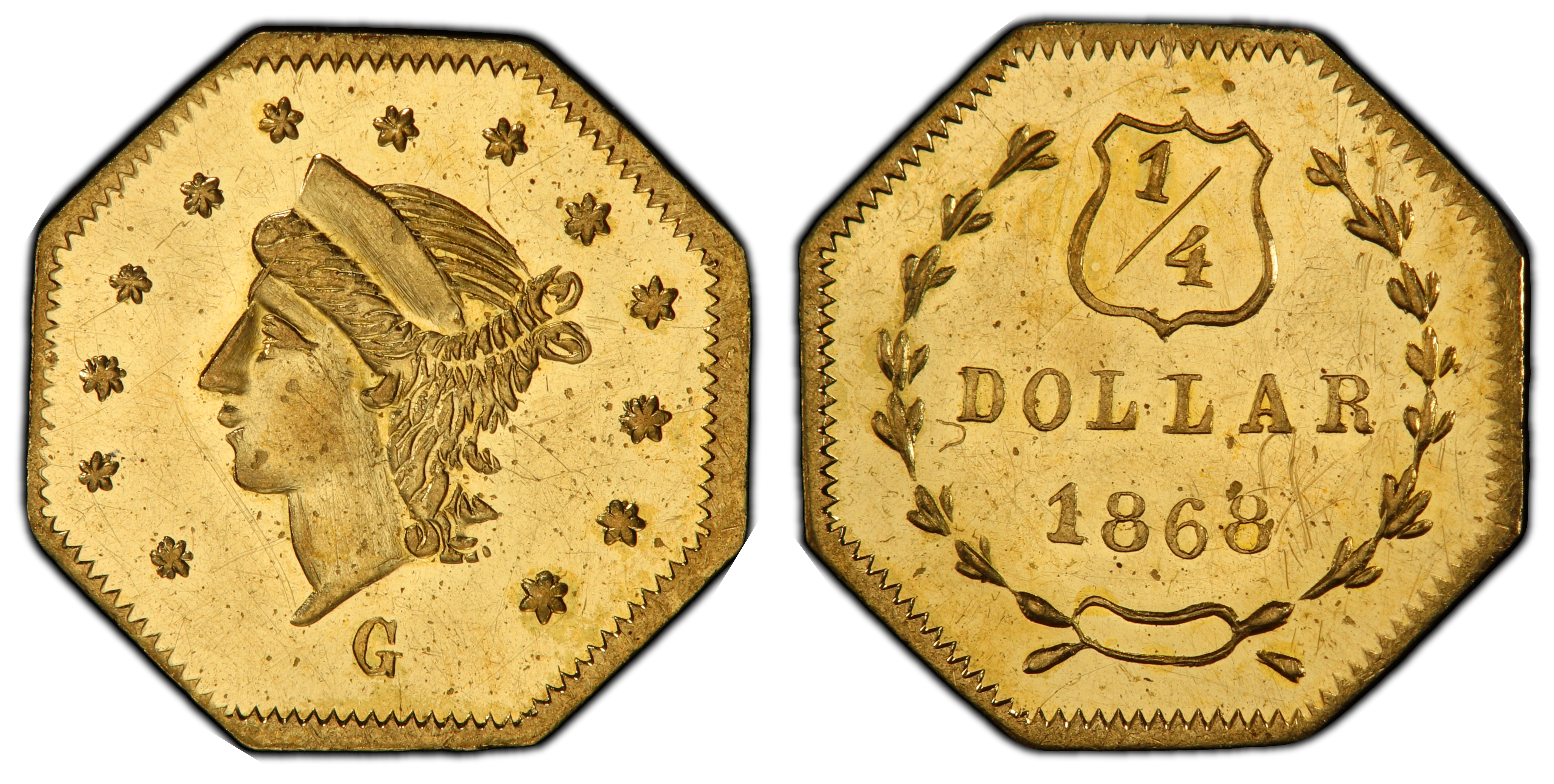
Obverse & Reverse
The 1868 BG-746 25 Cent piece is a quintessential example of 'Period Two' California Fractional Gold. By the late 1860s, the initial, desperate need for small circulating coinage that characterized the Gold Rush's peak in the early 1850s had largely subsided. The United States Mint in San Francisco was in full operation, and federal coinage had become more available. However, a thriving industry of private minting, primarily by local jewelers, persisted. These later issues, including the BG-746, transitioned from being utilitarian currency to serving as popular souvenirs and keepsakes. For easterners and tourists, these tiny gold pieces were a tangible, affordable link to the romance and adventure of the California Gold Rush. Despite the Coinage Act of 1864, which prohibited private coinage, enforcement was lax until the early 1880s, allowing this vibrant industry to continue. These 'jeweler's issues' were not intended to meet the intrinsic value of their stated denomination; their gold content was significantly less than twenty-five cents worth. Instead, their value was in their novelty and connection to the 'Golden State.' The BG-746, with its octagonal shape mimicking the iconic $50 slugs and its classic Liberty Head motif, was designed for maximum appeal. They were produced using hand-operated screw presses or even by hammer, resulting in inconsistent strike quality but lending each piece a unique, rustic charm that continues to attract collectors today. As a Period Two piece, its significance lies not in its role as emergency money, but as a cultural artifact representing the enduring legacy and commercialization of the Gold Rush.
Associated EventPost-Gold Rush California Commerce
Reason For MintingPrimarily produced as a novelty souvenir for the tourist trade and for export to the eastern U.S., capitalizing on the allure of the California Gold Rush.
Minter HistoryThe specific minter of BG-746 is not definitively known, a common trait for many Period Two fractional gold varieties. These pieces were typically the work of various San Francisco-based jewelers and artisans who created the dies and struck the coins. Their primary business was jewelry, and the production of these gold 'charms' was a profitable sideline. Unlike the assayers of the 1850s who prominently marked their work, these later producers often remained anonymous, making attribution of specific BG-varieties to a particular maker a significant challenge for numismatic researchers.
Historical SignificanceThis coin is historically significant not as a circulating medium of exchange, but as a tangible representation of the commercialization of the Gold Rush mythos. It marks the transition of private gold coinage from a response to economic necessity to a product of tourism and nostalgia, reflecting California's evolving identity in the post-pioneer era.
BG-746
Denomination25 Cents
Minting Period1868
Assayer/MinterUnknown San Francisco Jeweler
Geographic OriginSan Francisco, California
Obverse DescriptionA classic Liberty Head design, facing left, styled after the contemporary federal gold coinage of James B. Longacre. Thirteen stars encircle the bust, representing the original colonies. The date '1868' is positioned below the bust.
Obverse Inscription1868
Reverse DescriptionThe denomination '1/4' is enclosed within a wreath of two olive branches tied with a bow at the bottom. The legend 'CALIFORNIA GOLD' is inscribed around the periphery, outside the wreath.
Reverse Inscription1/4 CALIFORNIA GOLD
CompositionGold
Stated Fineness Actual FinenessVariable, but typically low fineness for Period Two issues, often around 10-14 karats (.417-.585 fine).
EdgePlain
Unknown
Survival Estimate30-50 coins estimated to exist in all grades. Population reports from PCGS and NGC show a combined total of around 50 graded examples, though this may include resubmissions.
Rarity ScaleR-6 (Very Rare: 31-75 known)
The BG-746 is highly sought after for its classic Liberty Head design on an octagonal planchet, its defined rarity, and its strong visual appeal, especially in prooflike (PL) examples which exhibit flashy, reflective surfaces. It represents a more attainable high-rarity piece within the popular and complex California Fractional Gold series.
Key VarietiesNo major varieties are noted for BG-746 during its period of issue. It is a 'Regular Strike' business issue, though many were struck with care on polished planchets to create a prooflike surface for souvenir sales. No later-date restrikes or official patterns are known to exist.
Authentication TipsAuthentic examples are die-struck, not cast. Look for sharp, albeit sometimes uneven, details. The date numerals on BG-746 are characteristically close-set. The surfaces, particularly on prooflike specimens, should show die polishing lines, not the uniform pitting of a cast counterfeit. The gold color is often a specific 'green-gold' hue due to the alloy. All Period Two pieces with denominations are considered authentic; post-1882 pieces without a stated denomination are tokens, and modern replicas are common but typically crude and often feature a bear on the reverse.
Shopping ConsiderationsA premium quality example of BG-746 is defined by the sharpness of the strike, the quality of its surfaces, and its eye appeal. Look for a well-centered strike with full details on Liberty's hair and the leaves in the wreath. The most desirable specimens are designated 'PL' (Prooflike) or 'DPL' (Deep Prooflike) and exhibit watery, reflective fields. Avoid examples that have been cleaned, which strips the original skin and imparts a dull or hairlined look. Also, inspect carefully for evidence of having been mounted in jewelry, such as rim damage, solder, or tooling marks. A CAC sticker on a certified example provides an extra layer of assurance regarding quality for the assigned grade.
A coin's grade is its condition, rated on a 1-70 scale. For rare coins, this is the most critical factor in determining value, as a tiny difference in preservation can mean a huge difference in price.
Relevant Grade TypesOriginal period issues of BG-746 were business strikes, often carefully made on polished planchets for the souvenir market. They are found in Circulated (1-58) grades, though this is uncommon, and are primarily collected in Mint State (MS, 60-70) grades. No true Proofs were struck during the original period. The 'PL' (Prooflike) designation is a crucial value-added descriptor for Mint State coins with reflective surfaces, and is particularly relevant and sought-after for this variety.
Mint State CharacteristicsUncirculated examples of BG-746 are characterized by their luster, which can range from satiny to deeply prooflike. Strike quality varies; a sharp strike will show clear definition in Liberty's coronet and the individual leaves of the reverse wreath. Weaker strikes are common and will show softness in these areas. Due to the hand-fed minting process, planchet quality can be inconsistent, and small, as-made flaws or flecks are sometimes present. The best examples have clean, mark-free fields with a strong contrast between the frosted devices and reflective surfaces.
Circulated Wear PatternsOn a circulated example, wear will first appear on the highest points of the design. For the obverse, this includes Liberty's cheek, the hair above the ear, and the coronet. On the reverse, the high points of the wreath's leaves and the bow will show flattening and loss of detail first. In lower grades (VF and below), the stars on the obverse and the letters in the legends will begin to merge with the fields.
Key Factors For ValueFor the BG-746, the single most important factor for value is surface quality, specifically a Prooflike designation. A certified MS-63 PL will trade for significantly more than a standard MS-63. Secondly, a sharp, well-centered strike commands a premium. Eye appeal is also critical; coins with original, attractive green-gold or reddish-gold toning are prized over cleaned or lackluster specimens. A CAC sticker is highly desirable for this issue, as it confirms the quality and originality of the coin's surfaces and strike for the grade.
PCGS Price Guide
| Grade | Price | Population |
|---|---|---|
| 62 | $500.00 | 1 |
| 65 | N/A | N/A |