1874/3 G50C BG-943, PL (Regular Strike)
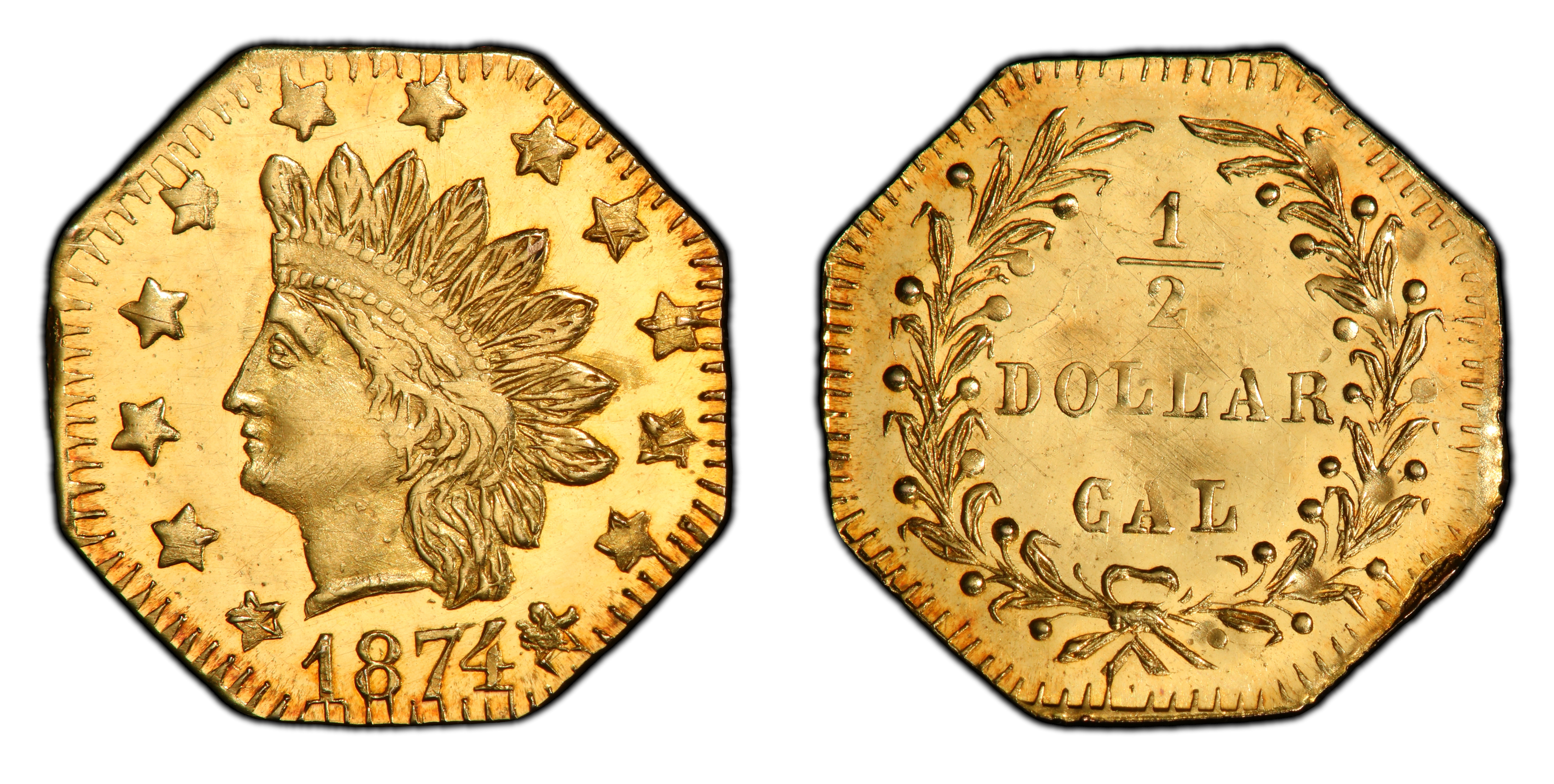
Obverse & Reverse
The 1874/3 50 Cents, cataloged as Breen-Gillio 943, is a quintessential example of a 'Period Two' California Fractional Gold piece. By the 1870s, the initial, urgent need for small circulating currency that drove the creation of the first fractional gold in 1852 had largely subsided. The establishment and efficiency of the San Francisco Mint provided ample federal coinage for daily commerce. However, the allure of California and the Gold Rush had transformed into a powerful national mythos, creating a burgeoning market for souvenirs and keepsakes. San Francisco jewelers, who had been the primary producers of the earlier circulating issues, astutely pivoted to meet this demand. These 'jeweler's issues' were not primarily intended to function as money, but rather as mementos for tourists and novelty items to be sent back East. The Private Coinage Act of 1864 had made the issuance of private money illegal, but the law was not aggressively enforced against these small-denomination pieces until 1883. To circumvent the law and add a veneer of historical legitimacy, producers often employed backdating or, as seen here, used dies over longer periods, sometimes creating overdates like the 1874/3. These coins were typically underweight for their stated value, their worth being in their novelty and material rather than their function as currency. The production process remained relatively crude, often involving a hammer-striking method, which resulted in significant variations in strike quality. The BG-943, with its distinctive Indian Head motif—a design popularized by federal coinage but reinterpreted by local engravers—and octagonal shape, catered perfectly to the romantic, 'Old West' image that captivated the public imagination. Its existence is a testament to the transition of fractional gold from a practical economic necessity to a commercialized symbol of the California Gold Rush.
Associated EventCalifornia Gold Rush Aftermath & Tourism Boom
Reason For MintingPrimarily created to serve the growing market for souvenirs and jewelry charms for tourists and collectors, rather than to alleviate a shortage of circulating coinage.
Minter HistoryWhile not definitively signed, the style and period of issuance are consistent with the work of Robert B. Gray & Co. of San Francisco. Gray was a prolific producer of fractional gold during this era, having taken over the business of Antoine Nouizillet around 1859-60. His firm produced a wide variety of 'jeweler's issues' marked with a 'G' or left unsigned. In 1871, Gray sold his interests to the California Jewelry Company, which may have continued using existing dies. The dies for BG-943 were likely created and used by one of these entities, representing the heart of San Francisco's souvenir gold manufacturing trade.
Historical SignificanceThis coin is historically significant not as a circulating medium, but as a tangible artifact of the commercialization of the Gold Rush legend. It represents a pivot in private minting from necessity-driven coinage to tourist-driven collectibles, illustrating a key chapter in the economic and cultural history of post-Gold Rush California.
N/A
Denomination50 Cents
Minting Period1874
Assayer/MinterRobert B. Gray & Co. or Successor
Geographic OriginSan Francisco, California
Obverse DescriptionA stylized bust of an Indian princess facing left, wearing a feathered headdress. The portrait is surrounded by 13 five-pointed stars. The date '1874' is below the bust, with a clear '4' punched over a '3'. The denticles along the octagonal border are typically sharp on well-struck examples.
Obverse Inscription1874
Reverse DescriptionThe denomination '1/2' is rendered in large, open numerals at the center, enclosed within a wreath. The wreath is composed of two branches tied with a bow at the bottom. The legend 'CALIFORNIA GOLD' encircles the wreath along the upper border. A distinctive feature for this variety is the specific arrangement of leaves and berries in the wreath.
Reverse Inscription1/2 CALIFORNIA GOLD
CompositionGold
Stated Fineness Actual FinenessTypically varied from 14 to 22 karats (.583 to .917 fine), often being of a lower fineness than official U.S. coinage.
Weight0.25 grams
Diameter10.00 mm
EdgePlain
Unknown, but relatively small.
Survival Estimate75-125
Rarity ScaleR-4+
The 1874/3 BG-943 is highly sought after due to its status as a clear overdate variety, its attractive Indian Head design, and its octagonal shape. The 'PL' (Prooflike) designation adds another layer of appeal, indicating an early strike from fresh, polished dies that resulted in mirrored fields, a finish rarely encountered on these utilitarian issues.
Key VarietiesThe primary variety is the 1874/3 overdate itself. No major sub-varieties from the original minting period are widely recognized. No known official restrikes or patterns exist. The key collector distinction is between regular business strikes and those with Prooflike (PL) or Deep Mirror Prooflike (DMPL) surfaces, which are exceptionally rare and command significant premiums.
Authentication TipsAuthentic pieces should have sharp, if sometimes unevenly impressed, details. The '4' over '3' should be clearly visible under magnification. The weight and diameter should be close to the known standards. Counterfeits are common; many are cast fakes that will have a soapy feel and porous surfaces. Others are modern strikes made of brass or low-karat gold that lack the denomination '1/2' and may feature a bear on the reverse—a design element never used on genuine Period Two denominated fractionals. Compare the style of the Indian Head and the wreath to known genuine examples, as fakes often have crude or incorrect details.
Shopping ConsiderationsFor a premium quality example, seek a coin with a sharp, well-centered strike, especially on the highest points of the Indian's cheek and the feathers, as well as the numerals of the date and denomination. For a designated 'PL' piece, the mirrored fields should be readily apparent and free from excessive hairlines or scuff marks that would disrupt the reflectivity. Original, undisturbed luster is paramount. These coins are often found cleaned or whizzed to simulate brilliance; look for the cartwheel effect of true mint luster. Avoid examples that have been holed or mounted for jewelry, as was common, unless acquiring a piece for a type collection at a lower price point. The overdate should be bold and unambiguous.
A coin's grade is its condition, rated on a 1-70 scale. For rare coins, this is the most critical factor in determining value, as a tiny difference in preservation can mean a huge difference in price.
Relevant Grade TypesOriginal period issues were business strikes intended for sale as souvenirs, not circulation. They are found in both Circulated (1-58) and, more commonly, Mint State (MS, 60-70) grades. No true Proofs were struck during the original period. However, special care in die preparation (polishing) resulted in a small number of Prooflike (PL) specimens. These are business strikes with mirrored surfaces, graded with an MS designation plus a 'PL' qualifier, and are considered distinct and far rarer than standard Mint State examples.
Mint State CharacteristicsUncirculated examples of BG-943 often exhibit a soft, satiny luster. The strike can be inconsistent due to the hammer-striking process, with some areas being sharper than others. The central devices (Indian's face, '1/2') are often better struck than the peripheral stars or legends. Small planchet flaws or adjustment marks are not uncommon. Prooflike examples are rare and are characterized by distinctly reflective, mirror-like fields, which will contrast with frosted devices if the strike is sharp enough.
Circulated Wear PatternsAlthough not intended for heavy circulation, some pieces did see handling. Wear first appears on the high points of the design: the cheek and brow of the Indian princess, the feathers in the headdress, and the numerals of the '1/2' on the reverse. On lower-grade examples, the stars and the finer details of the wreath will begin to merge with the fields.
Key Factors For ValueFor the BG-943 variety, the primary value drivers are: 1) Grade and surface preservation—a high-grade Mint State coin with minimal marks is prized. 2) The Prooflike designation—a confirmed PL or DMPL example carries a significant premium over a standard MS coin. 3) Strike quality—coins with a full, sharp strike on both sides are much more desirable than weakly struck examples. 4) Eye appeal—pieces with attractive, original color and luster command higher prices. A CAC sticker will add a premium, as it confirms the quality and originality for the assigned grade.
PCGS Price Guide
| Grade | Price | Population |
|---|---|---|
| 62 | N/A | 1 |
| 63 | $850.00 | 1 |
| 63+ | $925.00 | N/A |
| 64 | $1,025.00 | 3 |
| 64+ | $1,100.00 | N/A |
| 65 | $1,250.00 | 1 |
| 65+ | $1,750.00 | N/A |
| 66 | $2,500.00 | 1 |