1874 G25C BG-888 (Regular Strike)
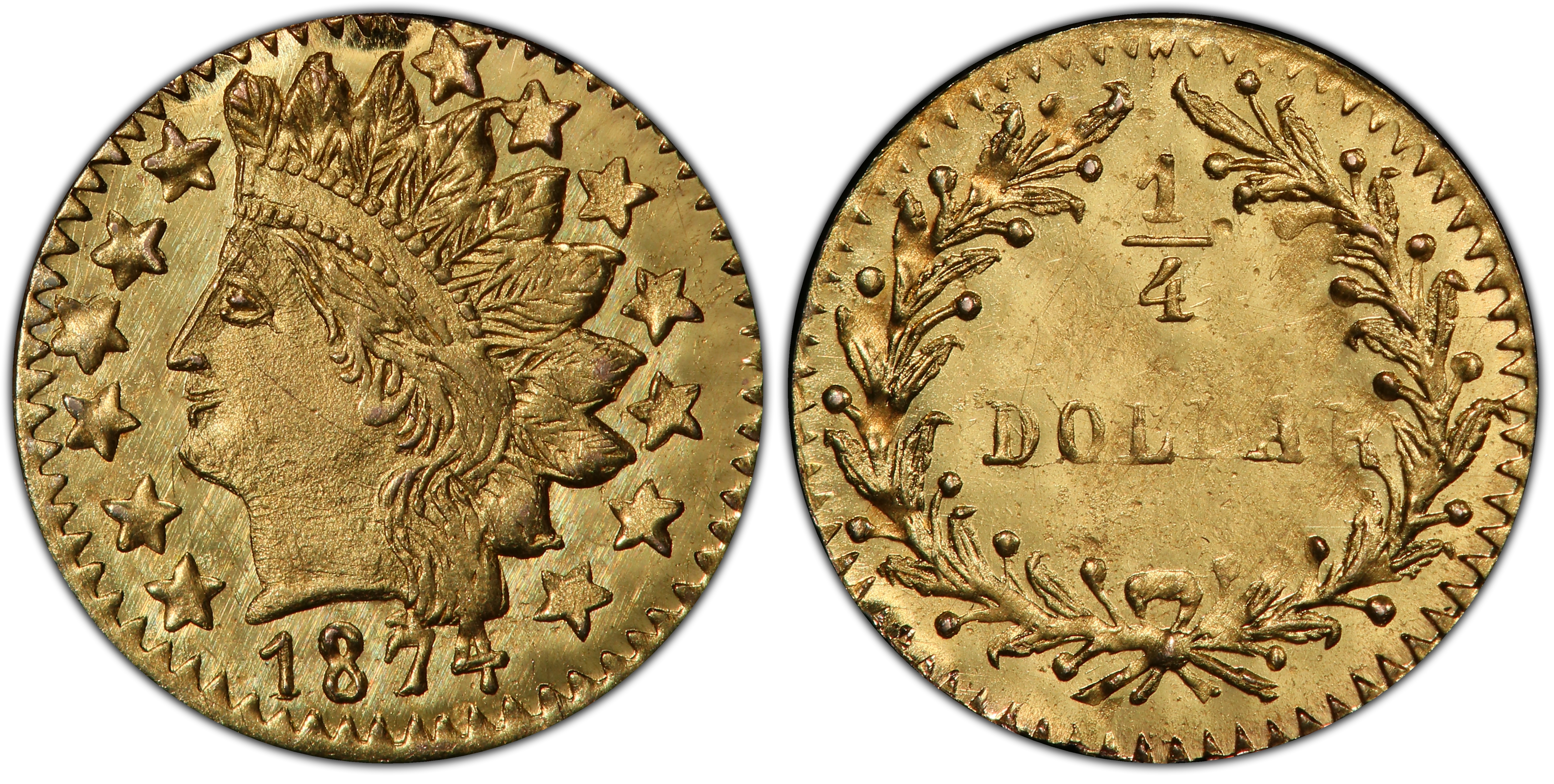
Obverse & Reverse
The 1874 G25C BG-888 is a product of the 'Period Two' (1856-1882) of California Fractional Gold production. This era, long after the initial chaos of the Gold Rush had subsided, saw a different need for small denomination coins. The official United States coinage system was well-established on the West Coast, but a lingering shortage of small change persisted, particularly for transactions under a dollar. Unlike the earlier Period One pieces, which were a direct response to a lack of any functional currency, these later tokens were primarily created by local jewelers as souvenirs and curiosities, capitalizing on the romanticism of the Gold Rush. They were, however, made of genuine gold and did circulate to a limited extent, often accepted in commerce at a value close to their intrinsic worth. The Act of 1864 had made private coinage illegal, but these pieces cleverly omitted the word 'DOLLAR' or the abbreviation 'DOL.' to circumvent the law, instead using 'DOLL,' 'D,' or simply the denomination like '1/4' and a bear symbol. The BG-888 variety, struck in 1874, is a classic example of this type. It features a standard 'Liberty Head' design, imitative of federal coinage but distinct in its execution. The manufacturer is not definitively known, but numismatic scholarship, particularly the work of Breen and Gillio, suggests many Period Two dies were cut by San Francisco die-sinkers like Albert Kuner and utilized by various jewelers, with Robert B. Gray & Co. being a prominent name associated with many of these issues. These small gold pieces served as a tangible link to California's golden identity, functioning as keepsakes for tourists and locals alike, while occasionally filling a minor role in the local economy. Their production ceased after 1882, making them a fascinating and closed chapter in American numismatic history.
Associated EventPost-Gold Rush Economic Period in California
Reason For MintingPrimarily created as souvenirs and novelty items, while also serving to alleviate a minor, lingering shortage of small change in local California commerce.
Minter HistoryThe specific minter for BG-888 is unconfirmed. However, the dies and planchets used for these 'Period Two' fractionals were often produced by specialized firms in San Francisco and sold to various jewelers. Robert B. Gray & Co. was a prominent jeweler and one of the most prolific distributors of these souvenir gold pieces during this period. Other known die-sinkers of the era include Albert Kuner and Nouzillet. These craftsmen were not minters in the traditional sense but artisans who supplied the tools for others to strike these popular tokens.
Historical SignificanceThe BG-888 represents a mature phase of private gold issuance in California, shifting from a currency of necessity to a commercial and souvenir product. It highlights a legal gray area in U.S. coinage law and serves as a physical artifact of California's enduring cultural identity tied to the Gold Rush, long after the initial fever had passed. These fractionals are a distinct and collectible field of U.S. exonumia.
N/A
Denomination25 Cents (Quarter Dollar)
Minting Period1874
Assayer/MinterUnknown private jeweler, possibly Robert B. Gray & Co.
Geographic OriginSan Francisco, California
Obverse DescriptionA beaded border encloses a Liberty Head facing left, with 13 stars surrounding the portrait. The date 1874 is below the truncation of the neck. This is referred to as Gillio's Obverse 14.
Obverse Inscription13 stars surrounding portrait, with 1874 below.
Reverse DescriptionA simple wreath tied with a ribbon at the bottom. Inside the wreath is the fraction '1/4' with a bear emblem below it. This is Gillio's Reverse P.
Reverse Inscription1/4
CompositionGold
Stated Fineness Actual FinenessVaries by specimen, typically between .500 and .750 fine gold, alloyed with silver and copper.
Weight0.25 grams
Diameter9.40 mm
EdgePlain
5,000-10,000
Survival Estimate500-750
Rarity ScaleR-4
The BG-888 is popular among collectors for its classic 'Liberty Head' design, the charming bear motif on the reverse, and its status as a relatively affordable entry point into the complex world of California Fractional Gold. Its specific date and known Breen-Gillio catalog number make it a well-defined and collectible variety.
Key VarietiesThe primary variety is the regular business strike. There are no known original proof strikings or major die varieties for the BG-888 marriage. Collectors should be aware of contemporary counterfeits and modern replicas, which are common for all California Fractional Gold. Restrikes are not a significant issue for this specific 'Period Two' variety, unlike some earlier issues.
Authentication TipsAuthentic BG-888 specimens often exhibit a somewhat soft or 'mushy' strike, particularly on the stars and the details of the wreath. The lettering and numerals should match known die characteristics for Gillio's Obverse 14 and Reverse P. Look for a natural, aged-gold patina; overly bright, brassy-looking pieces are suspect. The weight should be very close to the standard 0.25 grams. Many fakes are incorrect in weight, diameter, or have a soapy, cast-like appearance rather than the sharp details of a struck piece.
Shopping ConsiderationsA premium quality BG-888 will exhibit a sharper-than-average strike, particularly on Liberty's hair details and the bear on the reverse. Seek out examples with smooth, problem-free surfaces that retain some original mint luster, which often appears as a soft, satiny sheen. Avoid pieces that have been harshly cleaned, which imparts a bright but lifeless look and often leaves behind fine hairline scratches. Also, check for evidence of jewelry mounting, such as rim damage or solder marks, which drastically reduces the coin's numismatic value. A coin certified by PCGS or NGC is highly recommended for authenticity and grade verification.
A coin's grade is its condition, rated on a 1-70 scale. For rare coins, this is the most critical factor in determining value, as a tiny difference in preservation can mean a huge difference in price.
Relevant Grade TypesOriginal issues of BG-888 were business strikes intended for souvenir sales and limited circulation, so they are found in Circulated (AU-58 and below) and Mint State (MS, 60-70) grades. No original Proofs (PR/PF) were struck for this variety. Any piece described as a Proof is either a modern creation or a misattribution of a high-quality Mint State specimen with reflective surfaces (Prooflike or PL).
Mint State CharacteristicsUncirculated examples of BG-888 are characterized by a soft, satiny luster. The strike is often somewhat weak, with the highest points of the design (stars, hair curls, wreath leaves) showing some flatness even on a pristine coin. Planchet quality can be inconsistent, and small, as-made striations or marks are not uncommon. A truly choice Mint State coin will have minimal contact marks, a strong strike for the issue, and undisturbed original luster.
Circulated Wear PatternsWear first appears on the highest points of the design. On the obverse, check for flatness on Liberty's hair above the eye and on her cheekbone. On the reverse, the high points of the wreath leaves and the bear emblem will show the first signs of friction and metal loss. In lower grades (VF and below), the finer details of the hair and wreath will merge, and the legends may become weak.
Key Factors For ValueFor the BG-888, the primary value drivers are surface preservation and strike quality. An example with clean, original surfaces free of harsh cleaning or damage will always command a premium. A sharp strike, bringing out the details of the bear and Liberty's portrait, is highly desirable and uncommon. Eye appeal, including attractive original toning (often a deep reddish-gold color), adds significant value. A CAC sticker on a certified coin indicates premium quality for the grade and will result in a higher market price.
PCGS Price Guide
| Grade | Price | Population |
|---|---|---|
| 61 | $375.00 | N/A |
| 62 | $485.00 | 5 |
| 62+ | $525.00 | N/A |
| 63 | $700.00 | 5 |
| 63+ | $775.00 | N/A |
| 64 | $850.00 | 19 |
| 64+ | $975.00 | 1 |
| 65 | $1,100.00 | 11 |
| 65+ | $1,250.00 | N/A |
| 66 | $1,500.00 | 4 |