1871 G50C BG-923 (Regular Strike)
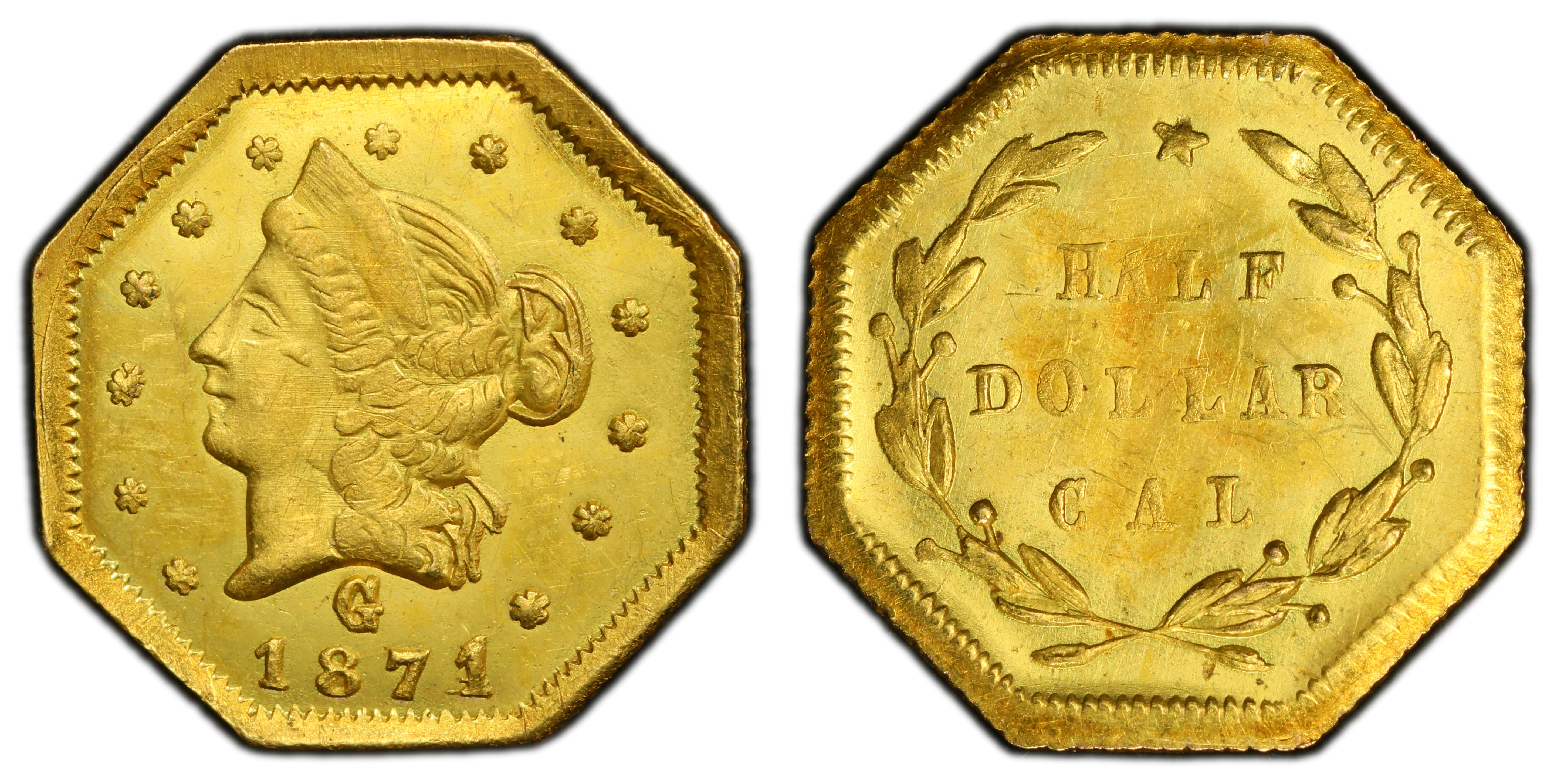
Obverse & Reverse
The 1871 Octagonal 50 Cents, cataloged as BG-923, is a quintessential example of a 'Period Two' California Fractional Gold piece. These later issues (1858-1882) are numismatically distinct from their 'Period One' predecessors, which were struck out of intense necessity to alleviate a severe shortage of small change during the initial frenzy of the Gold Rush. By the 1870s, the United States Mint in San Francisco was in full operation and the acute need for circulating private coinage had subsided. Instead, pieces like the BG-923 were primarily produced by jewelers as souvenirs and keepsakes. They capitalized on the romanticism of the Gold Rush, offering tangible, albeit small, pieces of gold as mementos for tourists, merchants, and those back East fascinated by the tales of California. Robert B. Gray & Co., a prominent San Francisco jeweler, was a significant producer of these fractional items from 1858 until this variety's year of issue, 1871. The production method for these tiny coins was rudimentary, typically employing a hammer-striking process. A planchet was placed on a lower die (anvil), and the upper die was held in place and struck with a sledgehammer. This manual method accounts for the frequent weak or uneven strikes, off-center designs, and overall crude appearance of many surviving specimens. Despite the Coinage Act of 1864, which outlawed private coinage, enforcement was lax for decades, allowing jewelers like Gray to continue production. These pieces contained gold, but their intrinsic value was intentionally less than their face value, classifying them as tokens rather than true coins. Their existence highlights a unique transitional period in California's economy, moving from a frontier society dependent on private issues to a more integrated monetary system. The eventual crackdown by the Secret Service in the early 1880s brought an end to this fascinating chapter of American numismatics, rendering the surviving pieces as cherished artifacts of a bygone era.
Associated EventPost-California Gold Rush economic development
Reason For MintingPrimarily created to be sold as souvenirs and jewelry, capitalizing on the romanticism of the California Gold Rush.
Minter HistoryRobert B. Gray & Co. was a San Francisco-based jewelry firm that became a prolific manufacturer of California fractional gold pieces during what is known as 'Period Two' (1858-1882). The firm began its numismatic production around 1858. In late 1858 or 1859, Gray acquired the business of another fractional gold producer, Antoine Louis Nouzillet, including his dies and hubs. Gray's own issues are identifiable by a 'G' mintmark, though not all his pieces bore it. The BG-923, issued in 1871, represents one of the final years of the company's fractional gold production.
Historical SignificanceThe BG-923 is significant not as a circulating coin, but as a historical artifact representing the commercialization of the Gold Rush legacy. It demonstrates the continued demand for gold souvenirs long after the initial rush had ended and exemplifies the privately-produced tokens that operated in a legal gray area for nearly two decades after federal laws prohibited them.
N/A (Breen-Gillio BG-923)
Denomination50 Cents
Minting Period1871
Assayer/MinterRobert B. Gray & Co.
Geographic OriginSan Francisco, California
Obverse DescriptionA Liberty Head, facing left, with hair tied in a bun. The portrait is encircled by eleven stars.
Obverse Inscription[No Inscription]
Reverse DescriptionThe denomination '50 CENTS' and the date '1871' are contained within a wreath composed of two branches tied with a bow at the bottom.
Reverse Inscription50 CENTS 1871
CompositionGold
Stated Fineness Actual FinenessVariable, typically ranging from 14 to 22 karats. The intrinsic gold value was intentionally less than the 50-cent face value.
Weight0.75 grams
Diameter11.20 mm
EdgePlain
Unknown
Survival Estimate46-60 pieces known
Rarity ScaleR-5
This variety appeals to collectors of California fractional gold due to its defined history with a known jeweler, its octagonal shape, and its relative scarcity. As a 'Period Two' issue, it is more affordable than the earlier circulating types, making it an accessible entry point into this historic and charming series.
Key VarietiesThere are no major die varieties of BG-923 known from the original period of issue. However, collectors should distinguish between regular business strikes and those with Proof-Like (PL) surfaces. While no true Proofs were struck, examples with deeply mirrored fields and frosted devices command a significant premium. No special collector restrikes of the BG-923 are known to exist.
Authentication TipsGenuine BG-923 pieces are very thin and lightweight. Counterfeits are often thicker, heavier, and feel more substantial. The strike on genuine examples is frequently soft or uneven, particularly on the high points of Liberty's hair and the center of the wreath; counterfeits may appear unusually sharp and well-struck. A key diagnostic for all genuine fractional gold is the presence of a denomination (e.g., 'CENTS' or 'DOLLAR'). Many common replicas and fantasy pieces lack a denomination, often featuring a bear on the reverse, which is a definitive sign of a non-authentic piece.
Shopping ConsiderationsWhen acquiring an 1871 BG-923, look for a premium quality example with a well-centered, reasonably sharp strike for the issue. Pay close attention to the surfaces; original, lustrous 'skin' is highly desirable. Many of these pieces have been cleaned or used in jewelry, so evidence of polishing, solder, or rim damage should be carefully checked. An example with attractive, original reddish-gold toning will command a premium over a harshly cleaned or dull specimen. Given the prevalence of counterfeits, purchasing examples certified by a major third-party grading service (PCGS or NGC) is strongly recommended.
A coin's grade is its condition, rated on a 1-70 scale. For rare coins, this is the most critical factor in determining value, as a tiny difference in preservation can mean a huge difference in price.
Relevant Grade TypesAll original 1871 BG-923 coins were struck as business strikes, intended for sale as souvenirs. They are found in Circulated grades (AU-58 and below, though heavy circulation is uncommon) and Mint State grades (MS, 60-70). No true Proofs were struck during the original period of issue. However, some examples were struck on highly polished planchets, resulting in a Proof-Like (PL) designation from grading services, which are highly sought after and considered a separate category by collectors.
Mint State CharacteristicsIn uncirculated grades, the BG-923 typically exhibits a soft, satiny luster. The strike is a key differentiator; many examples are softly struck on the highest points of Liberty's hair and the central part of the wreath. A coin with an unusually sharp strike is rare and commands a strong premium. Due to the softness of the gold and rudimentary handling, small, scattered contact marks are common and expected, even on high-grade specimens. Planchet quality can also vary, with minor striations or fissures sometimes visible from the manufacturing process.
Circulated Wear PatternsWear first appears on the high points of the design. On the obverse, check for flatness on the hair above Liberty's eye and on her cheekbone. On the reverse, the leaves and bow of the wreath will show the first signs of friction. In lower grades (VF and below), the fine details of the hair and wreath will merge, and the sharpness of the stars and lettering will diminish.
Key Factors For ValueThe primary drivers of value for this coin are grade and surface quality. An example with minimal contact marks and vibrant original luster will be worth significantly more than a marked or cleaned coin of the same grade. Strike quality is paramount; a sharply struck coin can be worth double a softly struck one. Eye appeal, characterized by attractive original toning and clean surfaces, is a crucial, though subjective, factor. Finally, a CAC sticker, indicating premium quality for the grade, adds a substantial premium for this and other California Fractional Gold issues.
PCGS Price Guide
| Grade | Price | Population |
|---|---|---|
| 40 | $190.00 | 1 |
| 45 | $200.00 | N/A |
| 45+ | $205.00 | N/A |
| 50 | $210.00 | 2 |
| 50+ | $215.00 | N/A |
| 53 | $220.00 | N/A |
| 53+ | $222.00 | N/A |
| 55 | $225.00 | 2 |
| 55+ | $230.00 | N/A |
| 58 | $250.00 | 7 |
| 58+ | $250.00 | N/A |
| 60 | $315.00 | 1 |
| 61 | $350.00 | 10 |
| 62 | $450.00 | 12 |
| 62+ | $525.00 | N/A |
| 63 | $600.00 | 12 |
| 63+ | $675.00 | N/A |
| 64 | $850.00 | 3 |
| 65 | N/A | N/A |