1874 G50C BG-959 (Regular Strike)
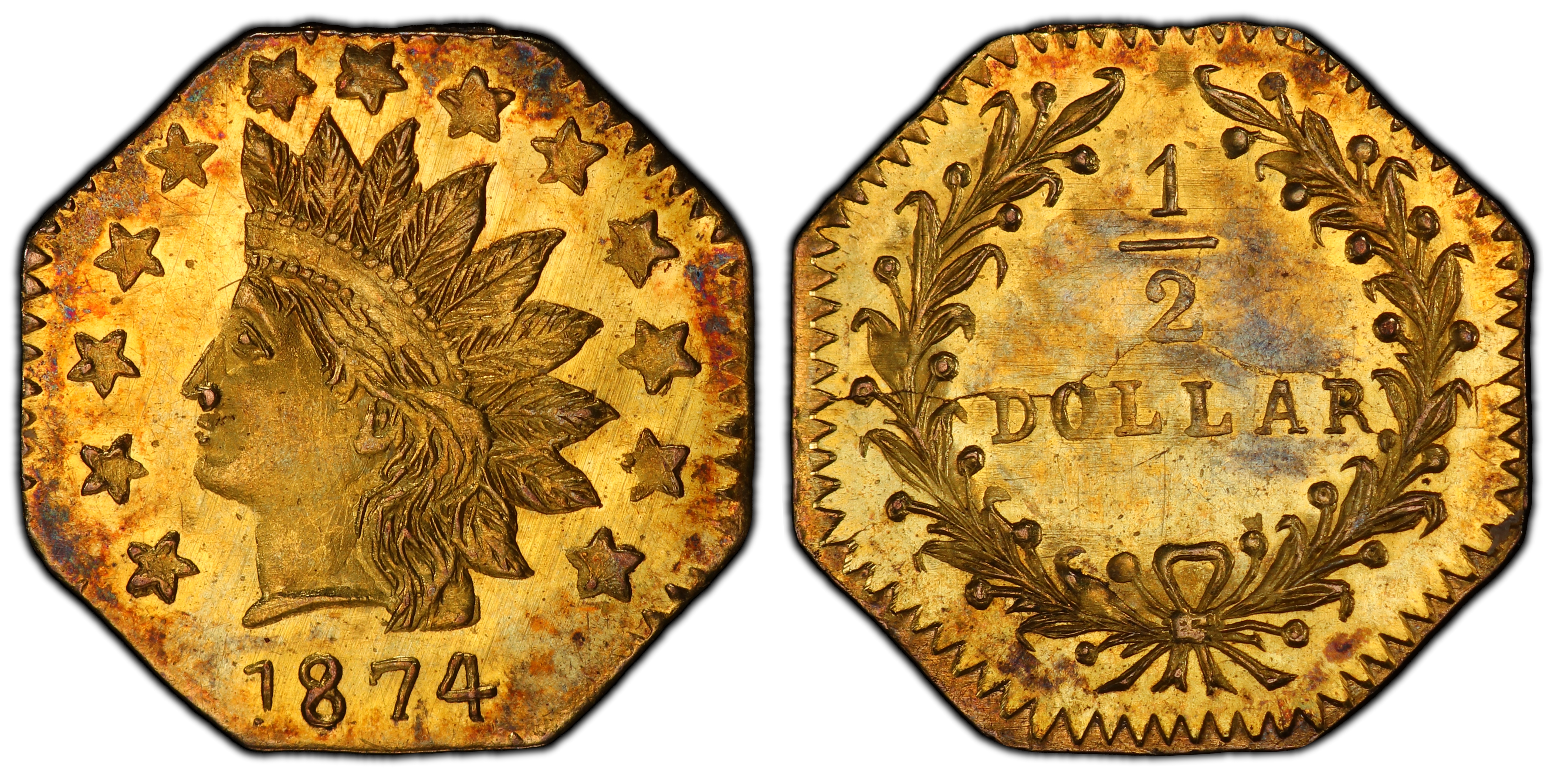
Obverse & Reverse
The 1874 50 Cents, cataloged as Breen-Gillio 959, is a product of the second period of California Fractional Gold production (1859-1882). This era, often termed the 'jeweler's period,' saw a shift from the earlier, heavier issues that were genuinely intended to alleviate a severe shortage of small change during the initial Gold Rush. By the 1870s, the monetary crisis had largely abated with the establishment of a U.S. Branch Mint in San Francisco. However, the demand for tiny gold novelties persisted, driven by local pride, the tourist trade, and their utility as convenient, small-value gifts. These 'Period Two' pieces were typically underweight for their stated value and were produced by various jewelers and metalworkers, primarily in San Francisco. The Coinage Act of 1864 had officially prohibited private coinage, but the law was not strictly enforced in the West until the early 1880s, allowing for the continued production of these denominated tokens. The BG-959, with its Indian Head design, was a popular motif of the era, reflecting a romanticized American frontier theme. These pieces were often struck by hand, using a hammer to impress the design from dies onto a small gold planchet, which accounts for the frequent variability in strike quality. While they were not intended to be a primary circulating medium in the same way as federal coinage, they filled a niche for very small transactions and were widely accepted locally. Their existence is a testament to the lingering economic independence and unique commercial environment of post-Gold Rush California. The eventual federal crackdown in the early 1880s brought an end to the legal production of these fascinating and historic pieces, cementing their status as a unique chapter in American numismatics.
Associated EventCalifornia Gold Rush and Post-Rush Era
Reason For MintingPrimarily created to serve as novelty items, souvenirs, and for small-scale local commerce during a period when production of private coinage was still tolerated in California.
Minter HistoryThe specific minter for BG-959 is unknown, which is common for many Period Two California Fractional Gold pieces. Production is attributed to the many jewelers and private minters operating in San Francisco during the 1870s. These artisans, many of French descent, capitalized on the continued demand for small gold pieces for both commercial and souvenir purposes, often operating semi-anonymously to create a wide variety of designs.
Historical SignificanceRepresents the later phase of private gold coinage in California, shifting from a necessary currency substitute to a commercial product for souvenirs and small gifts. It is a tangible link to the unique economic environment of 19th-century California and the lax enforcement of federal coining laws on the frontier.
N/A
Denomination50 Cents
Minting Period1874
Assayer/MinterPrivate, Unattributed (likely a San Francisco jeweler)
Geographic OriginSan Francisco, California
Obverse DescriptionAn Indian Head motif, facing left. The portrait is typically stylized, surrounded by thirteen stars representing the original colonies.
Obverse Inscription Reverse DescriptionThe denomination '1/2' is enclosed within a wreath of leaves. The date '1874' is positioned below the wreath. Some references note 'CALIFORNIA GOLD' around the periphery, but this can vary by specific die state.
Reverse Inscription1/2
CompositionGold
Stated Fineness Actual Fineness Weight0.25 grams
Diameter10.50 mm
EdgePlain
Unknown
Survival EstimateFewer than 10 known
Rarity ScaleR-7 (4-12 known).
The BG-959 is highly sought after due to its extreme rarity (R-7) and the general popularity of the California Fractional Gold series. Its octagonal shape and classic Indian Head design add to its aesthetic appeal. As a dated 'Period Two' issue, it is a key piece for specialists.
Key VarietiesThe primary variety is the Regular Strike intended for commerce and souvenir sales. No proof restrikes from the original dies are known or documented. Collectors should be aware of contemporary counterfeits and later-made, non-denominated souvenir tokens which are often confused with original fractional gold pieces. The key distinguishing feature of originals is the stated denomination ('1/2').
Authentication TipsAuthentic pieces often exhibit a somewhat crude, handmade quality. Look for die characteristics specific to BG-959, which can be found in the Breen-Gillio reference work. The gold should have a natural, slightly alloyed color. Counterfeits may be gold-plated, have incorrect weight or design details, or display a soapy, cast-like surface. Pay close attention to the style of the numerals in the date and the lettering in the inscriptions. Third-party certification by PCGS or NGC is highly recommended for this series.
Shopping ConsiderationsFor a premium quality BG-959, look for a sharp strike, especially on the high points of the Indian's headdress and the details of the wreath. Original, uncleaned surfaces with some remaining mint luster command significant premiums. Given the handmade nature of these coins, perfectly centered strikes are rare and desirable. Avoid examples that are bent, holed, or show signs of tooling or harsh cleaning, as this severely impacts value. High-grade, problem-free examples are exceptionally rare; even a well-struck AU piece is a major prize for a collector.
A coin's grade is its condition, rated on a 1-70 scale. For rare coins, this is the most critical factor in determining value, as a tiny difference in preservation can mean a huge difference in price.
Relevant Grade TypesOriginal period issues were business strikes intended for local circulation and souvenir sales. They are found in Circulated (1-58) and Mint State (MS, 60-70) grades. No proofs were struck during the original period. While some examples are described as 'Prooflike' (PL) or 'Deep Prooflike' (DPL) due to polished dies, these are designations of surface quality for a business strike, not a separate method of manufacture. These should not be confused with later-date souvenir tokens.
Mint State CharacteristicsAn uncirculated BG-959 typically exhibits a soft, satiny luster. The strike is often uneven due to the hand-hammering process, with weakness common on the stars or the wreath. The fields may show minor planchet striations or adjustment marks, which are characteristic of their private manufacture and generally accepted by collectors. Contact marks, even small ones, can be prominent due to the softness of the gold.
Circulated Wear PatternsWear first appears on the high points of the Indian's cheek, hair, and feathers of the headdress. On the reverse, the highest points of the wreath and the fraction '1/2' will show initial friction. In lower grades (VF and below), the stars on the obverse and the individual leaves of the wreath will begin to merge with the fields.
Key Factors For ValueRarity is the paramount factor for BG-959. Beyond that, a sharp strike is the most desirable quality, as many are softly or unevenly struck. Surface preservation is critical; an example with original, uncleaned 'skin' and luster is far more valuable than a cleaned one of the same grade. Eye appeal is also key; coins with a pleasing, original reddish-gold toning often command a premium. Given the series' complexity and prevalence of counterfeits, certification by PCGS or NGC is virtually required for any significant transaction, with a CAC sticker adding a further premium for exceptional quality.
PCGS Price Guide
| Grade | Price | Population |
|---|---|---|
| 62 | $2,500.00 | 2 |
| 62+ | $2,750.00 | N/A |
| 63 | $3,250.00 | 1 |
| 63+ | $3,500.00 | N/A |
| 64 | $4,750.00 | 3 |
| 64+ | $5,250.00 | N/A |
| 65 | $6,500.00 | N/A |
| 67 | N/A | N/A |