1871 G25C BG-765, PL (Regular Strike)
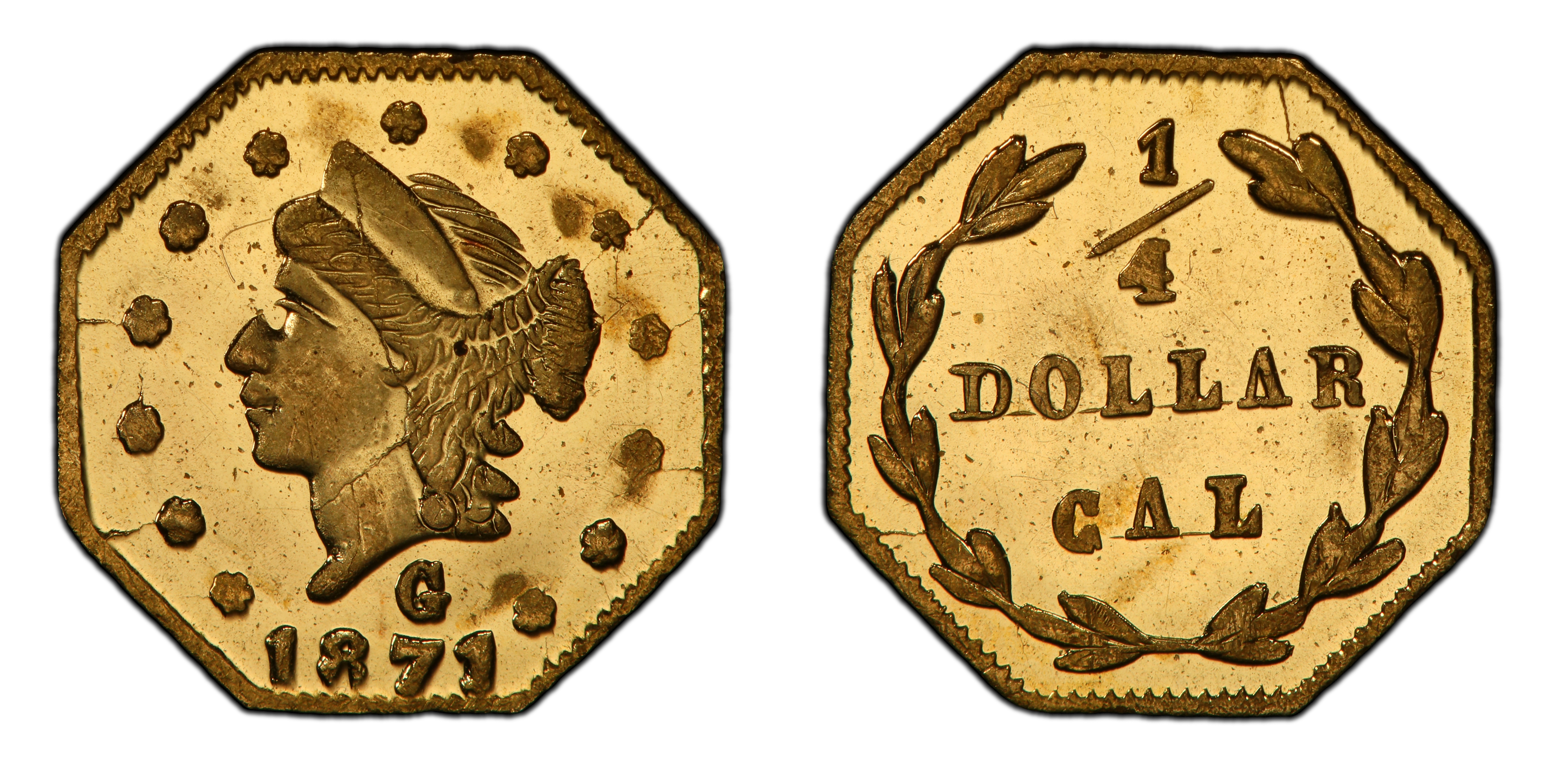
Obverse & Reverse
The 1871 G25C BG-765 is a product of the second period (1859-1882) of California Fractional Gold production, a fascinating and complex chapter in American numismatics. Born out of the initial chaos of the California Gold Rush, the earliest fractional gold pieces of 1852 were a genuine response to a severe shortage of small-denomination coinage for daily commerce. Gold dust and nuggets were impractical for minor transactions, leading private jewelers and assayers to strike quarter dollar, half dollar, and dollar coins. By the 1870s, however, the landscape had changed. The United States Mint in San Francisco was fully operational, and the initial, desperate need for small change had largely subsided. The nature of fractional gold shifted from a circulating medium of necessity to that of a popular souvenir and keepsake. Miners and tourists sought these miniature gold coins as mementos of their California adventure, easy and affordable to send back east to family. This piece, struck by the firm of Robert B. Gray & Co., is emblematic of this later period. Gray, a San Francisco jeweler, had acquired the business of another fractional minter, Antoine Louis Nouzillet, in the late 1850s and continued production for over a decade. The Coinage Act of 1864 had explicitly outlawed private coinage, but enforcement was lax, allowing jewelers like Gray to continue minting these denominated pieces. These 'Period Two' issues were typically lighter in gold content for their stated value than their 'Period One' predecessors, reinforcing their status as tokens or souvenirs rather than true coinage. Despite this, they were struck in gold and bear all the hallmarks of a coin, making them a tangible link to the fading days of the Gold Rush frontier economy and the burgeoning tourist trade that was beginning to define California's identity.
Associated EventPost-Gold Rush California Economy
Reason For MintingPrimarily created to serve the robust demand for gold souvenirs and novelties in post-Gold Rush California, rather than to alleviate a coinage shortage.
Minter HistoryRobert B. Gray & Co. was a prominent San Francisco jewelry firm that became a significant producer of California Fractional Gold. In late 1858 or early 1859, Gray purchased the fractional gold business from Antoine Louis Nouzillet, another jeweler. Gray & Co. continued to strike octagonal quarter dollars until 1871. Their issues are often identified by a small letter 'G' on the obverse, typically found between the date and the portrait of Liberty, a feature present on the BG-765 variety. The firm's longevity and consistent production made it one of the key players in the 'Period Two' era of fractional gold.
Historical SignificanceThe BG-765 represents the evolution of fractional gold from a necessary circulating medium to a commercial souvenir. It is a physical artifact of a unique period when private minting persisted despite federal laws, illustrating the independent economic spirit of 19th-century California and the transition of the Gold Rush from a frantic event into a celebrated memory.
N/A
Denomination25 Cents
Minting Period1871
Assayer/MinterRobert B. Gray & Co.
Geographic OriginSan Francisco, California
Obverse DescriptionA head of Liberty facing left, her hair tied in a bun. She is surrounded by 9 stars, with the date 1871 below. A small initial 'G' for the minter, Gray, is located in the field to the right of the date.
Obverse Inscription1871 G
Reverse DescriptionThe denomination '25 CENTS' is displayed within a decorative wreath of leaves and berries, tied with a bow at the bottom. The legend 'CALIFORNIA GOLD' is inscribed above the wreath, though some sources note this is an error in description and the wreath contains the full legend. The key diagnostic is the wreath enclosing the denomination.
Reverse Inscription25 CENTS
CompositionGold
Stated Fineness Actual FinenessVariable, typically lower than monetary-issue gold.
Weight0.24 grams
Diameter9.60 mm
EdgePlain
Unknown
Survival EstimateSeveral hundred; a relatively common variety.
Rarity ScaleR-3 (Scarce)
This variety is popular as an affordable and historically significant entry point into the California Fractional Gold series. Its distinct octagonal shape, clear date, and maker's mark ('G') make it a tangible connection to a San Francisco jeweler of the era. The availability of high-grade, proof-like (PL) examples adds to its appeal for quality-conscious collectors.
Key VarietiesThe primary variety is the BG-765 itself. While no major sub-varieties from 1871 are widely collected, the 'PL' (Proof-Like) designation is a key distinction sought by collectors. These are not true proofs but are regular business strikes from freshly polished dies, resulting in mirrored fields and frosted devices. No special collector restrikes from later periods are known; all genuine BG-765 coins are contemporary to 1871.
Authentication TipsGenuine BG-765 examples have a specific die characteristic: on the reverse, the letter 'C' in 'CENTS' is positioned noticeably lower than the adjacent 'AL' in 'CALIFORNIA' on some die states, though the primary diagnostic is the arrangement of the wreath and lettering. The strike is often soft, particularly on the stars and Liberty's hair. Counterfeits and modern replicas abound; authentication by a reputable third-party grading service is highly recommended. Genuine pieces have a specific weight around 0.24 grams and a diameter of 9.6 mm.
Shopping ConsiderationsFor a premium quality example, seek out a specimen certified as 'PL' (Proof-Like) or 'DMPL' (Deep Mirror Proof-Like). Look for sharp striking on the highest points, especially the strands of Liberty's hair and the details within the wreath. Original, lustrous surfaces command a significant premium; avoid coins that are cleaned, polished, or show evidence of being mounted in jewelry, which is a common issue for this series. A smooth, mark-free field is highly desirable, especially on proof-like specimens where imperfections are more noticeable. The evenness of the golden color can also enhance eye appeal.
A coin's grade is its condition, rated on a 1-70 scale. For rare coins, this is the most critical factor in determining value, as a tiny difference in preservation can mean a huge difference in price.
Relevant Grade TypesAll original 1871 BG-765 pieces are business strikes intended for sale as souvenirs. They are found in Circulated grades (AU-50 and below, though less common) and, more frequently, in Mint State (MS, 60-70) grades. No true Proofs (PR/PF) were struck during the original period. However, due to the use of highly polished dies to enhance their appeal as novelties, many examples exhibit mirrored surfaces and are designated 'PL' (Proof-Like) or 'DMPL' (Deep Mirror Proof-Like) by grading services. These are not a different type of coin, but rather a desirable manufacturing characteristic of a standard business strike.
Mint State CharacteristicsUncirculated examples of BG-765 are characterized by their luster. Base-level Mint State coins may have a soft, satiny luster, but premium examples display sharp, reflective, proof-like fields. The strike is a key variable; many are softly struck, with weakness on the stars and the highest points of Liberty's hair. A well-struck piece with full detail is rare and desirable. Due to the minting process and softness of the gold, small planchet flaws or contact marks are common, even on high-grade specimens.
Circulated Wear PatternsOn circulated examples, wear first appears on the high points of the design. For the obverse, this includes Liberty's cheek, the hair above her ear, and the eyebrow ridge. On the reverse, the highest parts of the wreath's leaves and the bow will show flattening and loss of detail first. In lower grades (VF and below), the legends will start to weaken, and the stars may become indistinct.
Key Factors For ValueThe most significant value driver for this coin is the surface characteristic, specifically a Proof-Like or Deep Mirror Proof-Like designation, which can make an example worth many times more than a standard MS counterpart. Secondly, the quality of the strike is crucial; a sharply struck coin with full details is always preferred over a weakly struck one. Thirdly, overall eye appeal, defined by clean, original surfaces free of distracting marks or signs of harsh cleaning, is paramount. Finally, certification by a top-tier grading service (PCGS or NGC) is standard, and a CAC sticker indicating premium quality for the grade adds a further layer of value.
PCGS Price Guide
| Grade | Price | Population |
|---|---|---|
| 62 | $425.00 | 1 |
| 62+ | $475.00 | N/A |
| 63 | $550.00 | N/A |
| 63+ | $675.00 | N/A |
| 64 | $850.00 | N/A |
| 64+ | $1,050.00 | N/A |
| 65 | $1,575.00 | 2 |
| 65+ | $1,750.00 | N/A |
| 66 | $2,000.00 | N/A |