1870 G25C BG-832 (Regular Strike)
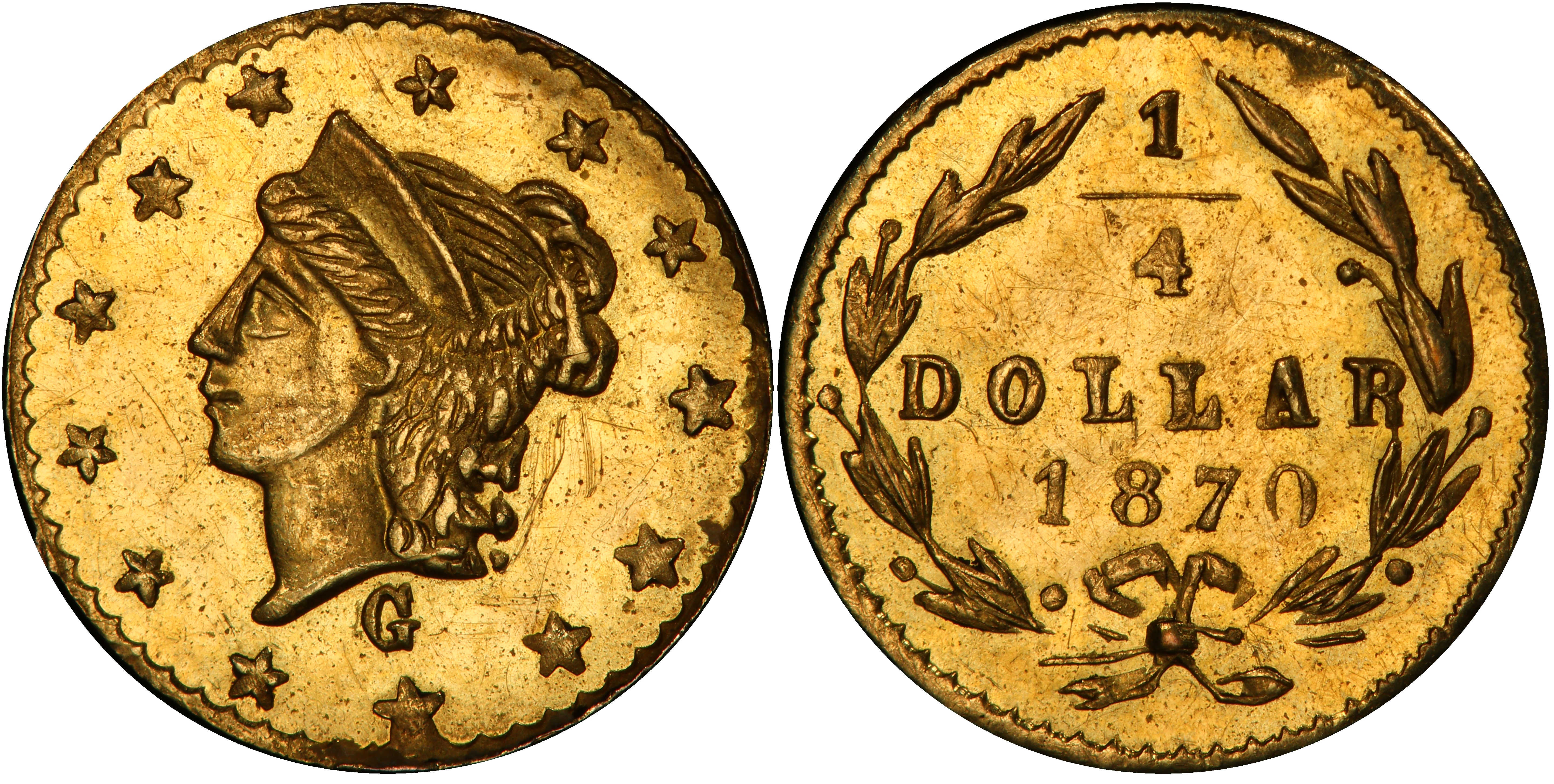
Obverse & Reverse
The 1870 'G' 25 Cents, cataloged as Breen-Gillio 832, is a fascinating product of the second major period of California Fractional Gold production (1859-1882). By this time, the initial, acute shortage of small change that characterized the Gold Rush's peak had been largely resolved by the output of the San Francisco Mint. However, a robust market for small gold pieces persisted, driven by a new purpose: commerce, novelty, and the burgeoning tourist trade. Local jewelers and private minters, operating in a legal gray area, stepped in to meet this demand. These 'Period Two' issues were distinct from their earlier 'Period One' counterparts (1852-1857). While the first issues were struck to approximate their intrinsic value and served a vital role in daily transactions, Period Two pieces were often underweight and served a dual role as both currency in small transactions and as popular souvenirs of the Golden State. Minted by the firm of Robert B. Gray & Co. in San Francisco, the BG-832 is a prime example of this era's output. Gray was a significant figure in the trade, having purchased the business of another prominent jeweler, Antoine Louis Nouizillet, around 1859. This acquisition gave him access to existing dies and punches, which he combined with his own new designs, often hallmarked with a distinctive 'G'. The coins were typically produced via the hammer method, where dies were struck by hand, leading to variations in strike quality. Despite the Coinage Act of 1864 making private minting illegal, enforcement by the Secret Service was lax until the early 1880s, allowing firms like Gray's to flourish. These tiny gold coins captured the romance of the West and were easily mailed back East or carried as pocket pieces and jewelry. Their existence speaks to the entrepreneurial spirit and unique economic conditions of post-Gold Rush California, a time when gold was still king and private enterprise continued to fill perceived gaps in the nation's monetary system, albeit more for novelty than necessity.
Associated EventPost-California Gold Rush Economic Expansion
Reason For MintingTo serve the continuing commercial and souvenir demand for small gold coinage in California long after the peak of the Gold Rush.
Minter HistoryRobert B. Gray & Co. was a prominent San Francisco jewelry firm and a prolific producer of 'Period Two' California Fractional Gold. Around 1859-60, Gray acquired the business of Antoine Louis Nouizillet, one of the key 'Period One' minters. Gray utilized Nouizillet's old dies for some issues while also creating new ones marked with his initial, 'G', as seen on this variety. His operation continued into the 1870s, producing some of the most consistently well-made and heaviest pieces of the era. In 1871, Gray sold his interests to the California Jewelry Co., marking the end of his direct involvement in the fractional gold trade.
Historical SignificanceThe BG-832 is historically significant not as a coin of necessity, but as a representation of the evolution of California's gold economy. It demonstrates the transition of fractional gold from essential circulating currency to a commercial product and popular keepsake, embodying the enduring mystique of the Gold Rush for a national audience.
BG-832
Denomination25 Cents
Minting Period1870
Assayer/MinterRobert B. Gray & Co.
Geographic OriginSan Francisco, California
Obverse DescriptionA well-defined Liberty Head facing left, her hair tied in a bun at the back. She wears a coronet or tiara inscribed with 'LIBERTY', although the inscription is often weak or incomplete due to the coin's small size. The portrait is encircled by 13 six-pointed stars. The date '1870' is positioned below the bust.
Obverse InscriptionLIBERTY (on coronet), 1870
Reverse DescriptionA simple but elegant wreath composed of two branches tied together with a bow at the bottom. The wreath encircles the denomination, expressed as '1/4 DOLLAR'.
Reverse Inscription1/4 DOLLAR
CompositionGold
Stated Fineness Actual FinenessWhile not specifically assayed, Period Two issues were known to be of lower fineness than official U.S. coinage, typically ranging from .500 to .800 fine.
Weight0.24 grams
Diameter9.60 mm
EdgePlain
Unknown; records were not kept by private minters.
Survival Estimate13-30 (The R-6 rating translates to this range)
Rarity ScaleR-6 (Low R-6)
This coin is highly sought after for its rarity (R-6), attractive Liberty Head design, and its connection to the well-documented jeweler Robert B. Gray & Co. It represents a tangible piece of the romantic post-Gold Rush era of California and is a key variety for specialists in the extensive fractional gold series.
Key VarietiesThe primary variety is the BG-832 business strike. At least one specimen is known with a faint obverse die break, a minor die state that is of interest to specialists. No proof or special collector restrikes are known to have been produced by Robert B. Gray & Co. for this variety.
Authentication TipsAuthentic examples must have a clear denomination (e.g., 'DOLLAR'). Replicas and tokens often feature a bear on the reverse or lack a denomination entirely. The strike can be uneven, with areas of weakness, which is a common characteristic of genuine, hand-struck pieces. Cast counterfeits will have a porous, soapy appearance and lack sharp detail. The Breen-Gillio reference is the definitive guide; if a piece is unlisted, it should be treated with extreme caution. Third-party grading and authentication is highly recommended for any raw example.
Shopping ConsiderationsA premium quality example for its grade will exhibit a sharp strike, particularly on Liberty's coronet and the reverse wreath. Look for smooth, lustrous surfaces that have not been harshly cleaned or polished. Many examples were used in jewelry and may show signs of soldering or tooling, which should be avoided. A well-centered strike is also desirable. The presence of original, reddish-gold 'skin' is a significant plus. A faint obverse die break noted on some examples can be a positive identifying feature and add to its appeal. Given the coin's rarity, even problem-free circulated examples are highly valued.
A coin's grade is its condition, rated on a 1-70 scale. For rare coins, this is the most critical factor in determining value, as a tiny difference in preservation can mean a huge difference in price.
Relevant Grade TypesAll original 1870 BG-832 coins are business strikes intended for commerce or sale as souvenirs and are found in Circulated (1-58) and Mint State (MS, 60-70) grades. No Proofs were struck during the original period of issue, and no later-date collector restrikes are known for this specific variety.
Mint State CharacteristicsUncirculated examples of BG-832 often display a soft, satiny luster. The strike can be variable; a fully struck piece will show clear details in Liberty's hair and the leaves of the wreath. Due to the hand-hammering process, perfect centering is rare. Small, mint-made planchet flaws or adjustment marks are not uncommon and are generally accepted by specialists. Some examples exhibit prooflike or glittering surfaces, which command a premium.
Circulated Wear PatternsWear first appears on the highest points: Liberty's cheek, the hair above the eye, and the coronet. On the reverse, the high points of the wreath's leaves and the bow will show initial friction. In lower grades (VF and below), the stars on the obverse and the lettering of the denomination will begin to lose their sharpness and merge with the fields.
Key Factors For ValueFor the BG-832, value is driven primarily by rarity and grade. Surface quality is paramount; an example with original, undisturbed luster and no evidence of cleaning, polishing, or jewelry mounting will be worth multiples of a damaged piece. Strike sharpness is the next key factor, with well-detailed examples being highly prized. Finally, superior eye appeal, characterized by a pleasing reddish-gold color and smooth surfaces, adds a significant premium. A CAC sticker on a certified coin provides third-party verification of quality for the grade and is highly desirable for this series.
PCGS Price Guide
| Grade | Price | Population |
|---|---|---|
| 45 | $250.00 | 1 |
| 45+ | $255.00 | N/A |
| 50 | $265.00 | 1 |
| 50+ | $270.00 | N/A |
| 53 | $275.00 | 1 |
| 53+ | $280.00 | N/A |
| 55 | $285.00 | 1 |
| 55+ | $290.00 | N/A |
| 58 | $300.00 | 1 |
| 58+ | $315.00 | N/A |
| 60 | $350.00 | 1 |
| 61 | $450.00 | 2 |
| 62 | $625.00 | 10 |
| 62+ | $750.00 | N/A |
| 63 | $1,250.00 | 5 |
| 63+ | $1,500.00 | N/A |
| 64 | $2,250.00 | 1 |
| 64+ | $2,500.00 | N/A |
| 65 | $3,250.00 | 1 |