1874 G50C BG-944 (Regular Strike)
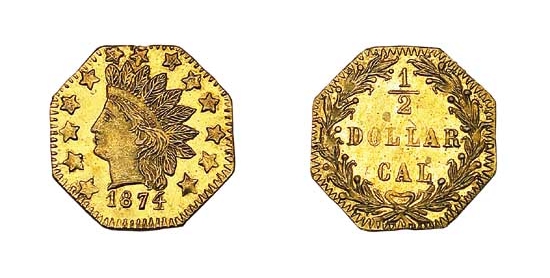
Obverse & Reverse
The 1874 Octagonal Indian Head 50 Cents, cataloged as Breen-Gillio 944, emerges from the second major phase of California's private gold coinage, a period numismatically distinct from the initial Gold Rush era. By the 1870s, the acute shortage of small change that spurred the creation of 'Period One' (1852-1857) fractional gold had been alleviated by the steady output of the San Francisco Mint. Consequently, the purpose of these diminutive gold pieces transformed. No longer essential for commerce, they became popular souvenirs and keepsakes, catering to a burgeoning tourist trade and a national fascination with the 'Golden West.' San Francisco's jewelers, many of whom were French immigrants, were the primary producers of these 'Period Two' (1858-1882) issues. They were often lighter and of a lower fineness than their stated face value, reflecting their new role as novelties rather than circulating currency. The Coinage Act of 1864 had technically prohibited private coinage, but the law was not rigorously enforced against these small tokens until 1883 by Secret Service Chief James J. Brooks. This legal gray area allowed for a prolific output of diverse designs throughout the 1870s. The BG-944, with its Indian Head motif, was a popular design choice of the era, evoking romanticized notions of the American frontier. These pieces were typically struck by hand using the hammer method, resulting in inconsistent strike quality and frequent die breaks, characteristics now appreciated by specialists. While the specific maker of the BG-944 die pair is not definitively recorded, prominent jewelers like Robert B. Gray & Co. were known to be active producers of similar pieces during this time. The existence of these coins today is a direct link to the post-Gold Rush economy of California, where the legacy of gold was commodified into miniature, tangible mementos of an adventurous era.
Associated EventPost-Gold Rush California Tourism & Commerce
Reason For MintingPrimarily struck to be sold as souvenirs and jewelry charms rather than to alleviate a coin shortage.
Minter HistoryThe specific minter of BG-944 is unconfirmed, but it was produced during the 'Period Two' or 'Jeweler's Issue' era. San Francisco jewelers, such as Frontier, Deviercy & Co., and Robert B. Gray & Co., were the primary manufacturers of fractional gold during this time. These artisans leveraged the public's fascination with the Gold Rush to create a vibrant market for these miniature gold tokens, which were often sold to tourists and residents as keepsakes. Their operations ceased in 1883 when the federal government began strictly enforcing the 1864 anti-private coinage laws.
Historical SignificanceThis coin is significant not as a monetary instrument, but as a cultural artifact representing the commercialization of the California Gold Rush legacy. It marks a shift from necessity-driven private coinage to souvenir production, illustrating a key economic and social transition in 19th-century California.
N/A
Denomination50 Cents
Minting Period1874
Assayer/MinterUnknown Jeweler (Possibly Robert B. Gray & Co.)
Geographic OriginSan Francisco, California
Obverse DescriptionAn Indian Head portrait faces left, a simplified and stylized depiction common to this series. The portrait is surrounded by thirteen stars, often unevenly spaced. The date, 1874, is positioned below the bust truncation.
Obverse Inscription1874
Reverse DescriptionThe reverse features a simple wreath composed of two branches tied together at the bottom with a bow. Within the wreath, the denomination is expressed as '1/2' with 'DOLLAR' inscribed below it. The legend 'CAL.' is typically absent on this variety.
Reverse Inscription1/2 DOLLAR
CompositionGold
Stated Fineness Actual FinenessVariable, often lower than official U.S. coinage, consistent with souvenir issues.
EdgePlain
Unknown
Survival Estimate76-150
Rarity ScaleR-5
The BG-944 is sought after for its classic octagonal shape and Indian Head design, which are emblematic of the California Fractional Gold series. As a 'Period Two' issue, it represents the fascinating transition from functional currency to souvenir. Its R-5 rarity ensures it is scarce enough to be challenging but accessible enough to be collectible.
Key VarietiesThe primary variety is the regular strike BG-944. A notable and much rarer related variety is BG-944A. Specialists also study minor die states, looking for evidence of die cracks or polishing, which are common on these hand-struck issues. No later-date restrikes or special collector issues are known for this specific Breen-Gillio number.
Authentication TipsGenuine Period Two pieces like BG-944 must have a denomination (e.g., 'DOLLAR'). Replicas often say 'CALIFORNIA GOLD' without a denomination or feature a bear on the reverse, a design never used on genuine 19th-century issues. The strike is often crude and uneven, with softness in the high points and sometimes planchet striations; a perfectly struck, flawless coin should be viewed with suspicion. The fabric of the coin should appear consistent with 19th-century gold, not a modern brassy or plated look.
Shopping ConsiderationsA premium quality example for its grade will exhibit a bold strike for the issue, with clear details on the Indian's headdress and the lettering on the reverse. Original, undisturbed surfaces with a hint of satiny luster are highly desirable. Avoid examples that have been harshly cleaned, polished, or mounted for jewelry, as this significantly impairs value. Pay close attention to the stars on the obverse; weakness in this area is common, but a specimen with unusually sharp stars commands a premium. Eye appeal is paramount; coins with attractive, deep old-gold toning are preferred over bright, dipped-out examples.
A coin's grade is its condition, rated on a 1-70 scale. For rare coins, this is the most critical factor in determining value, as a tiny difference in preservation can mean a huge difference in price.
Relevant Grade TypesAll original 1874 BG-944 issues were struck as business strikes, intended for sale as souvenirs rather than circulation. They are found in Circulated grades (1-58), though this is less common, and more frequently in Mint State (MS, 60-70) grades, as many were preserved as keepsakes. No proofs were struck during the original period of issue, and no later-date Proof restrikes of this specific variety are known to exist.
Mint State CharacteristicsUncirculated examples of BG-944 are characterized by a soft, often slightly prooflike or satiny luster. The strike is typically somewhat weak, particularly on the highest points of the Indian's hair and the centers of the stars. Small planchet flaws or die polishing lines are not uncommon and generally do not detract unless they are severe. Contact marks, while present, should be minimal for higher grades, with the fields and the cheek of the portrait being the most susceptible areas.
Circulated Wear PatternsOn circulated examples, wear first appears on the high points of the design. Look for flattening on the Indian's cheek, brow, and the feathers in the headdress. On the reverse, the leaves and bow of the wreath will show the first signs of friction. In lower grades (VF and below), the stars on the obverse begin to merge with the fields, and the fine details of the wreath become indistinct.
Key Factors For ValueThe primary value drivers for a BG-944 are grade and surface quality. An example with original, uncleaned surfaces and strong luster will command a significant premium over a cleaned or dull specimen of the same grade. Strike quality is also crucial; a coin with a sharp, well-centered strike is far more desirable than a weakly struck or off-center example. Finally, strong eye appeal, often enhanced by attractive original toning, makes a coin more valuable. A CAC sticker for this issue provides third-party confirmation of quality for the grade and typically results in a higher market value.
PCGS Price Guide
| Grade | Price | Population |
|---|---|---|
| 58 | $275.00 | 4 |
| 58+ | $300.00 | N/A |
| 60 | $325.00 | 1 |
| 61 | $350.00 | 1 |
| 62 | $385.00 | 7 |
| 62+ | $425.00 | N/A |
| 63 | $500.00 | 10 |
| 63+ | $675.00 | N/A |
| 64 | $900.00 | 12 |
| 65 | N/A | N/A |