1870 G25C BG-758, PL (Regular Strike)
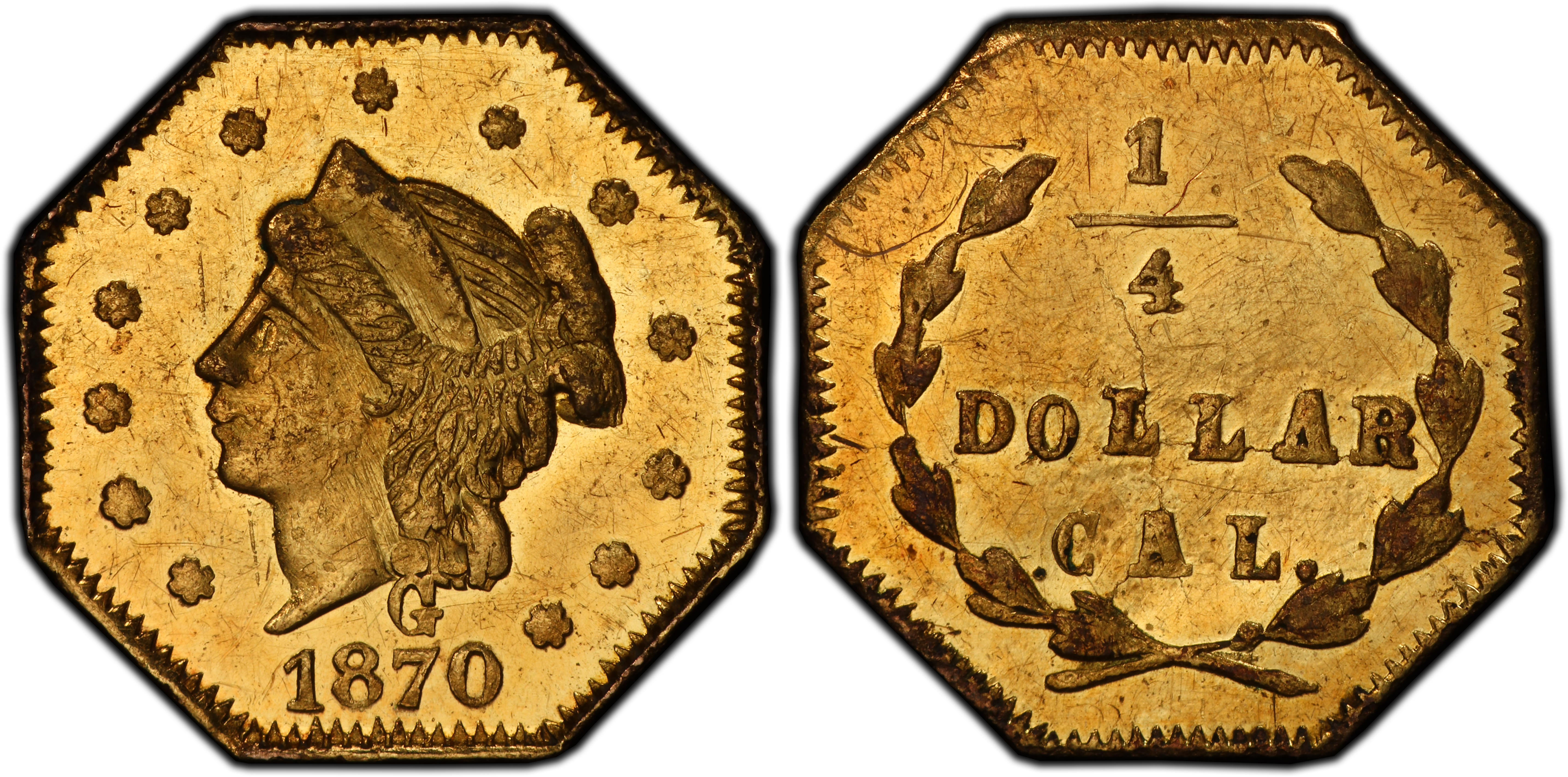
Obverse & Reverse
The 1870 Octagonal Liberty Head 25 Cents, cataloged as Breen-Gillio 758, is a product of the second period of California Fractional Gold production (1859-1882). By this time, the acute shortage of small change that characterized the Gold Rush heyday had largely subsided, thanks to the output of the official San Francisco Mint. The nature of fractional gold had thus shifted from utilitarian currency to souvenirs and novelty items. These 'jewelers' issues,' as they are often called, were privately struck, primarily in San Francisco, by craftsmen who recognized a market for mementos of the California Gold Rush, which had already passed into legend. The Coinage Act of 1864 had made the private issuance of coinage illegal, forcing these minters into a legally gray area. As a result, many pieces from this era were produced with less precious metal content than their stated face value, intended for sale to tourists and collectors rather than for circulation. The BG-758 is an artifact of this later period, a time when San Francisco was transitioning from a chaotic frontier town to a major American city. Its extreme rarity today suggests a minuscule original mintage, perhaps as a trial piece or a very limited issue by a small, and as-yet unidentified, jeweler. The 'PL' designation on some fractional gold pieces is believed to represent the minter's initials, but a definitive attribution for this specific variety remains one of the series' enduring mysteries. The coin's existence speaks to the persistent entrepreneurial spirit and the romantic allure of gold that defined California long after the peak of the rushes.
Associated EventCalifornia Gold Rush (Post-Boom Souvenir Period)
Reason For MintingPrimarily struck for sale as a souvenir or collectible charm rather than to alleviate a currency shortage.
Minter HistoryThe identity of the minter who used the initials 'PL' has not been definitively established by numismatic researchers. While several jewelers and engravers were active in San Francisco during this period, including figures like Pierre Loignon, no conclusive evidence has linked a specific individual to the BG-758 and other 'PL' varieties. These minters were typically skilled artisans who operated small, private enterprises, creating their own dies and striking pieces by hand or with simple screw presses. Their work constituted a clandestine industry following the Coinage Act of 1864, which adds to the difficulty in tracing their precise histories.
Historical SignificanceAs a 'Period Two' issue, the BG-758 represents the evolution of California Fractional Gold from necessary coinage to commercial souvenir. Its immense rarity highlights the small-scale, almost personal, nature of its production and its status as a tangible link to the post-Gold Rush souvenir trade in San Francisco.
N/A
Denomination25 Cents
Minting Period1870
Assayer/MinterUnknown Minter "PL"
Geographic OriginSan Francisco, California
Obverse DescriptionFeatures a Liberty Head facing left, similar in style to contemporary federal gold coinage but often of a cruder, simplified execution. The head is surrounded by thirteen stars representing the original colonies.
Obverse InscriptionNo inscription, only the Liberty Head and 13 stars.
Reverse DescriptionA wreath surrounds the denomination. Breen and Gillio note the reverse die, which is unique to this variety, features a horizontal fraction bar between '1' and '4'. The word 'CAL' appears below the word 'DOLLAR'. A defining characteristic on at least one known specimen is a notable arc-shaped striking imperfection.
Reverse Inscription1/4 DOLLAR CAL
CompositionGold
Stated Fineness Actual FinenessTypically varied and underweight for Period Two issues, often ranging from 14 to 22 karats.
EdgePlain
Extremely low, likely fewer than 25 pieces.
Survival EstimateFewer than 5 known specimens.
Rarity ScaleR-8 (Extremely Rare)
This variety is a holy grail for advanced specialists in California Fractional Gold. Its appeal is driven by its absolute rarity (R-8), its unique reverse die marriage, and the mystery surrounding its minter. The 'PL' designation in the user's input refers to the coin's Prooflike surfaces, a highly desirable characteristic that gives the fields a mirrored appearance, which is often seen on the finest surviving examples.
Key VarietiesThe BG-758 is a unique die marriage. The obverse die was also used to strike the very scarce BG-757 and the common BG-759. The reverse die, however, was used only for BG-758. No later-date restrikes or special collector issues are known to exist.
Authentication TipsAuthentication requires expert examination. Key diagnostics include the die characteristics of the unique reverse (horizontal fraction bar, 'CAL' below 'DOLLAR'). Comparison to high-resolution images of the few known examples is essential. The strike is often somewhat weak. Counterfeits are typically cast or have incorrect details in the wreath and lettering. Given its value, certification by a top-tier grading service (PCGS or NGC) is mandatory.
Shopping ConsiderationsAcquiring a BG-758 is a major numismatic event. A 'premium quality' example would be one that, despite a characteristically weak strike, retains sharp details on Liberty's portrait and the wreath. The most desirable pieces exhibit deeply prooflike (PL) or deep mirror prooflike (DMPL) fields with frosted devices, creating a strong cameo contrast. Any example, even circulated, is a major prize. Buyers should look for original, uncleaned surfaces with a pleasant apricot-gold luster. Hidden problems like tooling, repairs, or ex-jewelry mounting (evidence of having been soldered to a pin or bezel) must be carefully checked, though any genuine example would still be highly valuable.
A coin's grade is its condition, rated on a 1-70 scale. For rare coins, this is the most critical factor in determining value, as a tiny difference in preservation can mean a huge difference in price.
Relevant Grade TypesOriginal examples of BG-758 are business strikes, though they were likely never intended for general circulation. They are found in Circulated grades (AU-58 and below) and, more famously, in Mint State (MS, 60-70). No true Proofs were struck during the original period. The term 'Prooflike' (PL) is a designation added to Mint State business strikes that exhibit mirrored surfaces from being struck with highly polished dies, and the finest known examples of BG-758 have this coveted feature.
Mint State CharacteristicsUncirculated examples of BG-758 are characterized by their surfaces. The finest known have deeply reflective, prooflike fields. The strike is characteristically a bit weak, so some softness in the highest points of the design is expected and not necessarily a sign of wear. Luster is typically bright and flashy. Due to the small size and handling over the years, even high-grade examples may show minor hairlines or contact marks, which should be assessed carefully.
Circulated Wear PatternsWear first appears on the highest points of the design: Liberty's cheek, the hair above the ear, and the leaves and bow of the wreath on the reverse. On lower-grade circulated examples, the delicate stars on the obverse and the fine details of the wreath would begin to merge with the fields.
Key Factors For ValueFor a great rarity like BG-758, any genuine example is extremely valuable. The primary value driver is the grade, with a huge premium for Mint State over circulated examples. The presence of a Prooflike (PL) or Deep Mirror Prooflike (DMPL) designation elevates the value exponentially. Eye appeal is paramount; an example with original, lustrous surfaces and a strong visual contrast between the fields and devices will command the highest prices. Given the tiny population, any certified example appearing at auction would generate intense interest from the most advanced collectors.
PCGS Price Guide
| Grade | Price | Population |
|---|---|---|
| 61 | $6,750.00 | 1 |