1873 G25C BG-772, PL (Regular Strike)
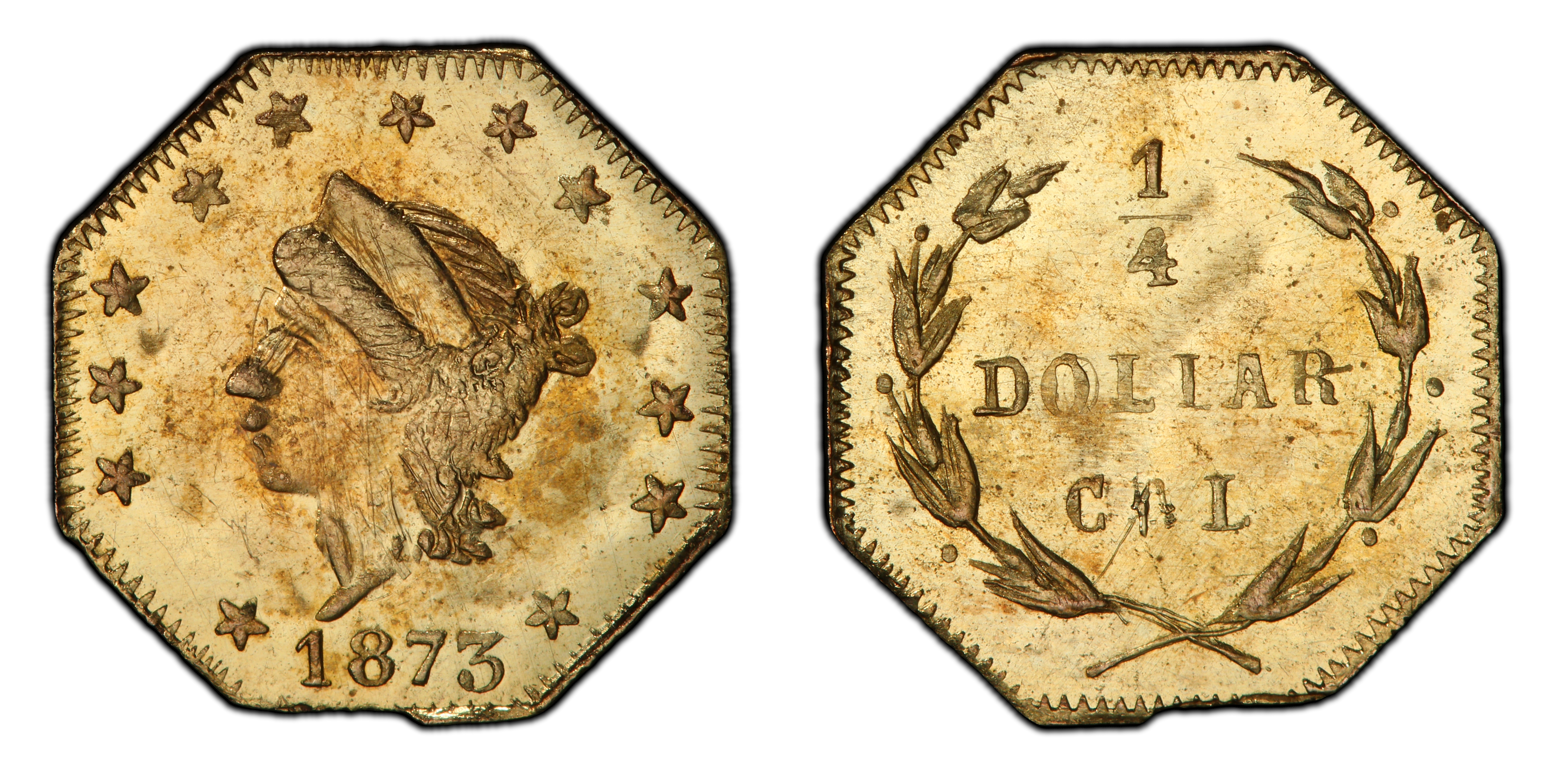
Obverse & Reverse
The 1873 25 Cents, cataloged as Breen-Gillio 772, is a product of the third and final distinct era of California Fractional Gold production (1870-1882). Unlike the Period One issues (1852-1856), which were struck out of genuine commercial necessity to alleviate a severe shortage of small change during the Gold Rush, these later pieces served a different purpose. By the 1870s, the San Francisco Mint was in full operation, and the acute need for private coinage had long passed. Instead, these small gold tokens were primarily manufactured as souvenirs and keepsakes for tourists, merchants, and collectors, capitalizing on the romantic allure of the Gold Rush. This period is often referred to as the 'Jeweler's Period,' as most pieces were made by jewelers and artisans, many of French origin, who had settled in San Francisco. The production of these denominated tokens existed in a legal gray area. The Coinage Act of 1864 had expressly forbidden the private issuance of coinage. However, the law was not aggressively enforced by the Secret Service in California until 1883. This lax enforcement created a window of nearly two decades during which jewelers could continue to strike these miniature gold pieces, often backdating them to the 1850s to create a veneer of legitimacy. The 1873 date on BG-772, however, is an honest declaration of its year of manufacture. These Period Three pieces are characterized by their generally lower gold content and lighter weights compared to their stated face value, confirming their status as tokens rather than true circulating currency. Their creation was a purely commercial enterprise, tapping into a nostalgic market for relics of a bygone era, much like the commemorative medals of today. The octagonal shape, a hallmark of many territorial gold issues, was a deliberate design choice to evoke the famous Fifty Dollar 'Slugs' of the 1850s and enhance their appeal as mementos of California's unique monetary history.
Associated EventCalifornia Gold Rush (Post-Rush Souvenir Period)
Reason For MintingPrimarily created as a commercial souvenir or token for collectors and tourists, not for general circulation.
Minter HistoryThe specific minter or jeweler responsible for the BG-772 die pair is not definitively known, which is common for many Period Three California Fractional Gold varieties. The style is consistent with other pieces produced by various San Francisco-based jewelers during the 1870s. These artisans, many of whom were French immigrants, operated small-scale striking operations. They produced a wide variety of designs, often mimicking Federal coinage but with their own distinct artistic touches. Their business model relied on selling these tiny gold tokens for more than their intrinsic metal value to a public fascinated with the Gold Rush.
Historical SignificanceBG-772 is significant as a representative of the final phase of private gold token production in California. It illustrates the transition of these pieces from essential circulating currency to commercial keepsakes. Its existence highlights a period of lax federal enforcement of coinage laws and the enduring romanticism of the Gold Rush that created a viable market for such souvenirs long after the original need had vanished. As a dated, denominated piece struck after the Coinage Act of 1864, it is a tangible artifact of this unique chapter in American numismatic history.
N/A
Denomination25 Cents
Minting Period1873
Assayer/MinterUnknown San Francisco Jeweler
Geographic OriginSan Francisco, California
Obverse DescriptionA small Liberty Head facing left, her hair tied in a bun. She is surrounded by thirteen five-pointed stars, seven to the left and six to the right, following the octagonal border of the coin.
Obverse Inscription Reverse DescriptionThe denomination '25 CENTS' is displayed within a wreath composed of two branches tied with a bow at the bottom. The date '1873' is located inside the wreath, just above the bow.
Reverse Inscription25 CENTS 1873
CompositionGold
Stated Fineness Actual Fineness Diameter10.00 mm
EdgePlain
Unknown
Survival Estimate13-30 (High R-6)
Rarity ScaleHigh R-6
This variety is highly sought after due to its extreme rarity (High R-6), attractive octagonal shape, and the high quality of strike seen on surviving examples. The notable prooflike surfaces on many specimens make it particularly appealing to collectors who value superb eye appeal.
Key VarietiesNo major varieties of BG-772 are noted in standard references. The primary distinction among surviving examples is the degree of prooflikeness in the fields. No special collector issues or later-date restrikes from the original dies are known to exist. All known examples are considered original business strikes from the 1873 period, though they were intended for souvenir purposes rather than circulation.
Authentication TipsAuthentication should be performed by an expert or a top-tier grading service. Genuine Period Three pieces must be denominated with 'CENTS' or 'DOLLAR.' Be wary of modern replicas, which are common in the Cal Gold series. Check for crisp details, especially in the stars and wreath, which are often weakly defined on counterfeits. The specific die markers for BG-772 are not widely published, but comparison with certified examples is the best authentication method. The fabric of the planchet should appear consistent with 19th-century minting practices.
Shopping ConsiderationsA premium quality example of BG-772 is defined by its surface preservation and strike. Look for specimens with highly reflective, prooflike (PL) or deep mirror prooflike (DMPL) fields, as this is a known characteristic of the variety and commands a significant premium. The strike should be sharp, with full details on Liberty's hair and the leaves of the wreath. Because these were not heavily circulated, most genuine examples are found in high grades (AU or MS). Avoid coins that have been harshly cleaned, which will appear dull or hairlined and lack the original skin. Minor, non-distracting planchet flaws are sometimes seen and may be acceptable, but any evidence of tooling, repairs, or jewelry mounting should be a major deterrent.
A coin's grade is its condition, rated on a 1-70 scale. For rare coins, this is the most critical factor in determining value, as a tiny difference in preservation can mean a huge difference in price.
Relevant Grade TypesOriginal period issues of BG-772 were business strikes intended for sale as souvenirs. They are found in Circulated (AU-50 to 58) and Mint State (MS, 60-70) grades. No true Proofs were struck during the original period. However, many surviving examples exhibit prooflike (PL) surfaces due to the use of polished dies and are designated as such by grading services. These are not a separate issue but rather a desirable characteristic of the original business strikes.
Mint State CharacteristicsUncirculated examples of BG-772 are prized for their luster. The finest known pieces exhibit deep, mirror-like fields, a feature that is highly desirable and rare for the series. Luster is typically frosty on the devices, creating a cameo contrast. The strike can be sharp, but weakness may be present on the central hair details or the bow of the wreath. Due to the small size and production method, minor planchet imperfections or striations may be present but should not be overly distracting.
Circulated Wear PatternsAlthough not intended for heavy circulation, light handling is seen on AU examples. Wear first appears on the highest points of the design: the hair above Liberty's eye and ear, her cheek, and the bow on the reverse wreath. On lower-grade AU coins, the luster in the fields will be noticeably disturbed, and the finer details of the wreath leaves will begin to merge.
Key Factors For ValueFor the BG-772, value is driven by three primary factors beyond the numerical grade: 1) Rarity: As a High R-6 variety, any example is valuable. 2) Surface Quality: The degree of prooflikeness is paramount. A coin with deep, clean, reflective fields will command a substantial premium over a standard MS example. 3) Eye Appeal: Coins with original, attractive golden toning and a strong strike are prized. The presence of a CAC sticker, verifying premium quality for the grade, adds a significant premium for this and other Cal Gold issues.
PCGS Price Guide
| Grade | Price | Population |
|---|---|---|
| 64 | $1,800.00 | 1 |