1876 G50C BG-949 (Regular Strike)
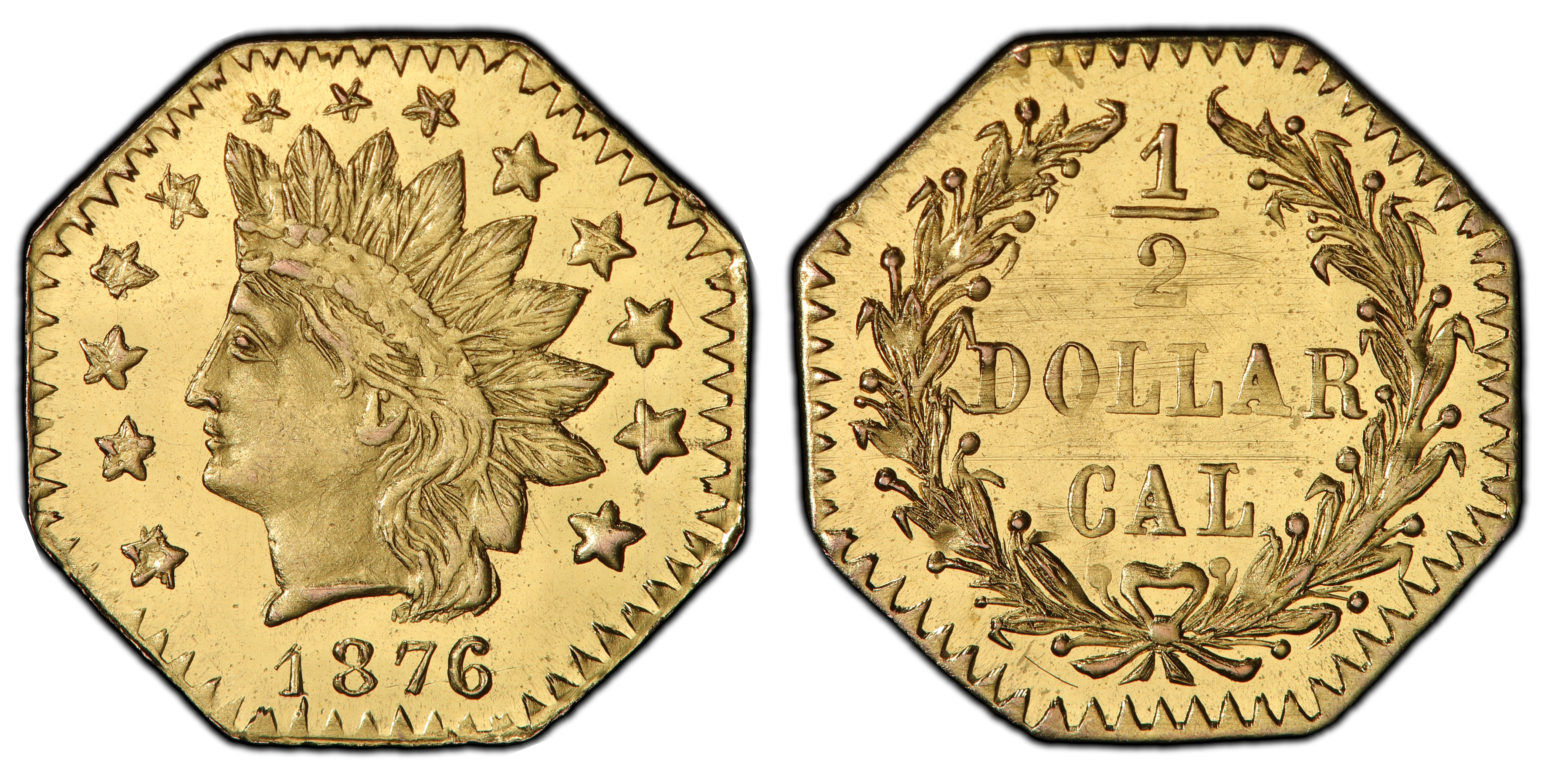
Obverse & Reverse
The 1876 BG-949 50 Cents represents a fascinating chapter in the story of California's gold legacy, long after the initial frenzy of the Gold Rush had subsided. This piece is classified as a 'Period Two' issue, struck between 1858 and 1882. Unlike the 'Period One' coins (1852-1857), which were minted out of a genuine necessity to alleviate a severe shortage of small-denomination coinage for commerce, these later issues served an entirely different purpose. By the 1870s, the San Francisco Mint was in full operation, and the state's economy was maturing. The acute need for privately minted fractional gold had vanished. Instead, these tiny gold pieces were produced by anonymous San Francisco jewelers almost exclusively as souvenirs and keepsakes. They capitalized on the powerful romance and nostalgia of the Gold Rush, offering tourists and locals a tangible, affordable piece of that celebrated history. The Coinage Act of April 22, 1864, had officially made private coinage illegal, yet the law was not aggressively enforced by the Secret Service until 1883. This legal gray area allowed jewelers to continue striking denominated 'coins' for nearly two decades. Many of these pieces were deliberately backdated to pre-1864 dates to feign legality, though this 1876-dated piece was struck contemporaneously. The BG-949, like its brethren, was likely struck using manual hammer methods on polished planchets, resulting in the frequently seen proof-like surfaces. Their gold content was intentionally less than their face value, solidifying their status as tokens rather than true coinage. These pieces were never intended for widespread circulation but were cherished as mementos of the 'Golden State,' often mounted into jewelry, which explains why many surviving examples are either in very high grades or show signs of damage from removal.
Associated EventCalifornia Gold Rush Souvenir Trade
Reason For MintingPrimarily minted as a nostalgic souvenir for the tourist and jewelry trade, not for general circulation.
Minter HistoryThe minters of 'Period Two' California Fractional Gold are largely anonymous, a stark contrast to the well-documented assayers of the Gold Rush proper. These pieces were the work of various jewelers and artisans centered in San Francisco. They operated small-scale, often clandestine, minting operations to supply the burgeoning souvenir market. Unlike firms such as Moffat & Co. or Kellogg & Co., which sought to create a trusted medium of exchange, these jewelers were entrepreneurs of nostalgia, producing charming but unregulated tokens for a public captivated by the romanticism of the gold fields.
Historical SignificanceThe BG-949 is historically significant not as a coin of commerce, but as a cultural artifact. It represents the commercialization of the Gold Rush narrative and the transition of gold from a raw monetary unit to a symbol of California's identity. These pieces are tangible links to the post-Gold Rush era, reflecting a society that was beginning to look back and mythologize its own recent past. They are a core component of the specialized field of collecting California small-denomination gold, with over 500 recognized Breen-Gillio varieties.
BG-949
Denomination50 Cents
Minting Period1876
Assayer/MinterAnonymous California Jeweler
Geographic OriginSan Francisco, California
Obverse DescriptionAn Indian Head motif facing left, stylistically similar to contemporary federal coinage. The portrait is surrounded by 13 stars along the octagonal border. The date, 1876, appears below the bust.
Obverse Inscription1876
Reverse DescriptionA wreath encircles the denomination. The legend 'CALIFORNIA GOLD' is inscribed above the wreath, following the upper facets of the octagonal planchet.
Reverse InscriptionCALIFORNIA GOLD 1/2 DOLLAR
CompositionGold
Stated Fineness Actual FinenessVariable, typically between 14 and 22 carats (.583 to .917 fine). The intrinsic value was always less than the 50-cent face value.
Weight0.55 grams
Diameter10.50 mm
EdgePlain
Unknown
Survival Estimate76-200
Rarity ScaleR-4
The BG-949 appeals to collectors for its direct connection to the California Gold Rush era, its charming Indian Head design on a tiny octagonal planchet, and its relative affordability compared to 'Period One' issues or larger pioneer gold coins. It is a popular type coin for those building a representative set of California fractionals.
Key VarietiesThe primary catalog number is Breen-Gillio (BG) 949. No major varieties are noted for this specific issue. It is crucial for collectors to understand that these original 'Period Two' pieces are distinct from the vast number of modern, non-denominated replicas and fantasy pieces. Authentic issues must bear a denomination (e.g., 'DOLLAR' or 'CENTS'). No official restrikes or collector proofs were issued by the original manufacturers.
Authentication TipsAuthentication is paramount. Genuine pieces are listed in the Breen-Gillio reference. Key diagnostics include the presence of a denomination ('DOLLAR' or 'CENTS') and a style consistent with known examples. Be extremely wary of pieces featuring a bear on the reverse, as this is a common motif on modern, non-collectible tokens. Due to the primitive striking process, authentic pieces can exhibit weak or uneven strikes, which is not necessarily a sign of a counterfeit. Conversely, many modern fakes are unnaturally sharp. Third-party grading by PCGS or NGC is highly recommended.
Shopping ConsiderationsA premium quality example of BG-949 will exhibit a sharp, well-centered strike, particularly on the details of the Indian's headdress and the wreath leaves. Many specimens were struck on polished planchets and possess attractive proof-like (PL) or deep proof-like (DPL) surfaces; this 'flash' is highly desirable and commands a premium. Look for original, uncleaned surfaces with attractive luster or light toning. Common problems to avoid are signs of having been used as jewelry (solder marks, harsh cleaning, scratches, or bending) and environmental damage. Given their souvenir nature, most surviving examples are in Mint State, so a circulated specimen would be unusual and less desirable.
A coin's grade is its condition, rated on a 1-70 scale. For rare coins, this is the most critical factor in determining value, as a tiny difference in preservation can mean a huge difference in price.
Relevant Grade TypesAll original 1876 BG-949 pieces were struck as business strikes, though intended as souvenirs rather than for circulation. They are found in both Circulated (1-58) and, more commonly, Mint State (MS, 60-70) grades. No official Proof (PR/PF) examples were struck during the original period of manufacture. However, because they were often struck with polished dies on polished planchets, many high-grade Mint State examples exhibit reflective, mirror-like surfaces and are designated 'Proof-Like' (PL) or 'Deep Proof-Like' (DPL) by grading services.
Mint State CharacteristicsIn uncirculated grades, the BG-949 often displays vibrant, satiny to proof-like luster. The quality of the strike can vary due to the manual striking process; a sharp strike across both the obverse portrait and reverse wreath is rare and desirable. Planchet quality can be irregular, and small, unstruck areas are not uncommon. Due to their history of being sold as souvenirs and handled, even high-grade specimens can show minor contact marks.
Circulated Wear PatternsOn the rare occasion a circulated example is found, wear will first appear on the highest points of the design. On the obverse, this includes the Indian's cheek, the bridge of the nose, and the tips of the feathers in the headdress. On the reverse, the highest points of the wreath's leaves and the bow will show the first traces of friction and flattening.
Key Factors For ValueThe primary value driver for an 1876 BG-949 is surface quality. An example with deep, mirror-like proof-like surfaces will command a significant premium over a frosty or satin-luster piece of the same numerical grade. A sharp, complete strike is the second key factor. Eye appeal, encompassing attractive original color and a lack of distracting marks, is also critical. Cleaned, scratched, or damaged coins are heavily penalized in the market. A CAC sticker, indicating premium quality for the grade, adds a notable premium.
PCGS Price Guide
| Grade | Price | Population |
|---|---|---|
| 55 | $230.00 | 1 |
| 55+ | $245.00 | N/A |
| 58 | $265.00 | 5 |
| 58+ | $275.00 | N/A |
| 60 | $300.00 | N/A |
| 61 | $325.00 | 1 |
| 62 | $375.00 | 20 |
| 62+ | $425.00 | N/A |
| 63 | $475.00 | 24 |
| 63+ | $600.00 | N/A |
| 64 | $725.00 | 34 |
| 64+ | $800.00 | N/A |
| 65 | $1,050.00 | 5 |
| 65+ | $1,250.00 | N/A |
| 66 | $1,850.00 | 3 |