1875 G25C BG-848 (Regular Strike)
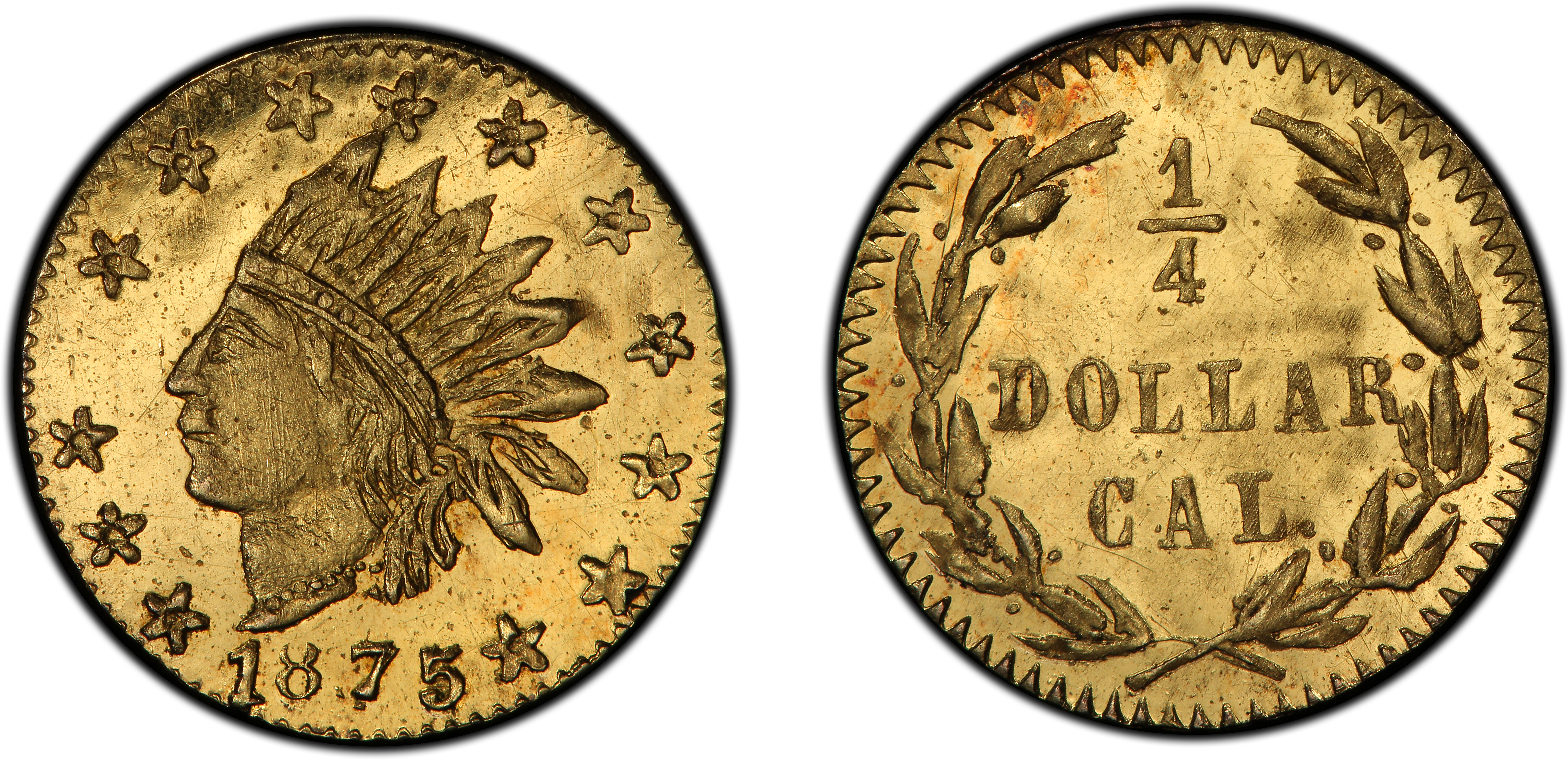
Obverse & Reverse
The 1875 25-cent piece, cataloged as Breen-Gillio 848, represents a fascinating chapter in the evolution of California's privately issued coinage. By 1875, the initial impetus for fractional gold—a severe shortage of small-denomination federal coinage during the Gold Rush—had long since passed. The San Francisco Mint, operating since 1854, was producing ample quantities of coins for commerce. Consequently, the production of these miniature gold pieces had transitioned from a utilitarian necessity to a commercial enterprise catering to tourists, jewelry makers, and souvenir collectors. These later issues are classified by numismatists as 'Period Two' (1858-1882) strikings. The minter of BG-848, Herman J. Brand, was a San Francisco manufacturing jeweler who, like his contemporaries, recognized the enduring market for these charming mementos of the Gold Rush. The pieces were no longer intended to serve as circulating currency but as keepsakes. Despite their non-monetary role, they were typically denominated, a practice that would come under increasing scrutiny and was eventually halted by stricter enforcement of the Coinage Act of 1864 in the early 1880s. The BG-848 was struck using the traditional, albeit crude, hammer method common for these pieces. This involved placing a gold planchet between two dies and striking the upper die with a sledgehammer, a process that often resulted in coins with inconsistent strike quality. The intrinsic value of the gold in these Period Two pieces was almost always significantly less than their face value, solidifying their status as tokens rather than true coinage. The 1875 Indian Head pieces, with their appealing design mimicking federal coinage, were popular items. Today, the BG-848 variety is recognized as a significant rarity, a tangible link to the post-Gold Rush era when the romanticism of the '49ers was monetized into tiny, golden souvenirs.
Associated EventCalifornia Gold Rush Aftermath & Souvenir Trade
Reason For MintingPrimarily struck for sale to tourists and collectors as souvenirs and jewelry items, not for monetary circulation.
Minter HistoryHerman J. Brand was a manufacturing jeweler based in San Francisco. He was one of several jewelers and private minters who produced fractional gold pieces during the 'Period Two' era (1858-1882). Unlike the Period One minters who filled a crucial economic need, Brand's operation catered to the burgeoning souvenir and jewelry market. His work is identified by specific die characteristics cataloged in the Breen-Gillio reference.
Historical SignificanceThis coin is historically significant not as a medium of exchange, but as a representation of the commercialization of the Gold Rush legacy. It marks the transition of fractional gold from a necessary form of local currency to a popular souvenir item, reflecting a mature California economy and a growing national fascination with the Wild West.
N/A
Denomination25 Cents
Minting Period1875
Assayer/MinterHerman J. Brand
Geographic OriginSan Francisco, California
Obverse DescriptionA portrait of a female figure facing left, wearing a Native American-style feathered headdress. The design is an imitation of the contemporary U.S. Indian Head cent. Thirteen stars encircle the portrait, representing the original colonies.
Obverse InscriptionNo textual inscription; design consists of the Indian Head portrait surrounded by 13 stars.
Reverse DescriptionA wreath of leaves and berries, open at the top, encircles the denomination. A bow with multiple loops is tied at the bottom of the wreath.
Reverse Inscription1/4 DOLLAR 1875
CompositionGold
Stated Fineness Actual FinenessFineness varied in Period Two issues, typically ranging from 14 to 22 carats.
EdgePlain
Unknown
Survival EstimateExtremely low. The Breen-Gillio reference suggests perhaps only 12 distinct examples are known to exist, with potential for duplication within that count.
Rarity ScaleR-7- (Low R-7), indicating 4 to 12 known specimens.
The BG-848 is highly sought after due to its extreme rarity (R-7-), classic Indian Head design, and its status as a well-documented Breen-Gillio variety from the popular California Fractional Gold series.
Key VarietiesThe BG-848 is itself a specific die variety. No major sub-varieties from the original minting period are known. As these were produced as souvenirs, no proof or special collector strikings were made at the time of issue.
Authentication TipsAuthentication requires expert examination. Key diagnostics include the precise die characteristics of both obverse and reverse as illustrated in the Breen-Gillio reference. Look for die markers, such as the exact positioning of the stars and date numerals. Genuine pieces often have a crude, hand-struck appearance. Counterfeits may appear too uniform, have incorrect weight or specific gravity, or exhibit tool marks and casting bubbles. Many modern replicas exist; genuine Period Two issues must be denominated to be considered authentic by major grading services.
Shopping ConsiderationsFor a premium quality BG-848, a buyer should prioritize sharpness of strike, particularly on the high points of the Indian Head's hair and the details of the wreath on the reverse. Minor striking weakness on the reverse is noted as being typical for this issue. Look for examples with clean, semi-prooflike or satiny fields and minimal contact marks. Original, undisturbed reddish-gold toning is highly desirable and adds to eye appeal. Avoid examples that have been harshly cleaned, polished, or used in jewelry, as this significantly impairs value. Given the coin's rarity, any example, even with minor imperfections, is significant, but a certified coin from PCGS or NGC is essential for guaranteeing authenticity and grade.
A coin's grade is its condition, rated on a 1-70 scale. For rare coins, this is the most critical factor in determining value, as a tiny difference in preservation can mean a huge difference in price.
Relevant Grade TypesOriginal issues were business strikes produced for souvenir purposes and not circulation, so they are typically found in high circulated grades (AU) or, more commonly, Mint State (MS, 60-70) grades. No Proofs (PR/PF) were struck during the original period of issue, and there are no known later-date restrikes.
Mint State CharacteristicsAn uncirculated BG-848 is defined by its luster and strike. Luster can range from satiny to semi-prooflike. The strike is often uneven due to the hammer-striking process; pleasing definition on the central design elements is a key value driver. A high-grade Mint State example will be free of wear but may exhibit minor planchet flaws or contact marks from the production and handling process. Minor striking weakness on the reverse is considered characteristic and may not detract significantly from the grade.
Circulated Wear PatternsAlthough not intended for circulation, some pieces may show wear from handling. Wear would first appear on the highest points: the cheek and feathers of the Indian Head, and the leaves and bow of the reverse wreath. In lower grades (e.g., AU), the field luster would be diminished in the most exposed areas.
Key Factors For ValueThe primary value driver for a BG-848 is simply its existence, due to its extreme rarity. Beyond that, value is determined by the numeric grade (e.g., MS-62 vs. MS-64), sharpness of the strike, surface quality (minimal marks and distractions), and overall eye appeal. Examples with original, attractive patina command significant premiums. Third-party certification by PCGS or NGC is mandatory for establishing authenticity and market acceptance. A CAC sticker for this issue would denote premium quality for the grade and add a substantial premium.
PCGS Price Guide
| Grade | Price | Population |
|---|---|---|
| 58 | $750.00 | 4 |
| 58+ | $800.00 | N/A |
| 60 | $1,075.00 | N/A |
| 61 | $1,145.00 | N/A |
| 62 | $1,250.00 | 5 |
| 62+ | $1,375.00 | N/A |
| 63 | $1,500.00 | 4 |
| 63+ | $1,750.00 | N/A |
| 64 | $2,250.00 | 5 |
| 64+ | $2,500.00 | N/A |
| 65 | $3,000.00 | N/A |