1865 G25C BG-822 (Regular Strike)
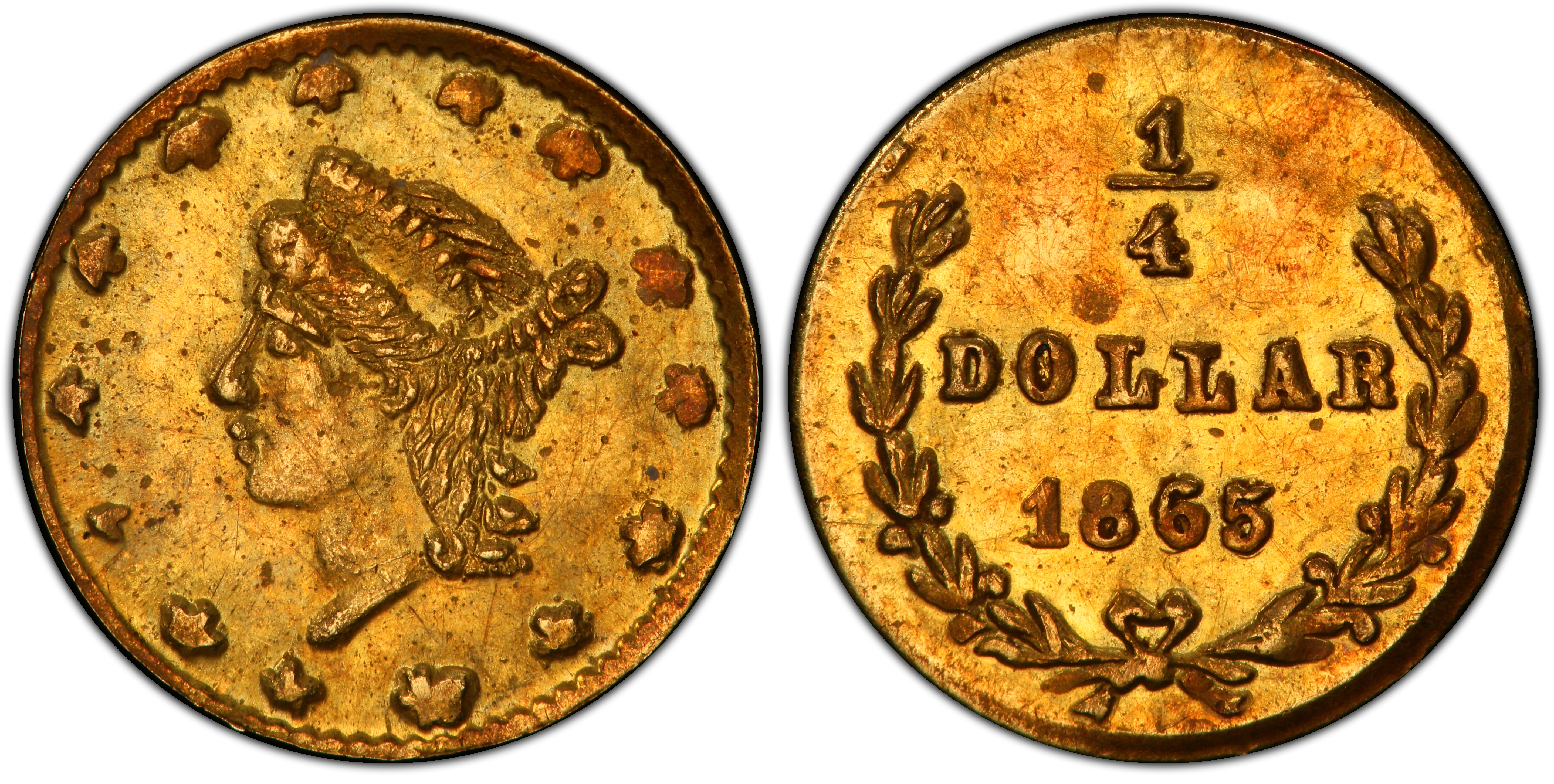
Obverse & Reverse
The 1865 BG-822 25 Cents is a product of the second period (1859-1882) of California Fractional Gold production, often termed the 'jeweler's issues.' By the mid-1860s, the initial, feverish peak of the Gold Rush had subsided, but California's economy remained robust and distinct from the rest of the Union, which was embroiled in the Civil War. A chronic shortage of small-denomination federal coinage persisted on the West Coast, making everyday transactions for items like newspapers or drinks difficult. This scarcity, which had plagued California since 1849, continued to provide a commercial niche for private minters. Unlike the earlier 'Period One' pieces that more closely resembled federal coinage, the second period issues were typically smaller, lighter, and of lower fineness, essentially functioning as privately issued tokens whose convenience outweighed their low intrinsic value. Many of the minters were jewelers by trade, primarily based in San Francisco, who possessed the requisite skills for die cutting and striking small gold planchets. These pieces were technically illegal following the Coinage Act of April 22, 1864, which prohibited private coinage. However, enforcement in distant California was lax, and production of these useful tokens continued unabated for nearly two more decades. The BG-822, dated 1865, was struck in this environment. It was not intended as a store of value but as a practical substitute for the missing federal cents, dimes, and quarters needed for daily commerce. These tiny gold pieces circulated freely, accepted by merchants and the public out of sheer necessity, until a greater supply of federal coinage finally reached the West and rendered them obsolete by the early 1880s.
Associated EventPost-Gold Rush California Economic Expansion
Reason For MintingTo alleviate a persistent shortage of small-denomination circulating coinage for daily commercial transactions in California.
Minter HistoryThe specific minter or jeweler who created the dies for the BG-822 variety is unknown. This anonymity is characteristic of the vast majority of 'Period Two' California Fractional Gold issues. These minters were often small-scale entrepreneurs, likely French or German immigrant jewelers in San Francisco, who produced the coins as a profitable sideline. They operated without official sanction and rarely, if ever, placed their names or identifying marks on their products to avoid potential legal repercussions, especially after the 1864 federal prohibition.
Historical SignificanceThe BG-822 is a tangible artifact of a unique period in American monetary history, representing a private solution to a government failure in supplying adequate coinage to the frontier. It demonstrates the continued economic isolation and independent spirit of California in the mid-19th century. As a 'jeweler's issue,' its numismatic importance lies in its role as a widely used commercial token that filled a critical monetary gap, rather than as a piece valued for its intrinsic gold content.
N/A
Denomination25 Cents
Minting Period1865
Assayer/MinterUnknown Private Minter
Geographic OriginSan Francisco, California
Obverse DescriptionA head of Liberty facing left, her hair tied in a bun. She is surrounded by thirteen six-pointed stars, seven to the left and six to the right. The date, 1865, is positioned below the truncation of the neck.
Obverse Inscription1865
Reverse DescriptionThe denomination '25 CENTS' is enclosed within a wreath of two olive branches tied with a ribbon at the bottom. A small dot or pellet is often visible between the denomination and the wreath below.
Reverse Inscription25 CENTS
CompositionGold
Stated Fineness Actual FinenessTypically low, often ranging from .300 to .600 fine.
EdgePlain
Unknown
Survival Estimate75-125
Rarity ScaleR-4 (Scarce)
The BG-822 is popular among collectors for its affordability relative to earlier territorial issues, its connection to the post-Gold Rush era, and its classic Liberty Head design. It serves as an accessible entry point into the fascinating and complex world of California Fractional Gold.
Key VarietiesThe primary reference is Breen-Gillio-822 (BG-822). No major varieties, patterns, or official restrikes are known to exist from the period. All known examples are considered business strikes. Modern replicas and fantasy pieces are common, but no legitimate historical variations have been cataloged.
Authentication TipsAuthentic BG-822 pieces often exhibit a somewhat crude, handmade quality. The strike can be uneven, and the surfaces may show planchet adjustment marks or parallel striations from the drawing process. The numerals in the date and letters in the legend should match the die characteristics cataloged by Breen-Gillio. Counterfeits are widespread; many are brass or gold-plated and often have a soapy, cast-like appearance or incorrect design details (e.g., a bear on the reverse, which is a fantasy element). Genuine pieces have a distinct 'feel' and luster that differs from plated copies. Comparison with certified examples is the most reliable authentication method.
Shopping ConsiderationsA premium quality example for its grade will exhibit a sharp, well-centered strike, particularly on Liberty's hair details and the leaves of the wreath. Look for coins with clean, original surfaces that have not been harshly cleaned or polished, as this is a very common issue. A lustrous, prooflike (PL) surface is highly desirable and commands a significant premium. Avoid examples with significant rim bumps, scratches, or evidence of having been mounted in jewelry, as was common. Attractive, original reddish-gold or orange-peel toning adds to the eye appeal and is sought after by discerning collectors.
A coin's grade is its condition, rated on a 1-70 scale. For rare coins, this is the most critical factor in determining value, as a tiny difference in preservation can mean a huge difference in price.
Relevant Grade TypesAll original 1865 BG-822 pieces are business strikes, made for general circulation. They are found in Circulated grades (AG-3 to AU-58) and Mint State grades (MS-60 to MS-70). No true Proofs were struck during the original minting period. While some Mint State examples exhibit reflective, prooflike surfaces (designated PL), these are a result of polished dies and are not true Proof coins.
Mint State CharacteristicsUncirculated examples of BG-822 are characterized by their luster, which is typically frosty and satiny. The strike is often somewhat soft in the centers, particularly on the highest points of Liberty's hair and the bow of the wreath. Due to the softness of the low-karat gold, even high-grade Mint State examples will often show small, scattered contact marks from mint handling and bag transport. A truly choice specimen combines strong luster with a sharp strike and minimal, non-distracting marks.
Circulated Wear PatternsWear first appears on the highest points of the design: Liberty's cheekbone, the hair above her eye and ear, and the leaves at the top of the wreath. As wear progresses, the individual hair strands will merge, and the details of the leaves and bow will become flat. In lower grades (VG and below), the stars will begin to lose their points and the legends will become weak, with the date being one of the last elements to become illegible.
Key Factors For ValueFor the BG-822, the primary value drivers are grade and surface quality. An example with original, uncleaned surfaces will always be worth more than a cleaned coin of the same grade. Strike sharpness is a key differentiator; a well-struck coin with full details is highly prized. Eye appeal, which includes luster, toning, and the absence of distracting marks, plays a major role. Finally, certification by a top-tier grading service (PCGS or NGC) is essential for market acceptance and value, with a CAC sticker adding a significant premium for coins that are considered superior for their assigned grade.
PCGS Price Guide
| Grade | Price | Population |
|---|---|---|
| 40 | $200.00 | 1 |
| 45 | $205.00 | 2 |
| 45+ | $210.00 | N/A |
| 50 | $215.00 | 3 |
| 50+ | $220.00 | N/A |
| 53 | $225.00 | 3 |
| 53+ | $230.00 | N/A |
| 55 | $235.00 | 7 |
| 55+ | $240.00 | N/A |
| 58 | $250.00 | 9 |
| 58+ | $270.00 | N/A |
| 60 | $300.00 | 1 |
| 61 | $350.00 | 12 |
| 62 | $425.00 | 25 |
| 62+ | $475.00 | N/A |
| 63 | $550.00 | 15 |
| 63+ | $700.00 | N/A |
| 64 | $1,000.00 | 7 |