1868 G25C BG-889 (Regular Strike)
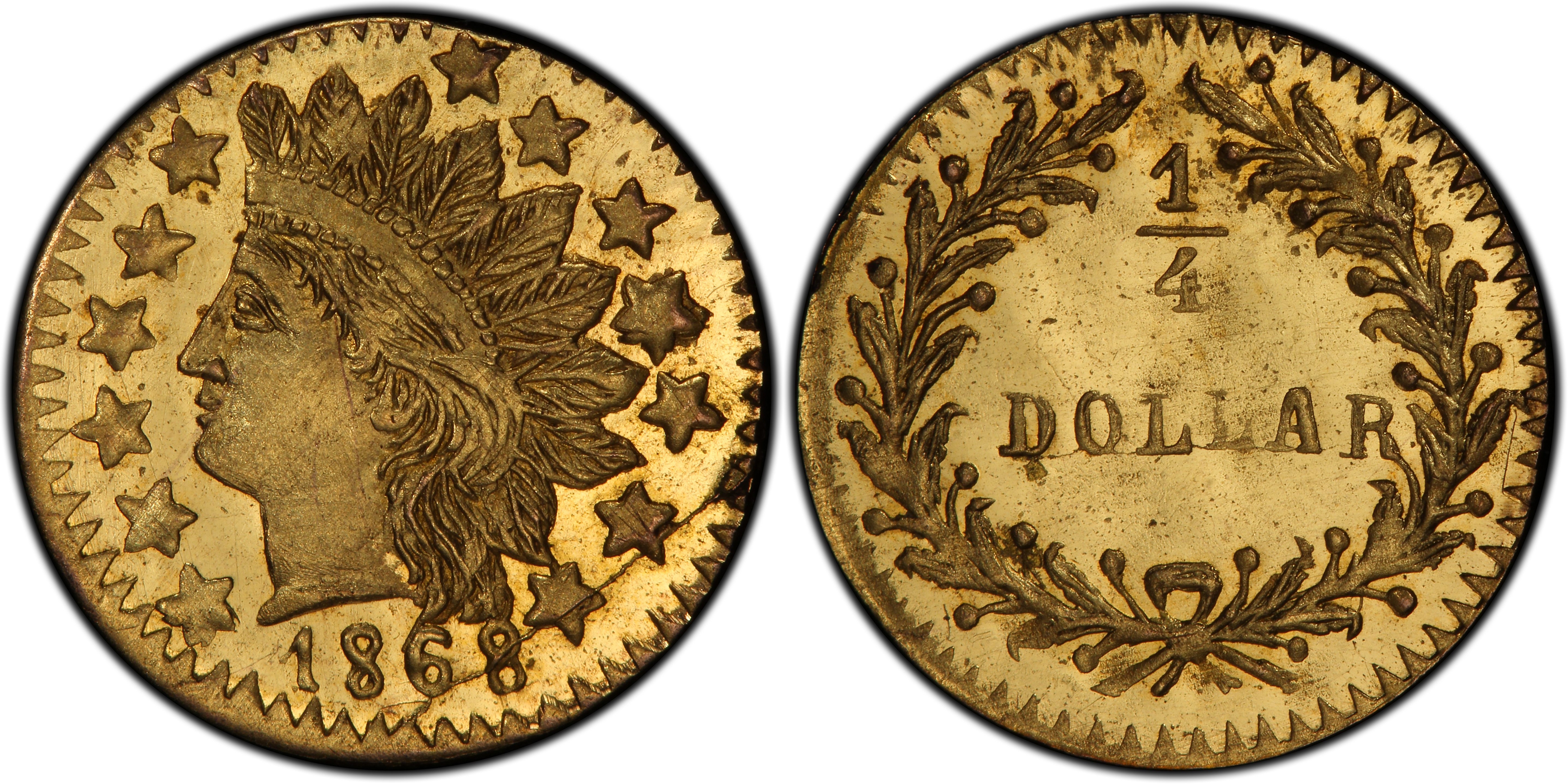
Obverse & Reverse
The 1868 BG-889 25 Cents piece emerges from the second major phase of California's private gold coinage, a period numismatists designate as 'Period Two' (1859-1882). Unlike the earlier 'Period One' issues, which were struck out of genuine necessity to alleviate a critical shortage of small change during the initial Gold Rush, Period Two pieces were created in a different economic climate. By the late 1860s, the San Francisco Mint was in full operation, supplying the region with ample federal coinage. The impetus for striking these tiny gold pieces had shifted from commerce to souvenir and novelty sales. San Francisco's jewelers, many of whom were French immigrants with exceptional engraving skills, recognized a lucrative market in selling these miniature gold 'coins' as keepsakes and jewelry items to tourists and locals alike. These 'jewelers' issues,' as they are often called, were not intended to circulate as money, a fact reflected in their physical characteristics. They were typically underweight for their stated denomination and often struck in gold of varying fineness, from as low as 14-karat up to near-pure gold, depending on the maker. The Coinage Act of 1864 had made private coinage illegal, but the law was not strictly enforced against these small, denominated tokens until the early 1880s. Minters operated in a legal gray area, producing pieces that mimicked federal coinage designs, like the popular Indian Head motif, to enhance their appeal. The BG-889 is a quintessential example of this phenomenon: a beautifully crafted, yet fundamentally unofficial, piece of gold that captures the transition of California from a raw frontier to a place of burgeoning tourism and commerce, where the memory of the Gold Rush was itself a commodity.
Associated EventCalifornia Gold Rush Aftermath
Reason For MintingPrimarily created as a souvenir or jewelry item for the novelty trade, rather than for circulation.
Minter HistoryThe specific minter of BG-889 is unknown, which is characteristic of many Period Two issues. These pieces were generally produced by various manufacturing jewelers operating in San Francisco. Firms such as Robert B. Gray & Co. and the California Jewelry Co. (Levison Bros.) were known producers of fractional gold during this era. They possessed the skilled engravers and coin presses necessary for this work. These minters were entrepreneurs who capitalized on the romantic appeal of the Gold Rush, creating a wide variety of designs to entice buyers. Their work is often unsigned, making specific attribution a challenge for numismatic researchers.
Historical SignificanceThe BG-889 is significant not as a circulating coin, but as a tangible artifact of California's economic evolution. It represents a period when the state's identity was shifting from a site of raw resource extraction to a cultural and tourist destination. These pieces demonstrate the privatization of the Gold Rush's legacy, transforming gold from a medium of exchange into a memento. As a 'jeweler's issue,' its existence highlights a niche but vibrant industry in post-Gold Rush San Francisco, and its high rarity today underscores the limited, artisanal nature of its production.
N/A
Denomination25 Cents
Minting Period1868
Assayer/MinterUnknown Private Minter
Geographic OriginSan Francisco, California
Obverse DescriptionThe obverse features a Native American princess profile facing left, commonly referred to as an 'Indian Head'. She wears a feathered headdress. The portrait is encircled by thirteen six-pointed stars, representing the original colonies. The date '1868' is positioned below the bust.
Obverse Inscription1868
Reverse DescriptionThe reverse design consists of a wreath composed of two branches tied together at the bottom with a bow. Within the wreath, the denomination is stated on two lines as '1/4' and 'DOLLAR'.
Reverse Inscription1/4 DOLLAR
CompositionGold
Stated Fineness Actual FinenessVaries, typically 14 to 22 karats for Period Two issues.
EdgePlain
Unknown, but extremely small.
Survival Estimate13-18 pieces.
Rarity ScaleHigh R-6
The 1868 BG-889 is highly sought after due to its extreme rarity and attractive Indian Head design. As a Period Two issue, it is part of the extensive and popular California Fractional Gold series. Its status as a 'High R-6' variety places it among the rarest and most desirable pieces in the entire series, appealing to advanced collectors who seek out trophy-level coins.
Key VarietiesThe BG-889 is a specific die marriage and represents a single variety. No major variations from the original minting period are known. Unlike some other private gold series, there are no known official restrikes. Any pieces appearing to be of this variety but with different characteristics are likely contemporary counterfeits or modern replicas.
Authentication TipsThe primary diagnostic for a genuine BG-889 is a prominent, bold obverse die crack running from the rim at approximately 3:30, down through the star, and continuing to the rim near 6 o'clock. This feature is a result of the die failing during the striking process and may have limited the total mintage. Look for sharp details on well-struck examples, but be aware that many fractionals exhibit some weakness. Genuine pieces from this era should have the denomination spelled out as 'DOLLAR'. Replicas often say 'CALIFORNIA GOLD' or feature a bear on the reverse, which are telltale signs of a non-contemporary souvenir token. The surfaces of fakes are often unnaturally smooth or have a cast-like texture, whereas genuine pieces have the flow lines and striking characteristics of a die-struck coin.
Shopping ConsiderationsFor a premium quality BG-889, a buyer should prioritize sharpness of strike on the Indian's headdress and the details within the wreath. Given its rarity, any example is significant, but those with minimal marks and abrasions command a substantial premium. Luster is also a key factor; original, Prooflike (PL) or Deep Mirror Prooflike (DMPL) surfaces are exceptionally rare and desirable, as evidenced by auction records. The die crack is an identifying feature, not a flaw, and should be present. Avoid examples that have been harshly cleaned, polished, or used as jewelry, as this severely impairs their value. Certification by PCGS or NGC is essential for a purchase of this magnitude to guarantee authenticity and provide a standardized grade.
A coin's grade is its condition, rated on a 1-70 scale. For rare coins, this is the most critical factor in determining value, as a tiny difference in preservation can mean a huge difference in price.
Relevant Grade TypesOriginal issues of BG-889 were business strikes, although they were not intended for circulation and were sold as souvenirs. Therefore, they are found in both Circulated (1-58) and, more commonly, Mint State (MS, 60-70) grades. No true Proofs were struck during the original period of issue. The jewel-like quality of some examples may earn them a Prooflike (PL) or Deep Mirror Prooflike (DMPL) designation from grading services, but these are a reflection of the planchet preparation and strike quality for a business strike, not a separate striking process.
Mint State CharacteristicsAn uncirculated BG-889 is defined by the quality of its luster and the absence of wear. High-grade examples often exhibit flashy, mirrored surfaces, hence the frequency of PL and DMPL designations. The strike can be uneven due to the crude hammer-press methods used, but premium examples will show crisp detail in the feathers and the wreath. Being very small and made of soft gold, even uncirculated pieces are susceptible to tiny contact marks or 'flyspecks' that can affect the grade. The overall eye appeal, combining luster, strike, and surface preservation, is paramount.
Circulated Wear PatternsAlthough not intended for circulation, some pieces may show wear from being handled or kept in a pocket. The highest points to show wear first would be the cheek and brow of the Indian princess, the feathers in the headdress, and the high points of the bow and leaves on the reverse. On lower-grade circulated examples, the stars and the finer details of the wreath would begin to merge with the fields.
Key Factors For ValueRarity is the primary driver of value for the BG-889. With only 13-18 known, any example is valuable. After that, grade and surface quality are the key differentiators. A coin with original, unimpaired surfaces and strong luster will be worth multiples of one that has been cleaned or damaged. The sharpness of the strike is critical; a fully struck specimen is a rarity and highly prized. Eye appeal, including any attractive reddish-gold toning that may develop, can add a premium. A CAC sticker for this issue would indicate premium quality for the grade and would be highly sought after by discerning collectors.
PCGS Price Guide
| Grade | Price | Population |
|---|---|---|
| 62 | $375.00 | 1 |
| 62+ | $425.00 | N/A |
| 63 | $500.00 | 4 |
| 63+ | $575.00 | N/A |
| 64 | $700.00 | 9 |
| 64+ | $850.00 | N/A |
| 65 | $1,000.00 | 1 |
| 65+ | $1,350.00 | N/A |
| 66 | $2,000.00 | 2 |