1871 G50C BG-1041 (Regular Strike)
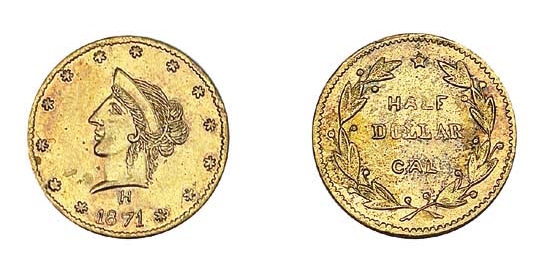
Obverse & Reverse
The 1871 G50C BG-1041 is a fascinating and historically rich artifact from the second period of California Fractional Gold production (1859-1882). This era, often termed the 'Jewelers' Period,' saw a shift from the earlier, more functional issues of the 1850s, which arose from a genuine shortage of small change, to pieces made primarily as souvenirs and keepsakes. By the 1870s, the California economy was more mature, and the initial, desperate need for circulating private coinage had waned with the establishment of the San Francisco Mint. However, the romance of the Gold Rush was a powerful marketing tool, and demand for tiny, gold mementos was high among tourists and those back East. Enter Reuben N. Hershfield and Noah Mitchell, enterprising jewelers who, rather unconventionally, operated not out of San Francisco but from Leavenworth, Kansas. In 1871, recognizing the lucrative market, they decided it was more profitable to manufacture their own 'California Gold' pieces than to buy them for resale. They hired a local die-cutter named Fredenburg to create dies for 25 and 50 cent denominations. These pieces, including the BG-1041, were all struck in 1871 and are identifiable by a small 'H' for Hershfield on the obverse. Their venture was short-lived. The pieces were significantly underweight for their purported face value, functioning purely as tokens. This practice, combined with the general crackdown on private coinage under the Private Coinage Act of 1864, drew the unwanted attention of the U.S. Secret Service. In August 1871, federal agents raided Hershfield and Mitchell's establishment, confiscating their stock and arresting the proprietors. This abrupt end to their minting operation is a primary reason for the rarity of their issues today. The BG-1041 is therefore not just a numismatic item, but a tangible link to the entrepreneurial spirit of the post-Civil War West and the federal government's efforts to centralize and control the nation's currency.
Associated EventPost-Gold Rush 'Jewelers' Period' of private token production.
Reason For MintingTo be sold as popular souvenirs and jewelry charms capitalizing on the mystique of the California Gold Rush.
Minter HistoryReuben N. Hershfield and Noah Mitchell were successful jewelers based in Leavenworth, Kansas, a bustling frontier town. Their firm grew rapidly, with a large manufacturing workforce and salesmen covering several states. In 1871, they ventured into the production of 'California Fractional Gold' tokens, all bearing an 'H' hallmark. Their operation was a prime example of the 'Period Two' issues being produced outside of California for a national market. However, their enterprise was abruptly terminated in August 1871 when the U.S. Secret Service, enforcing the long-standing but often ignored 1864 Private Coinage Act, arrested them and seized their inventory, making their one-year-only issues exceptionally scarce.
Historical SignificanceThe BG-1041 represents a unique and short-lived chapter within the broader California Fractional Gold series. It highlights how the production of these pieces had evolved from a necessity of commerce to a novelty industry, even extending far beyond California's borders. Its story, culminating in a government raid, underscores the legal and economic tensions surrounding private coinage in the late 19th century.
BG-1041
Denomination50 Cents
Minting Period1871
Assayer/MinterReuben N. Hershfield and Noah Mitchell
Geographic OriginLeavenworth, Kansas
Obverse DescriptionA head of Liberty facing left, with coronet inscribed LIBERTY. Thirteen stars encircle the bust, seven to the left and six to the right. The date 1871 is below. A small, distinctive letter 'H' (for Hershfield) is located in the field below the truncation of Liberty's neck.
Obverse InscriptionLIBERTY
Reverse DescriptionThe denomination '1/2' is enclosed within a wreath of two olive branches tied with a bow at the bottom. The legend CALIFORNIA GOLD surrounds the wreath.
Reverse InscriptionCALIFORNIA GOLD 1/2
CompositionGold
Stated Fineness Actual FinenessVariable, but generally lower than monetary-issue gold.
Diameter11.00 mm
EdgePlain
Unknown
Survival Estimate13 to 30 pieces
Rarity ScaleR-6
The BG-1041 is highly sought after for its high rarity (R-6), its one-year-only issuance, and its compelling backstory involving the U.S. Secret Service. The distinctive 'H' mintmark makes it an attributable and historically significant piece from a non-California minter, adding a unique layer to any collection of fractional gold.
Key VarietiesThere are no known major varieties of the BG-1041 from its original striking period. As a 'Period Two' or 'Jeweler's Issue,' it was created as a collectible from the start, so no patterns or trial pieces are known to exist. All genuine examples are considered business strikes. No later restrikes were made due to the seizure of the operation.
Authentication TipsThe primary diagnostic is the small 'H' below Liberty's bust, which should match the style used by Hershfield and Mitchell. The overall strike quality can be inconsistent, but the design details should be sharp on high-grade examples. Look for the correct die markers and compare against known genuine examples, such as those imaged by PCGS or NGC. Counterfeits of this series are rampant; many fakes are brassy in color, have incorrect weights, or feature a bear on the reverse instead of the proper wreath and denomination. Genuine pieces are typically very thin.
Shopping ConsiderationsFor a premium quality example, seek a specimen with a sharp strike, particularly on Liberty's coronet, the date, and the details of the wreath. Luster is a key factor; original, unimpaired surfaces will exhibit a soft, satiny glow, sometimes with semi-prooflike fields. Many surviving examples have been cleaned or used as jewelry, so check carefully for hairlines, evidence of solder or mounting, or rim damage. A smooth, problem-free surface commands a significant premium. Given the high rarity, any example without significant impairments is a prize, but one with strong eye appeal and certified by a top-tier grading service is the most desirable.
A coin's grade is its condition, rated on a 1-70 scale. For rare coins, this is the most critical factor in determining value, as a tiny difference in preservation can mean a huge difference in price.
Relevant Grade TypesOriginal BG-1041 issues were business strikes intended for sale as souvenirs, not circulation. They are found in both Circulated (1-58) and, more commonly, Mint State (MS, 60-70) grades, as many were saved as keepsakes. No Proofs were struck during the original period of manufacture, and no later-date restrikes exist for this variety.
Mint State CharacteristicsUncirculated examples of BG-1041 often display a soft, somewhat prooflike luster in the fields, a result of the polished dies used by jewelers. The strike can be variable; a sharply struck coin will show full details in Liberty's hair and the wreath's leaves, but some weakness is not uncommon. Due to the small size and soft gold, even high-grade specimens may exhibit minuscule planchet flaws or contact marks. A superior MS example will have minimal marks, strong luster, and excellent eye appeal.
Circulated Wear PatternsOn circulated examples, wear first appears on the highest points: Liberty's cheek, the hair above the ear, and the coronet. On the reverse, the leaves and bow of the wreath will show initial friction and flattening. In lower grades (VF and below), the letters in LIBERTY and the date will begin to soften and merge with the fields.
Key Factors For ValueRarity is the primary driver of value for this R-6 issue. After that, surface preservation is paramount. An example with original, uncleaned surfaces and vibrant luster will command a substantial premium over a cleaned or damaged coin of the same grade. Strike quality is also critical; coins with bold details are highly preferred. Finally, a CAC sticker for this issue provides third-party verification of quality and often results in a significantly higher market value.
PCGS Price Guide
| Grade | Price | Population |
|---|---|---|
| 50 | $375.00 | 1 |
| 50+ | $425.00 | N/A |
| 53 | $475.00 | N/A |
| 53+ | $525.00 | N/A |
| 55 | $575.00 | 3 |
| 55+ | $650.00 | N/A |
| 58 | $750.00 | 1 |
| 58+ | $850.00 | N/A |
| 60 | $1,000.00 | N/A |
| 61 | $1,250.00 | 1 |
| 62 | $1,750.00 | 4 |
| 62+ | $1,900.00 | N/A |
| 63 | $2,250.00 | 3 |