1876 G25C BG-879 (Regular Strike)
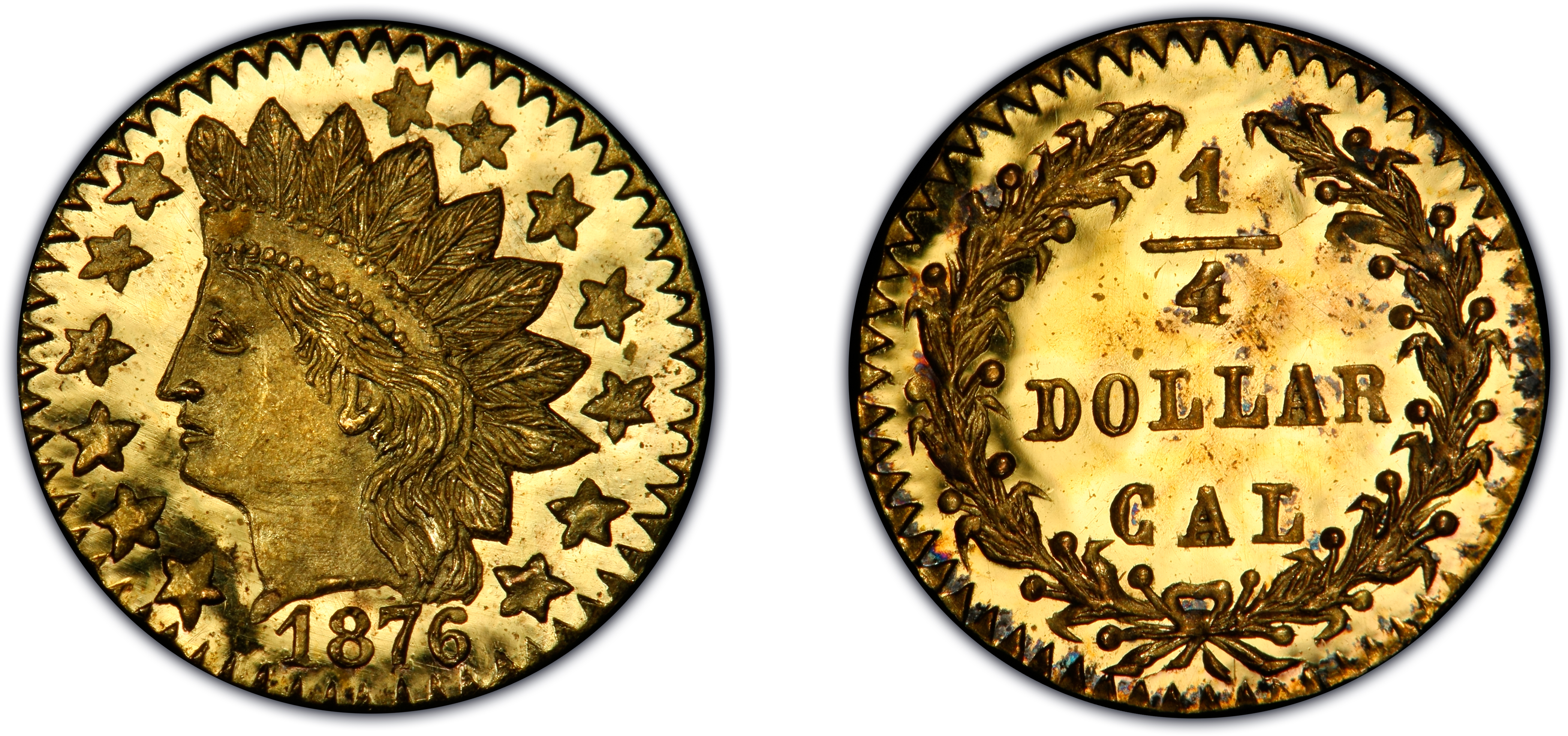
Obverse & Reverse
The 1876 BG-879 25 Cent piece emerged from the second period (1859-1882) of California Fractional Gold production, a fascinating and complex chapter in American numismatics. The initial impetus for these tiny gold coins in the early 1850s was a severe shortage of small denomination currency to facilitate everyday transactions in the isolated, gold-rich economy of post-Gold Rush California. Gold dust was cumbersome and unreliable for minor purchases, and the output of the new San Francisco Mint was initially focused on larger denominations. Private minters filled this void with quarter dollar, half dollar, and dollar pieces. By the mid-1870s, the economic landscape had changed. The San Francisco Mint was in full operation, and official U.S. silver and minor coinage had become plentiful, eliminating the original commercial need for fractional gold. The nature of these private issues thus transformed. The Act of 1864 had made private coinage illegal, but lax enforcement allowed production to continue. The coins of this 'Period Two' are often referred to as 'jeweler's issues,' as they were primarily struck by jewelers and artisans not as circulating currency, but as souvenirs, keepsakes, and novelty items for tourists and locals alike. They captured the romanticism of the Gold Rush era in a tiny, affordable, golden format. The BG-879, dated for the nation's Centennial, would have been an especially popular memento. These later issues were often lighter and of a more variable fineness than their Period One predecessors, as their value was in their novelty rather than their intrinsic worth. Production was crude, often employing a hammer-striking method where dies were struck manually, resulting in inconsistent strike quality. The Secret Service finally cracked down on their production in 1883, bringing the era of California Fractional Gold to a definitive end and cementing the status of existing pieces as treasured historical artifacts.
Associated EventPost-California Gold Rush economic development
Reason For MintingPrimarily created as souvenirs and novelty items for the tourist trade, not for general circulation.
Minter HistoryThe minters of most Period Two fractional gold, including the BG-879 variety, are anonymous. They were typically jewelers and artisans based in San Francisco who had the skills and equipment for die-sinking and striking. Unlike the more prominent private minters of the early 1850s (like Moffat & Co. or Wass, Molitor & Co.), these craftsmen operated on a smaller scale, producing a wide variety of designs to appeal to the souvenir market. Their identities are lost to history, but their prolific and diverse output created a rich field for modern numismatists to study.
Historical SignificanceThe BG-879 is a tangible link to the 'souvenir phase' of the California Gold Rush era. While not a coin of necessity like its earlier counterparts, it represents the enduring romanticism of gold and the West. It tells a story of adaptation in a private enterprise, shifting from fulfilling a monetary need to catering to a tourist and collector market. The entire series of fractional gold is a testament to the unique economic conditions of 19th-century California and a rare instance of sustained private coinage in U.S. history.
N/A
Denomination25 Cents
Minting Period1876
Assayer/MinterAnonymous (Jeweler's Issue)
Geographic OriginSan Francisco, California
Obverse DescriptionA stylized Native American head facing left, often described as an Indian Head. The portrait features a feathered headdress. The field is surrounded by 13 five-pointed stars, representing the original colonies. The date, 1876, appears below the bust.
Obverse Inscription1876
Reverse DescriptionThe central design element is the denomination expressed as '1/4 DOL.'. This is enclosed within a continuous wreath composed of two branches tied together by a bow at the bottom. The legend 'CAL.' is situated above the wreath, along the upper periphery.
Reverse InscriptionCAL. 1/4 DOL.
CompositionGold
Stated Fineness Actual Fineness EdgePlain
Unknown
Survival Estimate75-125 coins in all grades. This estimate is based on the combined NGC and PCGS population reports (totaling over 60 coins as of late 2025) and an allowance for raw, unsubmitted examples.
Rarity ScaleR-4 (76-200 known)
The 1876 BG-879 is popular due to its classic Indian Head design, its historic connection to the U.S. Centennial, and its status as a representative of the widely collected California Fractional Gold series. Its small size and relative affordability in lower mint state grades make it an accessible entry point into this fascinating field, while high-grade, sharply struck examples are prized by specialists.
Key VarietiesThe primary variety is the Regular Strike business issue. No proof strikings from the period of issue are known to exist. As these were made outside of official government channels, no patterns, trial pieces, or official restrikes are recorded. Collectors should be aware of a large number of modern replicas, fantasies (often with a bear on the reverse), and counterfeit pieces that plague the series. All genuine Period Two issues must be denominated.
Authentication TipsGenuine BG-879 pieces will have a specific die look that differs from forgeries. Look for sharp, well-defined details, especially in the fine feathers and the wreath, which are often mushy on counterfeits. The numerals in the date should have a distinct style consistent with known genuine examples. A key diagnostic for all genuine fractional gold is the presence of a denomination (e.g., 'DOL.', 'CENTS'); modern tokens made after the Secret Service crackdown often say 'CAL GOLD' or 'CHARM' instead. Pieces with a bear on the reverse are always modern fantasies. Authentication by a major third-party grading service (PCGS or NGC) is highly recommended.
Shopping ConsiderationsA premium quality BG-879 is defined by a sharp, well-centered strike. Look for full definition in the feathers of the headdress and the individual leaves and bow of the wreath. Luster is a key factor; original, vibrant, prooflike (PL) or deep prooflike (DPL) surfaces command significant premiums. The soft nature of the gold makes these coins susceptible to contact marks and scratches; a 'clean' coin with minimal distracting marks is highly desirable. Avoid examples that have been cleaned, which imparts a dull, lifeless appearance, or those that have been used in jewelry, which may show evidence of soldering or rim damage. Original, unadulterated surfaces and strong eye appeal are paramount.
A coin's grade is its condition, rated on a 1-70 scale. For rare coins, this is the most critical factor in determining value, as a tiny difference in preservation can mean a huge difference in price.
Relevant Grade TypesOriginal period issues were business strikes, although not intended for widespread circulation. They are found in Circulated (1-58) and, more commonly, Mint State (MS, 60-70) grades due to their use as souvenirs. The vast majority of surviving examples are uncirculated. No true Proof (PR/PF) examples were struck during the original period of issue; however, many were struck on polished planchets and exhibit prooflike surfaces, which are designated as PL or DPL by grading services and are highly sought after.
Mint State CharacteristicsIn Mint State, the BG-879 often displays a sharp strike, though weakness on the highest points of the design, such as the Indian's cheek or the center of the wreath's bow, is not uncommon due to the manual striking process. Luster can range from soft and satiny to deeply prooflike and reflective. As these coins were handled as novelties, even high-grade uncirculated examples can show minor scattered contact marks or 'tick' marks from being stored with other pieces. The overall eye appeal, combining strike, luster, and surface preservation, is critical.
Circulated Wear PatternsFor the rare circulated example, wear first appears on the highest points of the design. On the obverse, this includes the cheekbone and the feathers of the headdress. On the reverse, the highest parts of the wreath leaves and the tie of the bow will show the first signs of friction and flattening. In lower grades (VF and below), the finer details of the feathers and wreath will merge, and the legends and date will begin to soften.
Key Factors For ValueThe primary value drivers for an 1876 BG-879 are grade and surface characteristics. A Mint State coin is worth significantly more than a circulated one. Within uncirculated grades, the quality of the strike is paramount—a sharply struck coin is always preferred. Surface quality is the next key factor; coins with original, vibrant luster and minimal contact marks are prized. A significant premium is attached to examples designated as Prooflike (PL) or Deep Prooflike (DPL) by PCGS or NGC. Finally, certification by a top-tier grading service is essential for market acceptance, with a CAC sticker adding a further premium for coins deemed superior for the grade.
PCGS Price Guide
| Grade | Price | Population |
|---|---|---|
| 58 | $275.00 | 2 |
| 58+ | $280.00 | N/A |
| 60 | $300.00 | 1 |
| 61 | $350.00 | 1 |
| 62 | $400.00 | 16 |
| 62+ | $450.00 | N/A |
| 63 | $550.00 | 22 |
| 63+ | $580.00 | N/A |
| 64 | $620.00 | 26 |
| 64+ | $715.00 | 1 |
| 65 | $875.00 | 13 |
| 65+ | $1,150.00 | N/A |
| 66 | $2,500.00 | 2 |
| 66+ | $2,750.00 | N/A |
| 67 | $3,000.00 | N/A |