1871 G25C BG-862, PL (Regular Strike)
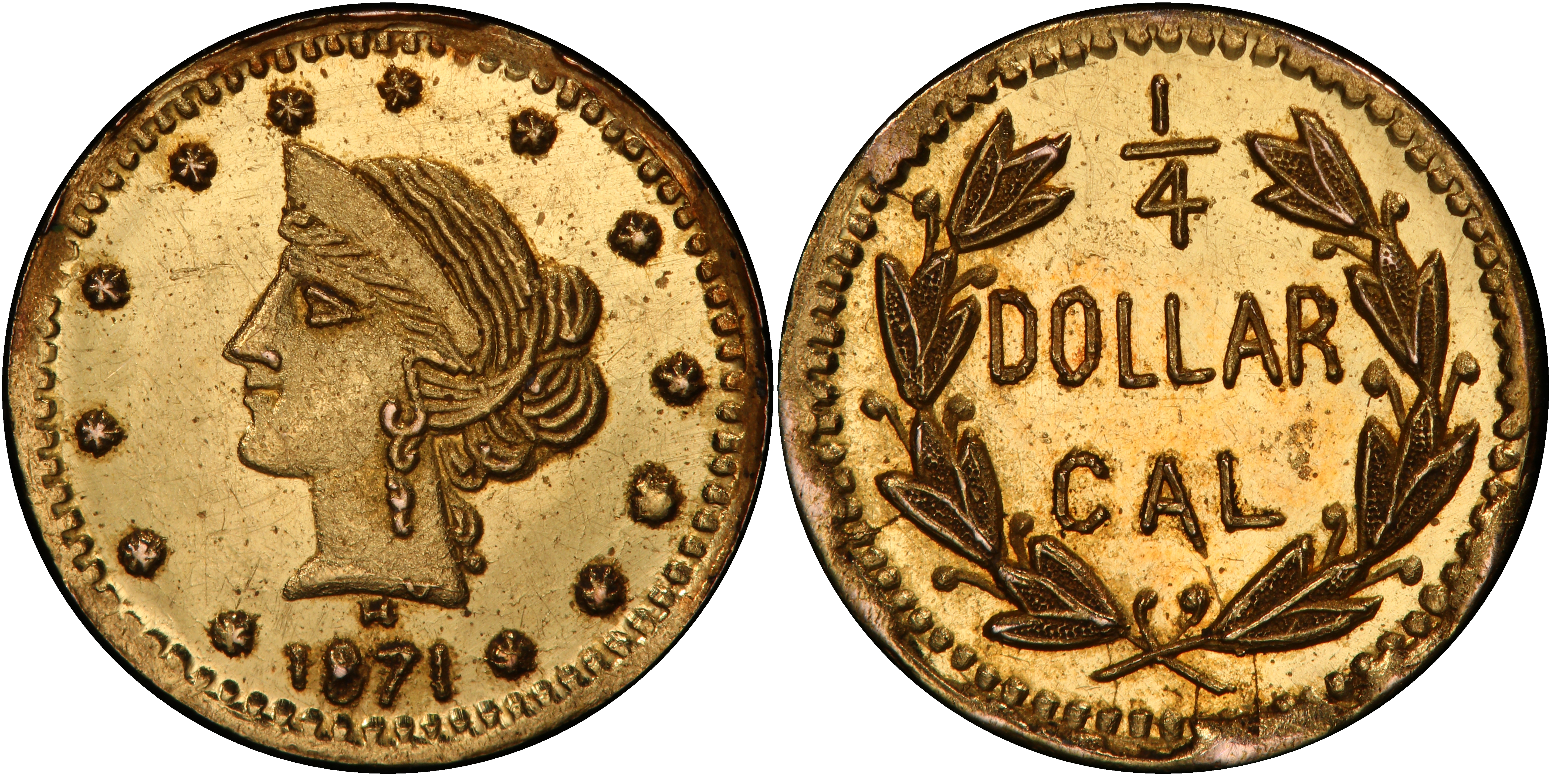
Obverse & Reverse
The 1871 BG-862 25 Cents represents the second major phase of California Fractional Gold production, often termed 'Period Two' (1859-1882). By this era, the raw necessity for small change that drove the creation of the earlier 'Period One' issues had largely subsided with the improved circulation of federal coinage. Instead, these later pieces evolved to serve a burgeoning souvenir and jewelry market. San Francisco jewelers, many of whom were anonymous, became the primary producers. These 'jeweler's issues' were not intended to meet a specific monetary standard; they were intentionally struck with a gold value significantly lower than their face value, functioning essentially as tokens or keepsakes. The Private Coinage Act of 1864 had explicitly forbidden the issuance of private coins intended for circulation, but the law was inconsistently enforced against these small, low-value pieces which were widely understood to be novelties. The makers often employed cruder, more stylized designs compared to their Period One predecessors, reflecting their commercial purpose. The BG-862 variety, with its simple Liberty motif, was a typical product of its time, offering a tangible, affordable memento of California's gold rush legacy to tourists and locals alike. Most were produced via the hammer method, where a planchet was struck between two dies using a sledgehammer, resulting in considerable variability in strike quality. The majority of these pieces met their end in the melting pot over the subsequent decades, making any surviving examples, particularly in high grade, significant numismatic rarities.
Associated EventPost-Gold Rush California Economic Expansion
Reason For MintingPrimarily created to serve as souvenirs and jewelry items for a growing tourist trade, rather than to alleviate a currency shortage.
Minter HistoryThe specific minter or jeweler who produced the BG-862 variety is unknown. This anonymity is characteristic of many 'Period Two' California Fractional Gold producers, who operated in a legally gray area following the Private Coinage Act of 1864 and produced these pieces as novelties rather than official currency.
Historical SignificanceThe BG-862 is significant not as a circulating coin, but as a historical artifact representing the commercialization of the Gold Rush legend. It marks the transition of private gold coinage from a utilitarian necessity to a popular souvenir, reflecting California's evolving economy and its burgeoning identity as a tourist destination.
BG-862
Denomination25 Cents (G25C)
Minting Period1871
Assayer/MinterAnonymous
Geographic OriginSan Francisco, California
Obverse DescriptionA crudely rendered Liberty Head facing left, with hair tied in a bun. The portrait is surrounded by thirteen five-pointed stars, often unevenly spaced and struck. The date '1871' is positioned below the bust.
Obverse Inscription1871
Reverse DescriptionThe denomination '1/4' is enclosed within a simple wreath composed of two olive branches tied with a bow at the bottom. The legend 'CALIFORNIA GOLD' encircles the wreath along the upper periphery. A small dot or pellet is often visible between the words CALIFORNIA and GOLD at the top.
Reverse InscriptionCALIFORNIA GOLD 1/4
CompositionGold
Stated Fineness Actual FinenessTypically low, estimated between .350 and .500 fine, consistent with Period Two jeweler's issues.
Diameter9.50 mm
EdgePlain
Unknown
Survival Estimate13-30 coins
Rarity ScaleHigh R-6
This variety appeals to specialists in California Fractional Gold due to its high rarity (High R-6). As a Period Two issue, it tells the story of the souvenir-driven phase of this fascinating series. The challenge of acquiring a well-struck, high-grade example is a primary driver of its desirability.
Key VarietiesThe BG-862 is a single, distinct die marriage. No major varieties, patterns, or official restrikes are known to exist from the period of issue. Any later reproductions are considered copies or replicas and have no numismatic value.
Authentication TipsAuthentic examples are struck in gold, not plated. Check for a soft, original luster rather than a hard, glassy shine typical of modern copies. The strike is often crude and uneven, a characteristic of hammer striking. Edges should be plain. The style of the numerals in the date and the lettering should be compared to known genuine examples, as counterfeit dies often have incorrect fonts. Diagnostics for this die pair include the specific positioning of the stars relative to the portrait and the pellet on the reverse.
Shopping ConsiderationsA premium quality example for this issue is defined by sharpness of strike, particularly on Liberty's hair details and the numerals of the '1/4' on the reverse. Many examples are weakly struck in the centers. Look for specimens with smooth, prooflike (PL) or semi-prooflike fields, which are highly coveted. Original, uncleaned surfaces with a hint of reddish-gold toning command significant premiums. Avoid coins that have been harshly cleaned, polished, or used as jewelry, although evidence of the latter is common for the series. Check carefully for tooling in the fields or around the devices, which may have been done to 'improve' a weak strike.
A coin's grade is its condition, rated on a 1-70 scale. For rare coins, this is the most critical factor in determining value, as a tiny difference in preservation can mean a huge difference in price.
Relevant Grade TypesOriginal issues were business strikes, although intended as souvenirs rather than for circulation. They are found in Circulated grades (1-58), but are much more commonly encountered and collected in Mint State (MS, 60-70). Some specimens exhibit prooflike (PL) surfaces from being struck with polished dies, but these are not true Proofs. No official Proofs were struck during the original minting period, and no later-date official restrikes exist.
Mint State CharacteristicsUncirculated examples are defined by their luster, which can range from satiny to deeply prooflike. Due to the hammer-striking process, the quality of the strike is paramount and varies widely. Many MS examples are weakly struck on the high points of Liberty's hair and the wreath. The fields are susceptible to small planchet flaws and ticks, even on high-grade pieces. A premium MS coin will have a bold strike, clean fields, and vibrant luster.
Circulated Wear PatternsOn circulated examples, wear first appears on the highest points of Liberty's cheek, hair bun, and the leaves of the wreath. As wear progresses, the stars on the obverse and the fraction on the reverse will begin to lose their definition. In lower grades (Fine and below), the date and peripheral lettering start to become weak or merge with the rim.
Key Factors For ValueFor the BG-862, value is driven by three main factors: rarity, grade, and eye appeal. Given its High R-6 status, any example is valuable. A high Mint State grade (MS-63 or better) dramatically increases value. Surface quality is critical; coins with original, undisturbed luster and minimal marks are prized. A specimen designated as Prooflike (PL) will command a substantial premium over a standard MS example of the same grade. Finally, a CAC sticker, indicating premium quality for the grade, adds another significant layer of value.
PCGS Price Guide
| Grade | Price | Population |
|---|---|---|
| 64 | $2,500.00 | 1 |