1855/4 G25C BG-106, PL (Regular Strike)
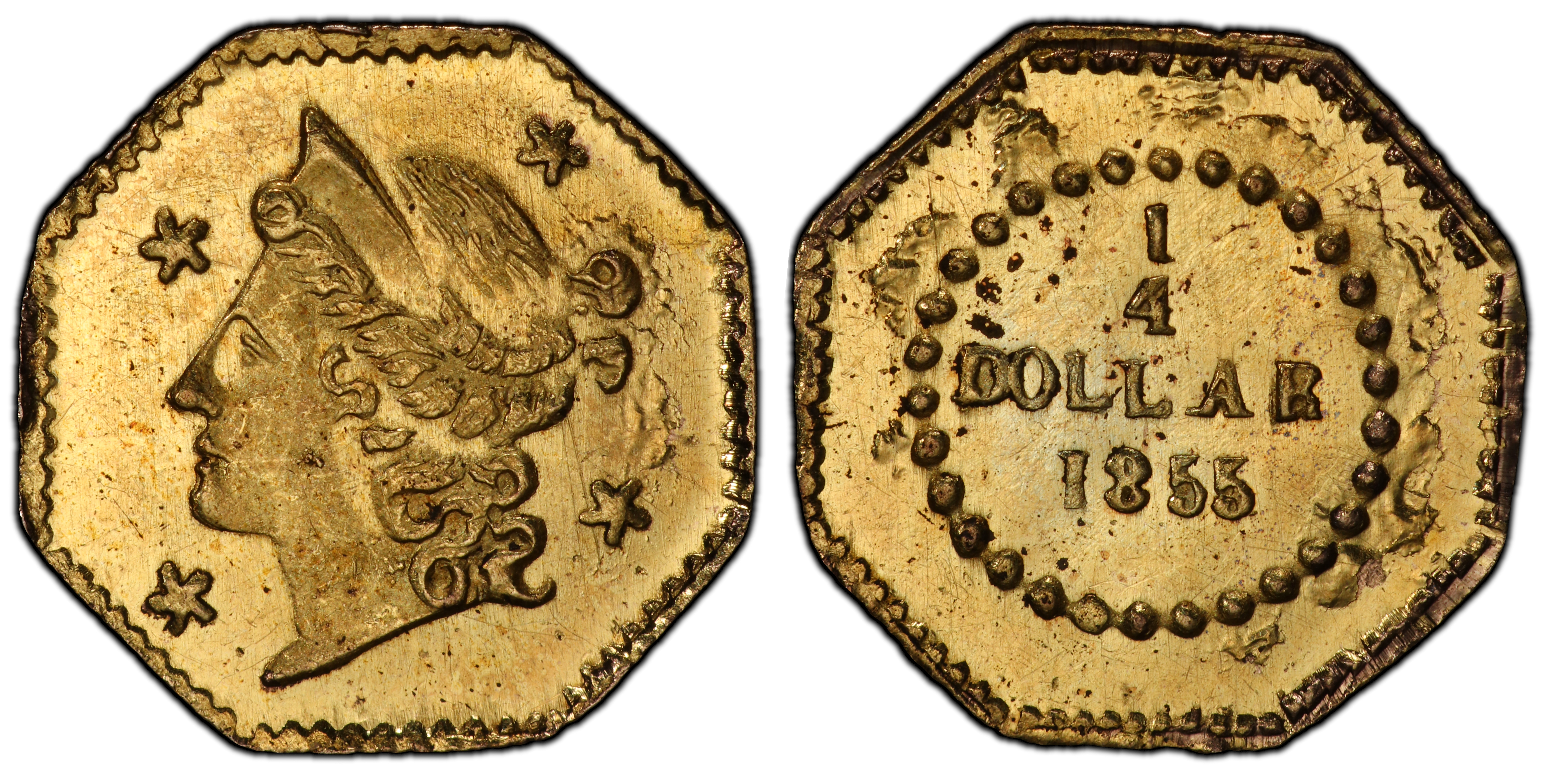
Obverse & Reverse
The 1855/4 BG-106 25 Cents is a quintessential artifact of the 'Period One' California Fractional Gold series, a tangible link to the chaotic and economically vibrant era of the California Gold Rush. Following the discovery of gold at Sutter's Mill in 1848, a massive influx of over 300,000 people descended upon California, creating an instant and overwhelming demand for housing, goods, and services. This new economy was awash in gold dust, but critically lacked sufficient circulating coinage for everyday transactions. A 'pinch' of gold dust for a drink was an imprecise and often contentious method of payment. While the U.S. government was slow to respond—the San Francisco Mint would not open until 1854 and initially focused on larger denominations—private jewelers and metallurgists stepped into the void. These artisans, leveraging their skills in working with precious metals, began producing their own small-denomination gold coins in 1852. These pieces, including quarter dollars, half dollars, and dollars, were not official U.S. tender but were widely accepted in commerce out of sheer necessity. The BG-106 variety is attributed to the firm of Gaime, Guillemot & Co., French jewelers located at 140 Montgomery Street in San Francisco. Like most of its contemporaries, it was produced by the crude but effective 'hammer method,' where a gold planchet was placed between two dies and struck with a sledgehammer, resulting in variable strike quality. The BG-106 is an overdate, with the 5 punched over a 4 on the reverse die, a common money-saving practice of the time. These 'Period One' coins (1852-1857) were minted with the genuine intent of serving as currency. However, their minuscule size made them impractical and easy to lose, and as the San Francisco Mint increased production of federal coinage, the need for these private issues waned. By 1858, the nature of fractional gold shifted towards souvenirs for tourists and collectors, but the BG-106 remains a relic of the brief period when private enterprise directly solved a critical monetary crisis on the American frontier.
Associated EventCalifornia Gold Rush
Reason For MintingTo alleviate a severe shortage of small-denomination circulating coinage for daily commerce in Gold Rush-era California.
Minter HistoryGaime, Guillemot & Co. were French jewelers and watchmakers active in San Francisco during the 1850s. Their establishment on Montgomery Street placed them in the heart of the city's burgeoning commercial district. While primarily jewelers, the economic conditions of the Gold Rush led them, like many of their peers, to enter the lucrative business of private coining. They are numismatically credited with producing a series of octagonal Liberty Head fractional gold pieces, cataloged as Breen-Gillio numbers 101 through 111. Their work is characteristic of the 'Period One' issues, intended for actual circulation and generally of higher quality and gold content than the later souvenir pieces.
Historical SignificanceThe BG-106, as a 'Period One' fractional gold piece, represents a direct solution by private enterprise to a failure in the government's monetary supply chain. It is a historical testament to the resourcefulness of merchants and artisans during the Gold Rush and embodies the economic reality of a society where gold was plentiful but small change was scarce. These pieces are among the only privately issued coins to have circulated widely as money in American history, preceding federal laws that would later prohibit such practices.
BG-106
Denomination25 Cents
Minting Period1855
Assayer/MinterGaime, Guillemot & Co.
Geographic OriginSan Francisco, California
Obverse DescriptionA fairly crude representation of a Liberty Head, facing left, with hair tied in a bun. The portrait is encircled by thirteen five-pointed stars, representing the original colonies. The stars are unevenly spaced and styled.
Obverse Inscription Reverse DescriptionThe denomination '1/4' appears in the center, with 'DOLLAR' below it, all enclosed within a simple wreath of two branches tied by a bow at the bottom. The date '1855' is positioned above the wreath. This is an overdate variety, with the final '5' clearly punched over a '4'.
Reverse Inscription1/4 DOLLAR 1855
CompositionGold
Stated Fineness Actual FinenessPeriod One issues typically ranged from 14 to 22 carats (.583 to .917 fine).
Weight0.25 grams
Diameter9.50 mm
EdgePlain
Unknown
Survival Estimate201-300
Rarity ScaleR-3 (Scarce)
This coin is highly sought after as an authentic 'Period One' issue that actually circulated during the Gold Rush. The distinct octagonal shape, clear 1855/4 overdate, and connection to a specific San Francisco jeweler make it a historically rich and desirable collectible. Its R-3 rarity makes it accessible enough for dedicated collectors to find, yet scarce enough to be highly valued.
Key VarietiesThe primary variety is the 1855/4 overdate itself. Some examples are designated as 'PL' (Prooflike) or 'DMPL' (Deep Mirror Prooflike) by grading services, indicating unusually reflective surfaces, and these command significant premiums. No special collector restrikes or patterns are known for this specific variety from the period.
Authentication TipsGenuine BG-106 coins are very thin and lightweight. Replicas are often thicker, heavier, and have a soapy or cast-like appearance. Look for a sharp, albeit sometimes uneven, strike from hammered dies, not a soft, modern machine strike. All genuine 'Period One' fractionals are denominated; pieces that say 'CAL GOLD' with no 'DOLLAR' or 'CENTS' are almost always modern tokens. The overdate (5 over 4) should be clearly visible under magnification and match known die characteristics. Be wary of pieces with bears on the reverse, as these are a hallmark of 20th-century souvenir tokens, not genuine circulating issues.
Shopping ConsiderationsA premium quality BG-106 for its grade will exhibit a bold strike, especially on Liberty's hair and the numbers of the date and fraction. Due to the crude manufacturing, perfectly centered strikes are rare; well-centered examples command a premium. Seek out coins with minimal distracting marks and original, uncleaned surfaces, which may show a pleasant reddish-gold or deep yellow-gold patina. Weakness on the peripheral stars or wreath is common and should be expected, but the central details should be as sharp as possible. Prooflike examples are rare and highly desirable. Avoid pieces that have been harshly cleaned, bent, or used as jewelry, as these issues significantly impair value.
A coin's grade is its condition, rated on a 1-70 scale. For rare coins, this is the most critical factor in determining value, as a tiny difference in preservation can mean a huge difference in price.
Relevant Grade TypesOriginal period issues like the BG-106 were business strikes intended for circulation, and are found in Circulated (1-58) and Mint State (MS, 60-70) grades. Due to their practical use, most survivors are circulated. No proofs were struck during the original minting period. The 'PL' or 'DMPL' designation on a Mint State coin is not a separate issue type, but rather an indicator of a business strike made with highly polished dies, and it is a highly prized characteristic.
Mint State CharacteristicsAn uncirculated BG-106 often exhibits a soft, satiny luster, though some possess desirable prooflike or even deep mirror prooflike surfaces. The strike can be inconsistent due to the hammer-striking process; a specimen that is sharply struck on both the central Liberty portrait and the reverse denomination is rare and valuable. Planchet quality can be crude, with occasional striations or minor adjustment marks made before striking being considered acceptable. Contact marks, even on MS examples, are common due to the softness of the gold and the way these tiny coins were handled.
Circulated Wear PatternsWear first appears on the highest points: Liberty's cheek, the hair above the ear, and the strands of the bun. On the reverse, the high points of the wreath's leaves and the numerals of the fraction will show initial friction and smoothing. In lower grades (VG and below), the stars will begin to merge with the fields, and the date and 'DOLLAR' will become faint.
Key Factors For ValueThe primary drivers of value are grade and surface preservation. An example with original, uncleaned 'skin' is far more valuable than one that has been polished or cleaned, even if the latter has less wear. Strike quality is crucial; a sharply struck coin will always be worth more than a weakly struck one of the same grade. Eye appeal, enhanced by attractive original toning and a lack of distracting marks, plays a major role. Finally, certification by a top-tier grading service (PCGS or NGC) is essential for market acceptance, and a CAC sticker for this issue indicates premium quality for the grade and adds a significant premium.
PCGS Price Guide
| Grade | Price | Population |
|---|---|---|
| 65 | $1,750.00 | 1 |
| 66 | N/A | N/A |