1871-H G50C BG-1046 (Regular Strike)
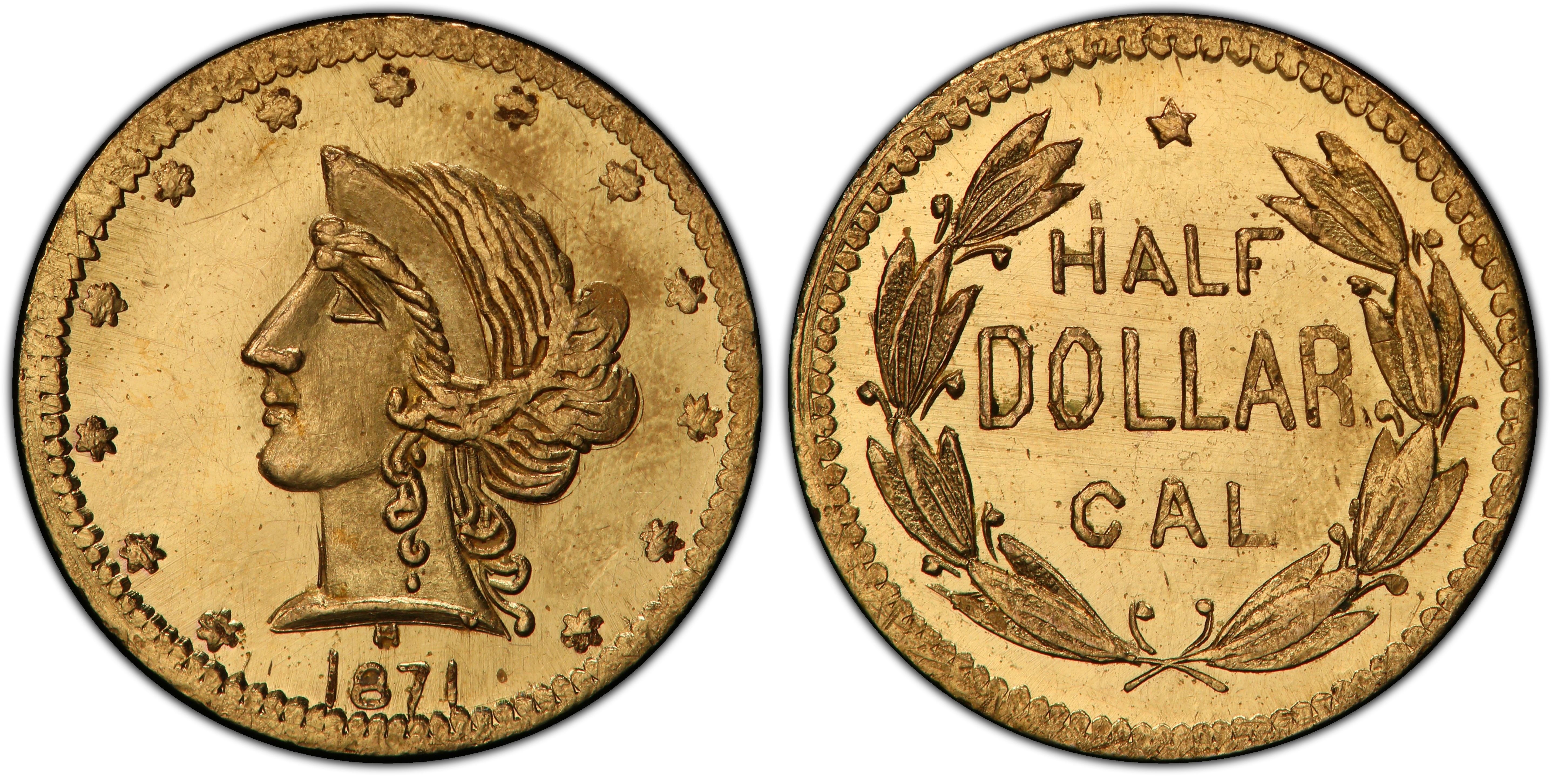
Obverse & Reverse
The 1871-H 50 Cents, cataloged as Breen-Gillio 1046, emerged from the second period of California Fractional Gold production (1856-1882), a fascinating and complex chapter in American numismatics. By the early 1870s, the initial frenzy of the Gold Rush had subsided, but California's economy remained dynamic and distinct from the rest of the nation. The official scarcity of small denomination coinage, a persistent issue since the 1850s, was exacerbated by the economic effects of the Civil War, which had caused federal silver and copper coins to be hoarded nationwide. In the West, where gold was king and paper money was met with suspicion, this 'small change' problem was particularly acute. Jewelers and private minters, who had begun producing tiny gold quarter, half-dollar, and dollar tokens in the 1850s to facilitate commerce, saw a renewed, if somewhat altered, demand. These later-period fractionals were less a direct response to a desperate need for circulating currency and more a popular expression of regional identity, functioning as souvenirs, keepsakes, and jewelry items, while still occasionally serving in commercial transactions. Unlike the earlier, cruder issues, the pieces from the 1870s often exhibited a higher degree of artistry and technical refinement, reflecting the maturation of the private minting industry in San Francisco. The 'H' mintmark on BG-1046 is attributed, though not with absolute certainty, to the firm of Herman J. Brand and Herman K. Hahn, jewelers and watchmakers who operated in San Francisco. Their production, like that of their competitors, walked a fine legal line. The U.S. government viewed these private issues with growing disdain, and the Secret Service actively investigated their makers, viewing them as illegal competitors to federal coinage. This pressure culminated in the Act of 1883, which finally prohibited the private minting of coins, bringing the colorful era of California Fractional Gold to a definitive end. Today, these miniature gold pieces are cherished as tangible links to the post-Gold Rush West, embodying the ingenuity and independent spirit of California's pioneers.
Associated EventPost-Civil War Economic Expansion in California
Reason For MintingPrimarily created to satisfy a commercial and souvenir demand for small denomination currency in an economy still reliant on gold dust and lacking sufficient federal coinage.
Minter HistoryThe 'H' mintmark is generally attributed to the San Francisco jewelry and watchmaking firm of Herman J. Brand and Herman K. Hahn, who were active during the 1870s. Like many producers of fractional gold, they were skilled artisans who saw a business opportunity in the persistent shortage of small change and the public's fascination with gold. They were not a large-scale mint but rather a private enterprise that produced a variety of these small gold pieces. Their operations, along with those of other San Francisco jewelers, were eventually curtailed by increased scrutiny from the U.S. Secret Service and the ultimate prohibition of private coinage.
Historical SignificanceThe BG-1046 represents the later, more refined period of California Fractional Gold. It serves as a historical artifact illustrating the continued economic isolation of the West, the persistent cultural importance of gold, and the blurry line between private enterprise and federal authority in 19th-century America. Its existence highlights a unique solution to a regional currency shortage that lasted for three decades after the initial Gold Rush.
N/A
Denomination50 Cents
Minting Period1871
Assayer/MinterHerman J. Brand & Herman K. Hahn (Tentative)
Geographic OriginSan Francisco, California
Obverse DescriptionFeatures a rendering of the head of Liberty, facing left, adorned with a beaded coronet. She is surrounded by thirteen stars, representing the original colonies.
Obverse InscriptionNo textual inscription on the obverse; the design consists solely of the Liberty head and thirteen stars.
Reverse DescriptionA simple wreath composed of two branches tied together by a ribbon at the bottom. The denomination '50 CENTS' and the date '1871' are located within the wreath. The 'H' mintmark, for Hahn (tentative), is located below the ribbon.
Reverse Inscription50 CENTS 1871 H
CompositionGold
Stated Fineness Actual FinenessVaries, but typically lower than federal coinage, often in the range of .500 to .800 fine.
Weight0.25 grams
Diameter10.00 mm
EdgePlain
Unknown
Survival Estimate50-100
Rarity ScaleR-5 (Very Scarce)
BG-1046 is sought after for its attractive classic design, its connection to the romanticized 'Old West,' and its status as a tangible piece of the California Fractional Gold series. As an R-5 variety, its scarcity adds significantly to its desirability among specialists.
Key VarietiesThe primary issue is the 'Regular Strike.' No known proof restrikes or major die varieties from the original minting period are widely recognized for this specific BG number. The entire category of California Fractional Gold, however, includes numerous die marriages, makers, and metallic compositions, making it a rich field for specialization.
Authentication TipsAuthentic examples have sharp, well-defined details for their grade, particularly in Liberty's hair and the leaves of the wreath. The lettering and numerals should be correctly formed and spaced, consistent with known genuine examples. Counterfeits, both contemporary and modern, often exhibit a soapy, soft appearance, incorrect lettering styles, or have a brassy color. Weight and specific gravity tests are crucial, as many fakes are underweight or made of gold-plated base metal. Comparison with high-resolution images of certified specimens is essential.
Shopping ConsiderationsA premium quality example for its grade will possess a sharp strike, especially on the high points of Liberty's hair and the bow on the reverse. Seek out coins with smooth, lustrous surfaces and minimal distracting contact marks—a significant challenge given their small size and history of use in jewelry. Original, uncleaned surfaces are paramount; many have been harshly cleaned or polished, which drastically reduces their value and appeal. Look for a warm, reddish-gold toning that is often indicative of originality. Avoid examples with evidence of soldering or rim damage, as they were frequently mounted as jewelry.
A coin's grade is its condition, rated on a 1-70 scale. For rare coins, this is the most critical factor in determining value, as a tiny difference in preservation can mean a huge difference in price.
Relevant Grade TypesAll original 1871-H G50C coins were struck as business strikes, intended for potential commerce or as souvenirs, and are found in Circulated (1-58) and Mint State (MS, 60-70) grades. No proofs were struck during the original period of issue, and there are no known later-date proof restrikes for this variety. Any piece described as a 'Proof' should be regarded with extreme skepticism and is likely a modern copy or fantasy piece.
Mint State CharacteristicsAn uncirculated BG-1046 will display full, unbroken mint luster, often with a slightly satiny texture. Strike quality varies, but a premium MS example will show strong definition in the finer details of Liberty's hair and the individual leaves in the wreath. Due to the nature of their production and handling, even Mint State examples may show minor planchet flaws or small, scattered contact marks. A truly 'gem' example (MS-65 or higher) with clean surfaces and a sharp strike is exceptionally rare.
Circulated Wear PatternsWear first appears on the highest points: Liberty's cheek, the hair above her eye, and the ear. The beaded coronet is also a high point. On the reverse, the highest points of the wreath's leaves and the knot of the bow will show initial friction and flattening. In lower grades (VG and below), the stars on the obverse may become indistinct, and the reverse legends will start to weaken, blending into the fields.
Key Factors For ValueThe primary drivers of value for this coin are grade and surface preservation. An example with original, uncleaned 'skin' commands a substantial premium over a dipped or cleaned counterpart. Strike sharpness is a key differentiator; a well-struck coin is always preferred. Eye appeal, which includes factors like luster, color, and the absence of distracting marks, plays a major role. Finally, certification by a top-tier service (PCGS or NGC) is nearly mandatory for establishing market value, and a CAC sticker for this issue indicates superior quality for the grade and will result in a significant price premium.
PCGS Price Guide
| Grade | Price | Population |
|---|---|---|
| 58 | $900.00 | 2 |
| 58+ | $1,000.00 | N/A |
| 60 | $1,200.00 | N/A |
| 61 | $1,350.00 | 3 |
| 62 | $1,575.00 | 3 |
| 62+ | $1,750.00 | N/A |
| 63 | $2,000.00 | 4 |
| 63+ | $2,250.00 | N/A |
| 64 | $2,500.00 | 3 |
| 64+ | $2,850.00 | N/A |
| 65 | $4,000.00 | 1 |
| 65+ | $4,500.00 | N/A |
| 66 | $5,000.00 | N/A |
| 68 | N/A | N/A |