1872/1 G25C BG-790, DMPL (Regular Strike)
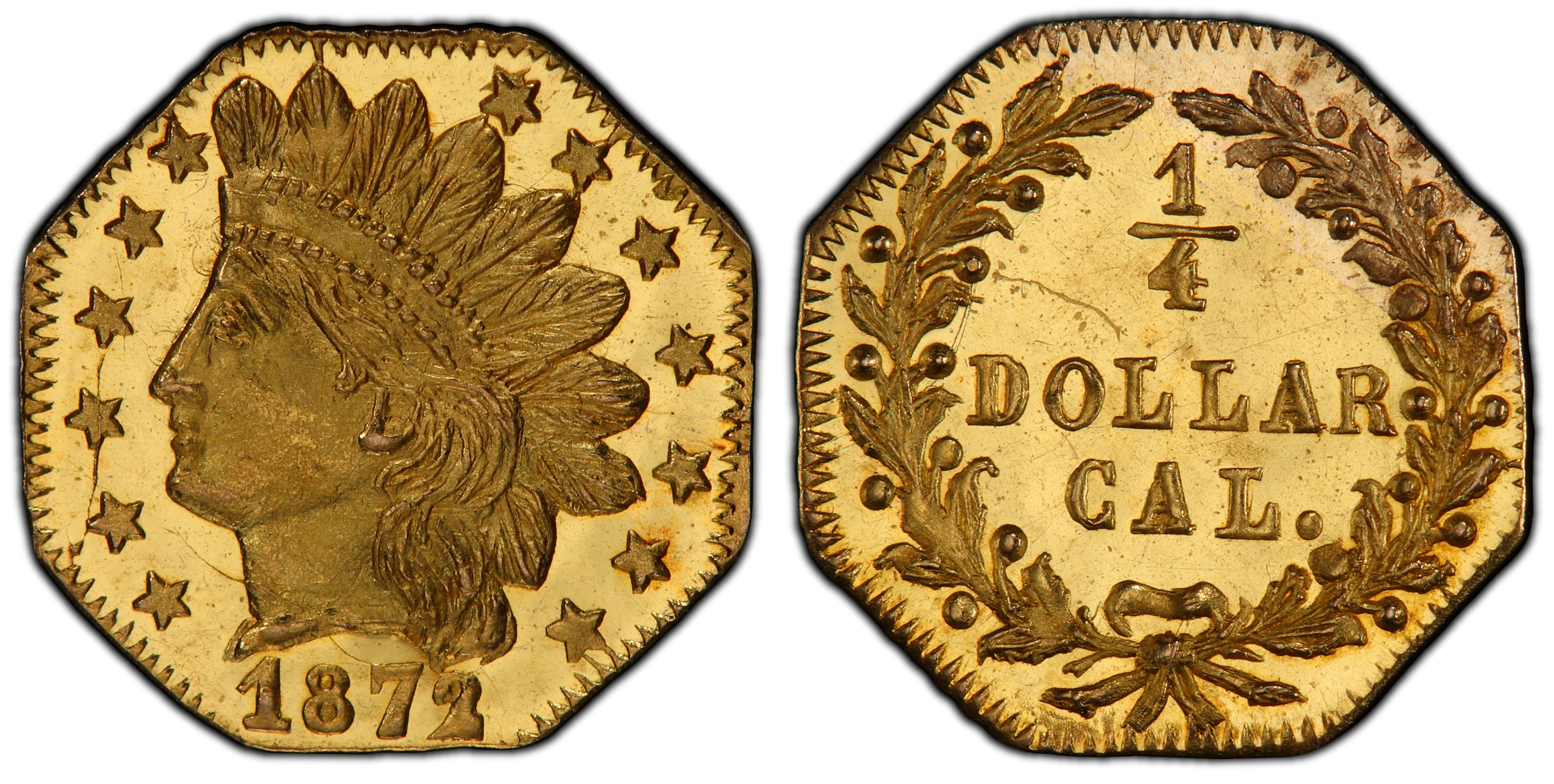
Obverse & Reverse
The 1872/1 G25C BG-790 is a quintessential example of 'Period Two' California Fractional Gold, a fascinating and complex series born from necessity and entrepreneurial spirit. Following the initial California Gold Rush boom, the region experienced a chronic shortage of small denomination coinage for daily commerce. Gold dust, while plentiful, was impractical for minor transactions. This void prompted private jewelers and metallurgists, primarily in San Francisco, to begin striking their own small gold coins in 25-cent, 50-cent, and one-dollar denominations starting in 1852. These pieces, while not official government tender, served as a crucial stopgap currency, facilitating everyday trade in the rapidly growing economy. The first period (1852-1857) saw coins intended to circulate, though often underweight. A federal law in 1864 made private coinage illegal, but production of these 'tokens' or 'charms' resumed shortly after and continued into the early 1880s. The 'Period Two' issues (1859-1882) are characterized by this quasi-legal status; they were technically tokens but were often made of high-purity gold and aesthetically mimicked federal coinage, leading to their widespread acceptance. The BG-790 variety, with its '1872/1' overdate, offers a glimpse into the minting practices of the time, where dies were often repurposed to save on costs. Struck by unknown minters, these pieces were likely produced using hand-operated screw presses or even simpler hammer methods, resulting in significant variation in strike quality. Their small size made them easily lost, and their unofficial status led many to be melted down over the years, contributing to their present-day rarity. Today, California Fractional Gold coins are prized by numismatists for their direct connection to the romanticized 'Old West,' representing the ingenuity of pioneers in building a functional economy from the ground up.
Associated EventCalifornia Gold Rush and Western Expansion
Reason For MintingTo alleviate a severe shortage of small-denomination coinage for everyday commercial transactions in California.
Minter HistoryThe specific minters of most 'Period Two' California Fractional Gold, including the BG-790, are unknown. Unlike earlier territorial issues with identifiable assayers, these later pieces were produced more anonymously, likely by a number of competing jewelers and artisans primarily located in San Francisco. These individuals were skilled metallurgists who saw a commercial opportunity in the region's lack of small change. They operated outside of federal authority, and after the Act of 1864 which criminalized private coinage, they continued production by backdating coins or omitting any minter's marks to avoid prosecution, classifying their products as tokens or souvenirs.
Historical SignificanceCalifornia Fractional Gold coins are historically significant as they represent a grassroots solution to a critical economic problem on the American frontier. They demonstrate the adaptability of local economies in the absence of sufficient federal infrastructure and are tangible artifacts of the California Gold Rush's lasting impact. Though technically tokens, their widespread use in commerce showcases a fascinating chapter in the history of U.S. currency, blurring the line between private enterprise and monetary authority.
N/A
Denomination25 Cents
Minting Period1872
Assayer/MinterUnknown, likely various San Francisco jewelers.
Geographic OriginSan Francisco, California
Obverse DescriptionThe obverse features a left-facing Indian Head, likely modeled after the contemporary Indian Head cent. The portrait is surrounded by thirteen stars, representing the original colonies.
Obverse InscriptionNo inscriptions are present on the obverse die.
Reverse DescriptionThe reverse displays the denomination '1/4 DOLLAR' within a wreath of leaves and berries, tied with a bow at the bottom. The date '1872' is positioned below the wreath, with a clear '2' punched over a '1'.
Reverse Inscription1/4 DOLLAR 1872
CompositionGold
Stated Fineness Actual FinenessVaries, but generally ranges from .500 to .900 fine gold.
Diameter9.70 mm
EdgePlain
Unknown
Survival Estimate201-300 (per PCGS population data)
Rarity ScaleR-3 (Scarce)
The BG-790 is highly sought after for its distinct 1872/1 overdate, its octagonal shape, and its connection to the California Gold Rush. The special designation of DMPL (Deep Mirror Prooflike) adds immense appeal, as it signifies a coin struck with freshly polished dies, resulting in mirrored fields and frosted devices, a rarity for this typically utilitarian series. It is a popular and relatively attainable variety within a vast and complex series.
Key VarietiesThe primary variety is the 1872/1 overdate itself. Within the BG-790 designation, collectors differentiate specimens by strike quality and surface characteristics, with Prooflike (PL) and Deep Mirror Prooflike (DMPL/DPL) examples commanding significant premiums. No official restrikes or patterns are known for this specific variety, as these were private, unofficial issues. However, contemporary souvenir tokens, often gold-plated base metal, were also produced and are sometimes confused with genuine fractional gold pieces.
Authentication TipsAuthentic BG-790s have a specific die marker: a small die crack often visible from the rim to the 'O' in 'DOLLAR'. The '2' over '1' in the date should be clear under magnification. Counterfeits are common and may be cast, showing a porous or soapy texture, or struck with incorrect details (wrong font, crude design). Weight and specific gravity tests can also help, as fakes are often underweight or made of brass. Authentication by a major grading service (PCGS or NGC) is highly recommended.
Shopping ConsiderationsFor a premium quality example, especially a DMPL, look for deep, clear, and consistent mirroring in the fields on both sides. The devices (Indian Head, wreath) should be sharply struck with a noticeable cameo contrast. On this variety, the sharpness of the stars and the details in the wreath are key indicators of a strong strike. Common problems include cleaning, which will impair the delicate mirrored surfaces, and small planchet flaws or edge clips, which are common due to the crude manufacturing process. A coin with original, undisturbed surfaces and strong eye appeal will always command a significant premium. A CAC sticker on a DMPL holder would signify the highest level of quality for the grade.
A coin's grade is its condition, rated on a 1-70 scale. For rare coins, this is the most critical factor in determining value, as a tiny difference in preservation can mean a huge difference in price.
Relevant Grade TypesOriginal period issues of BG-790 were business strikes intended for circulation and are found in Circulated (1-58) and Mint State (MS, 60-70) grades. No true Proofs were struck during the original minting period. However, coins struck from freshly polished dies can exhibit reflective surfaces and are designated as Prooflike (PL) or Deep Mirror Prooflike (DMPL or DPL) by grading services. These are not separate strikings but rather early-state business strikes of exceptional quality, and they are highly prized by collectors.
Mint State CharacteristicsAn uncirculated BG-790 often shows some degree of striking weakness, particularly on the highest points of the Indian Head's feathers and the bow on the reverse wreath. Luster on non-PL examples is typically subdued and satiny. The DMPL designation requires deeply reflective, mirror-like fields that are free of significant impairments. Contact marks, even small ones, are magnified by the mirrored surfaces and will greatly impact the grade and eye appeal. The ideal MS DMPL coin has a strong cameo contrast between the frosted devices and the mirrored fields.
Circulated Wear PatternsWear first appears on the high points of the design: the cheek and feathers of the Indian Head on the obverse, and the leaves and bow of the wreath on the reverse. On lower-grade circulated examples, the stars and the date will begin to lose their sharpness and merge with the fields.
Key Factors For ValueFor the BG-790, and especially the DMPL variety, the most critical value factor is the quality and preservation of the mirrored surfaces. A coin with deep, clean mirrors and a strong cameo contrast is paramount. Strike sharpness is also key; a fully struck-up piece is much more desirable than one with weak details. Eye appeal is crucial – coins with original, vibrant gold color are preferred over those that have been cleaned or have developed distracting spots. Finally, given the subjectivity of the PL and DMPL designations, a CAC sticker provides a strong third-party endorsement of quality and often results in a significant price premium.
PCGS Price Guide
| Grade | Price | Population |
|---|---|---|
| 66 | $2,350.00 | 2 |
| 66+ | $3,150.00 | N/A |
| 67 | $4,750.00 | N/A |