1876 G25C BG-850, PL (Regular Strike)
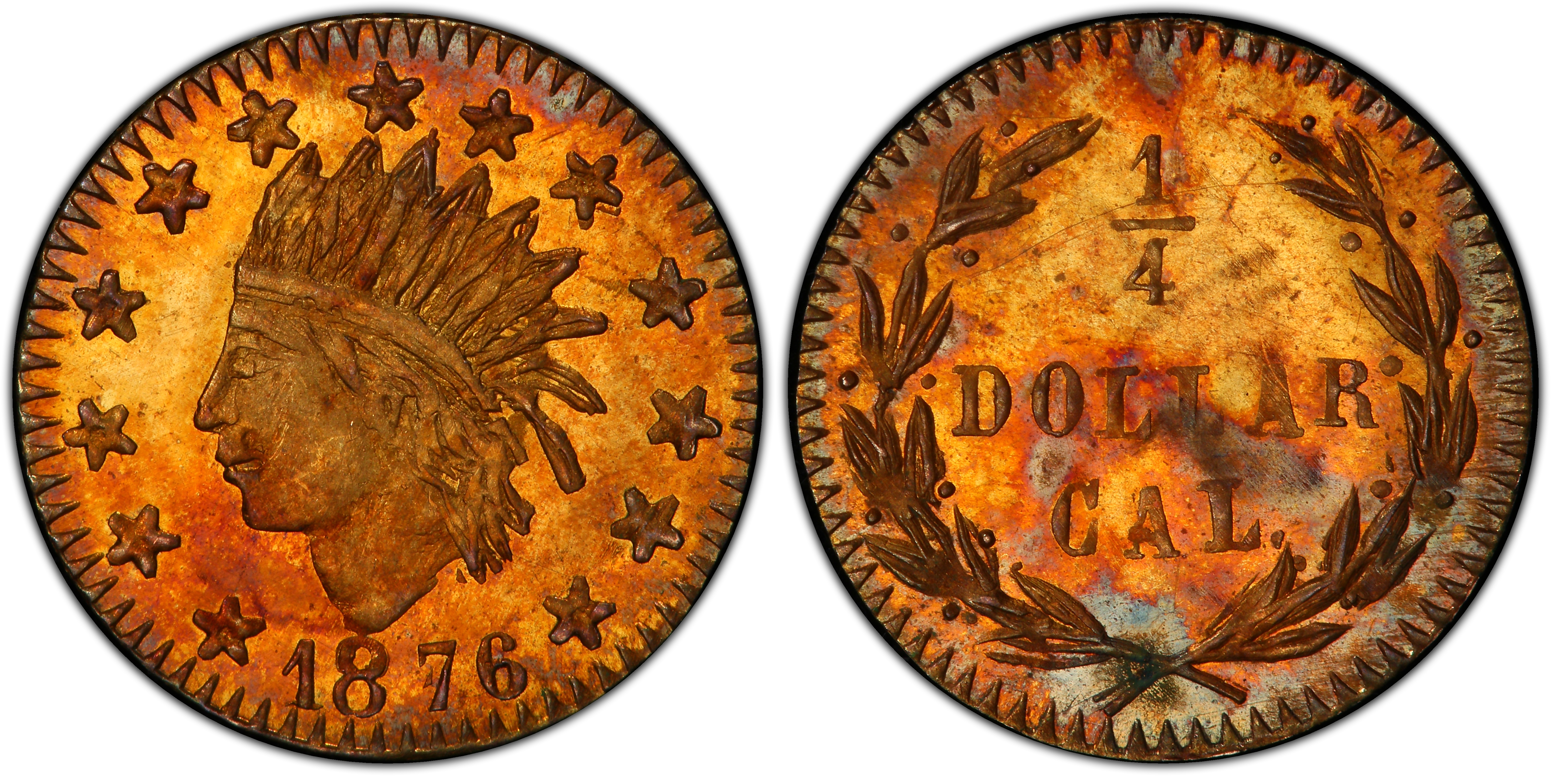
Obverse & Reverse
The 1876 BG-850 Quarter Dollar is a product of the second major phase of California Fractional Gold production, a period numismatists define as 1858-1882. Unlike the 'Period One' issues (1852-1857), which were struck out of genuine commercial necessity to alleviate a severe shortage of small change during the initial chaos of the Gold Rush, these later pieces were created primarily as souvenirs and collector's items. By the mid-1870s, the San Francisco Mint was in full operation, and the acute need for private coinage had long passed. Instead, a cottage industry of local jewelers and engravers, mostly centered in San Francisco, capitalized on the romantic allure of the Gold Rush that still captivated the nation. The year 1876 was particularly significant due to the Centennial Exposition in Philadelphia, which spurred a national interest in history and souvenirs. These jewelers, including known figures like Robert B. Gray & Co. and Herman J. Brand, produced vast numbers of these miniature gold coins, often with designs mimicking federal coinage, such as the popular Indian Head motif. The production methods were rudimentary, often involving a sledgehammer to strike a gold planchet between two hand-cut dies, which resulted in significant variations in strike quality. The gold content was unregulated and often of low fineness, far below the coin's face value. These pieces were sold to tourists, sent back East to family, and mounted into jewelry. The U.S. Secret Service viewed these denominated pieces with suspicion, as they technically violated the Private Coinage Act of 1864. While enforcement was sporadic, it intensified in the early 1880s, effectively ending the era of denominated fractional gold and forcing producers to switch to undenominated 'charms' or 'tokens.' The BG-850 is a quintessential example of this 'jeweler's issue,' a tangible link not to the commercial needs of the 49ers, but to the enduring mythology of the Gold Rush in the American imagination.
Associated EventCalifornia Gold Rush Aftermath & U.S. Centennial
Reason For MintingPrimarily struck to be sold as souvenirs and curiosities capitalizing on the legacy of the Gold Rush, not for general circulation.
Minter HistoryThe specific maker of the BG-850 variety is unknown, a common trait for many 'Period Two' California Fractional Gold issues. Dozens of jewelers and private minters operated in San Francisco during this era, creating a competitive market for these popular souvenirs. Prominent contemporaries included Robert B. Gray & Co. and Herman J. Brand, who were known for producing a wide array of small-denomination gold pieces. These craftsmen typically hand-engraved their own dies, leading to the vast number of distinct varieties cataloged by Breen and Gillio. Their operations were eventually curtailed by increased scrutiny from the U.S. Secret Service, which moved to suppress all private issues bearing a denomination by 1883.
Historical SignificanceThis coin represents the transition of private California gold from a necessary medium of exchange to a commercial souvenir product. It is a numismatic artifact of the post-Gold Rush era, reflecting how the event was memorialized and commercialized for a national audience. Its rarity and design make it a key piece for specialists collecting 'Period Two' varieties.
N/A
Denomination25 Cents
Minting Period1876
Assayer/MinterUnknown Jeweler
Geographic OriginSan Francisco, California
Obverse DescriptionA small, stylized Indian Head faces left, adorned with a feathered headdress. The portrait is encircled by thirteen five-pointed stars, representing the original colonies. The date '1876' is positioned prominently below the bust.
Obverse Inscription1876
Reverse DescriptionA decorative wreath, composed of two branches with leaves and berries, is tied at the bottom with a bow. The wreath encircles the denomination, which is expressed as the fraction '1/4' above the word 'DOLLAR'.
Reverse Inscription1/4 DOLLAR
CompositionGold
Stated Fineness Actual FinenessVariable, often low-karat gold (estimated 10-14K).
Weight0.25 grams
Diameter9.80 mm
EdgePlain
Unknown, but extremely small.
Survival Estimate13-30 coins known.
Rarity ScaleLow R-6
The BG-850 is highly prized for its classic Indian Head design on a miniature gold planchet, its direct connection to the romantic legacy of the California Gold Rush, and its significant rarity. As a 'Period Two' issue, it is more affordable than the earlier, circulating types, making it an attractive entry point for specialists.
Key VarietiesThe primary variety is the regular business strike as cataloged. No original proofs were issued. However, specimens with deeply mirrored fields and frosted devices are designated 'Proof-Like' (PL) or 'Deep Proof-Like' (DPL) by grading services. These PL examples are considered a distinct and highly desirable subset of the issue, commanding significant premiums. No official restrikes are known, but collectors should be aware of the plethora of modern, undenominated replicas and charms that imitate the style of genuine fractional gold.
Authentication TipsAuthentic Period Two pieces like BG-850 must bear a denomination (e.g., 'DOLLAR', 'CENTS', or 'DOL.'). Replicas often lack a denomination or feature a bear, a design never used on genuine fractional issues. The strike can be uneven, with some weakness in the stars or wreath, which is not necessarily a sign of a fake. Look for the correct die characteristics as pictured in the Breen-Gillio reference. Counterfeits are often soapy in appearance, have incorrect weights, or are made of gold-plated base metal.
Shopping ConsiderationsA premium quality example for its grade will exhibit a sharp, well-centered strike, especially on the fine details of the headdress and the lettering on the reverse. For this specific variety, look for specimens with reflective, proof-like (PL) surfaces, as this is a key element of its appeal and value. Check carefully for any evidence of having been mounted in jewelry, such as rim damage, solder, or excessive polishing, which is common for these pieces and drastically reduces value. Original, reddish-gold toning over lustrous surfaces is highly desirable. Avoid coins that appear cleaned, heavily scratched, or have distracting planchet flaws.
A coin's grade is its condition, rated on a 1-70 scale. For rare coins, this is the most critical factor in determining value, as a tiny difference in preservation can mean a huge difference in price.
Relevant Grade TypesAll original examples of BG-850 are business strikes, intended for sale as souvenirs. They are found in Circulated (1-58) and, more commonly, Mint State (MS, 60-70) grades. No true Proofs were struck during the original period of issue. However, due to the use of polished dies, many examples exhibit mirrored surfaces and are designated as Proof-Like (PL) or Deep Proof-Like (DPL) by third-party graders. These PL/DPL coins are not a different type of striking but rather a desirable surface characteristic of the business strikes.
Mint State CharacteristicsUncirculated examples are defined by their luster, which for this issue is often highly reflective or 'proof-like'. A superior Mint State specimen will showcase sharp details on the highest points of the Indian's cheek and headdress feathers. Due to the crude manufacturing process, it is common to find examples with some inherent strike weakness, particularly among the stars on the obverse or the bow on the reverse. Small planchet flaws or die polishing lines are often present and should be considered characteristic of the issue.
Circulated Wear PatternsWear first appears on the high points of the design: the Indian's cheek, the brow, and the tips of the feathers in the headdress. On the reverse, the highest leaves and berries of the wreath will show flatness first. On heavily circulated examples, the stars and date will begin to merge with the fields.
Key Factors For ValueThe single most important factor for this issue's value is the quality of its surfaces, with a strong premium paid for coins designated Proof-Like (PL). Beyond that, a sharp, full strike is highly prized, as many are softly struck. Eye appeal is critical; examples with clean, reflective fields and original, uncleaned 'skin' are sought after. Conversely, any damage, such as rim bumps, scratches, or evidence of having been used as jewelry, will severely depress the value. CAC certification for any grade, especially Mint State, adds a significant premium, confirming the quality for the assigned grade.
PCGS Price Guide
| Grade | Price | Population |
|---|---|---|
| 63 | $750.00 | 1 |
| 64 | N/A | N/A |