1881 G25C BG-886 (Regular Strike)
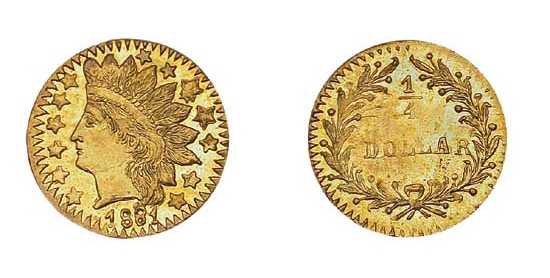
Obverse & Reverse
The 1881 BG-886 25 Cent piece is a quintessential example of a 'Period Two' California Fractional Gold coin. The initial period of these private issues, from 1852 to roughly 1857, arose from a genuine and severe shortage of small change in Gold Rush California. Gold dust was impractical for minor transactions, and the output of the new San Francisco Mint had not yet saturated the region with federal silver and gold coins. Jewelers and assayers filled this void with tiny, privately struck quarter-dollar, half-dollar, and dollar coins that, while often underweight, served a vital commercial purpose. By the 1870s and early 1880s, however, the economic landscape had changed. The San Francisco Mint was a powerhouse, and federal coinage was plentiful. The reason for producing fractional gold shifted from commerce to tourism and novelty. These 'Period Two' pieces, including the BG-886, were primarily created as souvenirs, keepsakes, and jewelry items for visitors to San Francisco and miners wanting a memento of the Gold Rush era. Their production was a direct violation of the Coinage Act of April 22, 1864, which forbade private coinage. However, enforcement by the U.S. Secret Service was inconsistent until a major crackdown in 1883. Minters of this era operated in a legal gray area, often producing pieces with designs reminiscent of, but not identical to, federal coinage to avoid immediate confiscation. The Indian Head motif was popular, evoking a uniquely American and 'Wild West' theme that appealed to buyers. The BG-886 was likely produced in very small quantities by an uncredited jeweler using hand-operated presses, resulting in variable strike quality. Their light weight and debased gold content meant their intrinsic value was far below their 25-cent face value, confirming their status as tokens rather than circulating currency. Today, these pieces are highly prized by collectors for their direct connection to the romantic era of the American West and for their intrinsic rarity, as most varieties were made in minuscule numbers and few have survived.
Associated EventPost-Gold Rush California Tourism
Reason For MintingPrimarily minted as souvenirs and keepsakes for the tourist trade, not for general circulation.
Minter HistoryThe specific minter of the BG-886 dies is unknown, which is common for many 'Period Two' fractional gold pieces. The work is attributed generally to the community of San Francisco jewelers who engaged in this practice between the late 1850s and the Secret Service crackdown of 1883. These artisans, many of French origin, used skills honed in jewelry making to create dies and strike these miniature gold pieces. Unlike the 'Period One' minters who sometimes initialed their work (e.g., 'D.N.' for Deriberpe & Nouizillet), the later producers often remained anonymous to avoid legal trouble.
Historical SignificanceThe BG-886 represents the final phase of private gold coinage in California, a period when these pieces transitioned from being a necessary medium of exchange to popular souvenirs. Its existence highlights a numismatic gray market that persisted for nearly two decades after private coinage was outlawed, serving as a tangible link to the enduring mythology of the California Gold Rush.
BG-886
Denomination25 Cents
Minting Period1881
Assayer/MinterUnknown San Francisco Jeweler
Geographic OriginSan Francisco, California
Obverse DescriptionA stylized Indian Head portrait facing left, adorned with a feathered headdress. The portrait is encircled by thirteen stars, representing the original colonies. The date '1881' is positioned below the bust.
Obverse Inscription1881
Reverse DescriptionThe reverse features a simple agricultural wreath of two branches tied with a ribbon at the bottom. Within the wreath is the denomination '1/4 DOLLAR'.
Reverse Inscription1/4 DOLLAR
CompositionGold
Stated Fineness Actual FinenessTypically a debased gold alloy, common for Period Two issues, but specific fineness for BG-886 is not documented.
EdgePlain
Unknown
Survival Estimate31-45 (High R-5)
Rarity ScaleHigh R-5
BG-886 is sought after as a scarce, dated example of the popular Indian Head type from the final years of fractional gold production. Its appeal lies in its clear connection to the souvenir trade of Gold Rush-era San Francisco. The challenge of acquiring a well-struck, problem-free example adds to its desirability.
Key VarietiesThe primary known variety involves die rotation. Examples are known to exist with significant (90°–120°) clockwise rotation of the reverse die. No official restrikes or patterns are recorded, though counterfeit and replica pieces are abundant in the market.
Authentication TipsGenuine BG-886 examples should be compared against high-resolution images from the Breen-Gillio reference or major auction archives. Key diagnostics include the specific letter and number punch styles for the date and legends. The overall fabric should appear correct for a hand-struck piece, often showing some unevenness. Modern replicas often have a soapy, cast-like appearance, incorrect weight or diameter, and may feature a bear on the reverse, a design element never used on genuine denominated fractional gold.
Shopping ConsiderationsA premium quality BG-886 is defined by its strike and surfaces. Look for an example with a fully struck obverse, showing clear details in the headdress feathers and all thirteen stars. The reverse is characteristically weak; examples with unusual sharpness on the fraction '1/4' and the word 'DOLLAR' command a premium. Many genuine pieces exhibit prooflike or mirrored fields from being struck on polished planchets, which is highly desirable. Avoid examples that have been harshly cleaned, which strips the original skin and luster, or pieces that have been used as jewelry and show evidence of mounting, soldering, or excessive rim damage. Central planchet roughness on the reverse is common and should be distinguished from post-strike damage.
A coin's grade is its condition, rated on a 1-70 scale. For rare coins, this is the most critical factor in determining value, as a tiny difference in preservation can mean a huge difference in price.
Relevant Grade TypesOriginal BG-886 pieces were business strikes, although struck on polished planchets as souvenirs and thus are almost exclusively found in Mint State (MS, 60-70) grades. It is exceptionally rare to find a circulated example (1-58), as they did not serve as currency. No true Proofs (PR/PF) were struck during the original period of issue.
Mint State CharacteristicsUncirculated examples often exhibit a contrast between a fully impressed obverse and a softly struck reverse. The highest points of the Indian's cheek and headdress are well-defined on gem examples. Luster is typically bright and flashy, often with a prooflike (PL) or deep mirror prooflike (DMPL) character due to the polished planchets used. Common imperfections, even on high-grade pieces, include minor planchet flaws (especially central roughness on the reverse) and the aforementioned strike weakness on the denomination.
Circulated Wear PatternsOn the rare occasion a circulated example is encountered, wear would first appear on the high points of the design. On the obverse, this would be the Indian's cheekbone, the eyebrow, and the feathers of the headdress. On the reverse, the leaves of the wreath and the edges of the fraction '1/4' would show the first signs of friction and flattening.
Key Factors For ValueFor the BG-886, value is driven by several key factors. First is grade and surface preservation; a coin with original, undisturbed prooflike fields is paramount. Second is the strike; a specimen with a sharp reverse strike is a significant rarity and will command a strong premium. Third is eye appeal, with coins exhibiting attractive, original apricot or lemon-gold toning being highly prized. Finally, a CAC sticker adds a significant premium, confirming the quality for the assigned grade in a series where strike and surface quality can be highly variable.
PCGS Price Guide
| Grade | Price | Population |
|---|---|---|
| 62 | $325.00 | 3 |
| 62+ | $375.00 | N/A |
| 63 | $425.00 | 7 |
| 63+ | $475.00 | N/A |
| 64 | $625.00 | 6 |
| 64+ | $675.00 | N/A |
| 65 | $925.00 | 5 |
| 65+ | $1,250.00 | N/A |
| 66 | $1,650.00 | 2 |