1869 G25C BG-750, PL (Regular Strike)
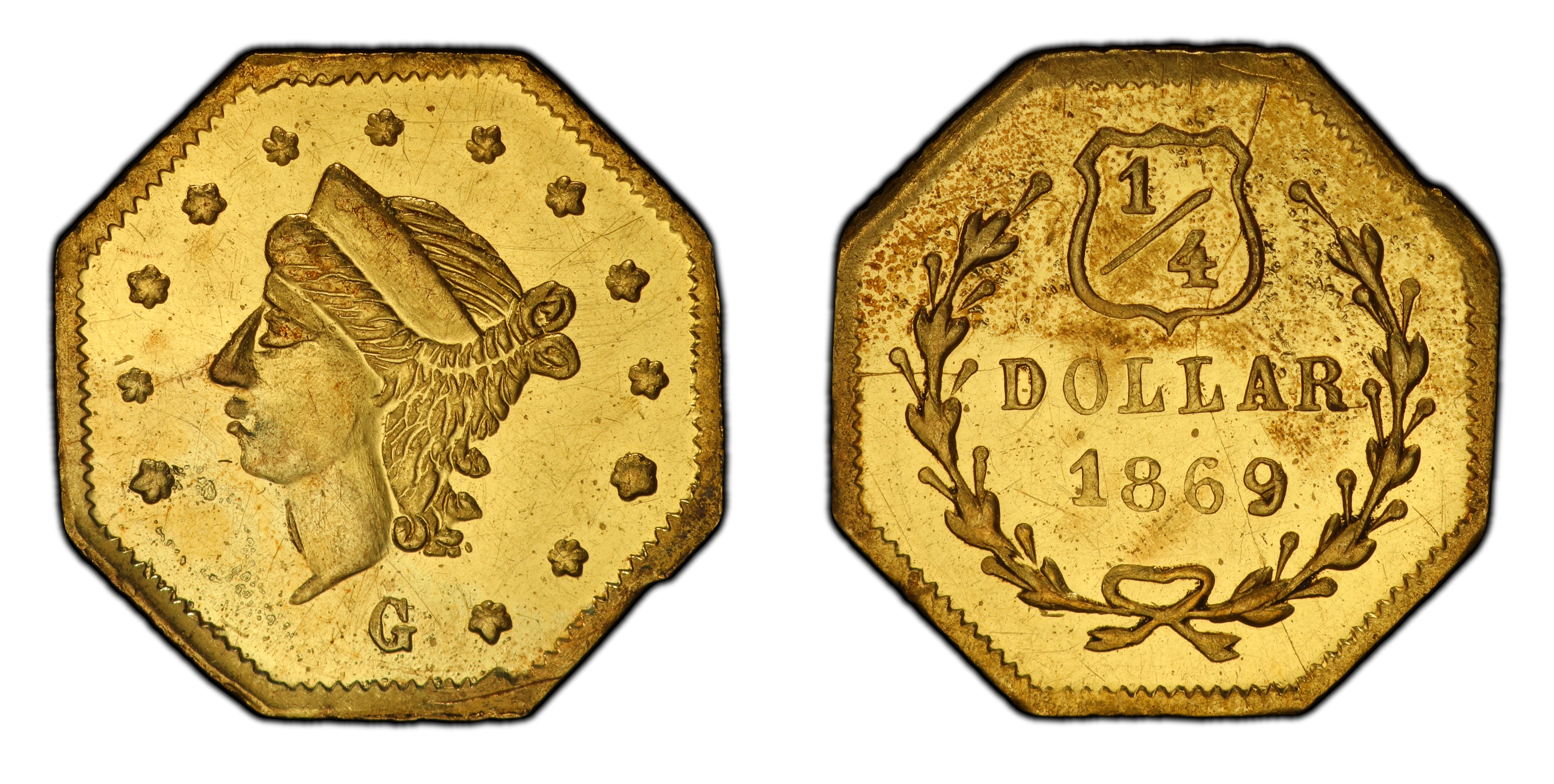
Obverse & Reverse
The 1869 BG-750 25 Cent piece is a quintessential example of a 'Period Two' California Fractional Gold issue. By the late 1860s, the acute shortage of small denomination coinage that had plagued California during the initial Gold Rush years had largely subsided, thanks to the robust output of the San Francisco Mint, which opened in 1854. The impetus for producing these miniature gold tokens had shifted dramatically from necessity to novelty. The 'Period One' issues (1852-1857) were struck, however underweight, with the genuine intent of facilitating commerce. In contrast, the Period Two pieces (1858-1882) were almost exclusively manufactured by jewelers and private minters as souvenirs and keepsakes. These items catered to a burgeoning tourist trade and a national fascination with the 'Golden West.' They were popular items to be mounted into jewelry, kept as pocket pieces, or sent back East as affordable and exotic mementos of California. The Coinage Act of April 22, 1864, had made private coinage illegal, but this law was not rigorously enforced by the Secret Service against these small, denominational tokens until 1883. This legal gray area allowed numerous San Francisco jewelers, many of French origin, to produce a wide variety of designs and denominations. The quality of these 'jeweler's issues' varied, but they often mimicked the official Liberty Head design of federal gold coinage to enhance their appeal. However, their gold content was typically far below their face value, rendering them profitable novelties rather than functional currency. The BG-750 is a product of this specific era, a time when the memory and romance of the Gold Rush were being packaged and sold. Its extreme rarity today suggests a very limited original production, likely struck to order for a specific client or as a small batch test of a particular die pairing. Its numismatic significance lies not in its use as money, but as a tangible artifact of how the Gold Rush was memorialized and commercialized in the decades that followed.
Associated EventPost-Gold Rush California Economic Development
Reason For MintingPrimarily struck as a souvenir or novelty item for the jewelry and tourist trade, not for general circulation.
Minter HistoryThe specific minter or jeweler who produced the BG-750 die pair is not definitively known, a common trait for many Period Two issues where dies were often unsigned and traded among various producers. Research into die sinkers of the period, such as Gaetano F. Esherick of Philadelphia (who is known to have produced dies for other private coiners), has not conclusively linked any single entity to this variety. These producers were typically small-scale artisans operating in the jewelry districts of San Francisco.
Historical SignificanceThis coin is a prime example of a 'Period Two' California Fractional Gold piece, significant for its role as a souvenir of the Gold Rush rather than a circulating coin. Its extreme rarity underscores the ephemeral and small-scale nature of many private jewelers' minting operations in San Francisco during the era.
N/A
Denomination25 Cents (G25C)
Minting Period1869
Assayer/MinterUnknown
Geographic OriginSan Francisco, California
Obverse DescriptionOctagonal planchet. Features a Liberty Head design facing left, modeled after the federal gold coinage of James B. Longacre. The portrait is surrounded by thirteen five-pointed stars, representing the original colonies.
Obverse Inscription Reverse DescriptionA wreath of two branches tied with a ribbon at the bottom encircles the denomination. The date is positioned within the wreath.
Reverse Inscription1/4 CENTS 1869
CompositionGold
Stated Fineness Actual FinenessVariable, but typically low for Period Two issues, often between .500 and .750 fine.
EdgePlain
Extremely Low
Survival EstimateFewer than 10; likely 4-6 pieces.
Rarity ScaleR-7 (4-12 known)
The BG-750 is a trophy coin for the advanced specialist in California Fractional Gold. Its appeal is driven by its extreme rarity (R-7), octagonal shape, and status as a high-grade, often Prooflike, example from the popular Period Two era. The challenge of acquiring one of the few known examples makes it a significant numismatic prize.
Key VarietiesThis is a unique die marriage (BG-750) and has no major varieties from its original minting period. No known restrikes or special collector issues were made from these specific dies.
Authentication TipsAuthentication requires comparison to known genuine examples due to the proliferation of modern replicas. Genuine Period Two pieces should exhibit a denomination (e.g., 'CENTS'). Replicas often feature a bear on the reverse, which is an immediate red flag. The strike on genuine pieces can be uneven, a characteristic of manual hammer striking, whereas modern fakes are often sharply and uniformly struck. Look for the specific die characteristics of the BG-750 pair, such as the exact positioning of the stars and date numerals, which can only be confirmed by referencing high-quality images of certified examples.
Shopping ConsiderationsFor an R-7 issue, any example offered is a major opportunity. A premium quality specimen would be one that is well-centered and sharply struck, particularly on Liberty's hair and the details of the wreath. Many Period Two issues were struck on polished planchets to enhance their appeal as jewelry, so examples with deep, original Prooflike (PL) or Deep Mirror Prooflike (DMPL) surfaces command significant premiums. Avoid examples that have been obviously cleaned, polished, or show evidence of being removed from jewelry (solder marks, rim damage). Eye appeal is paramount; coins with lustrous, original surfaces and a pleasing reddish-gold toning are highly coveted.
A coin's grade is its condition, rated on a 1-70 scale. For rare coins, this is the most critical factor in determining value, as a tiny difference in preservation can mean a huge difference in price.
Relevant Grade TypesOriginal issues were business strikes, although many were produced with polished dies and planchets, resulting in Prooflike (PL) surfaces. As souvenirs not intended for circulation, they are most commonly found in Mint State (MS, 60-70) grades. A few may exist in high circulated grades (e.g., AU-58) from minor handling. No official Proofs (PR/PF) were struck during the original period, and no later restrikes are known for this variety.
Mint State CharacteristicsIn uncirculated condition, the BG-750 is characterized by its surface quality. A key attribute is the presence of original, reflective fields, as these were often struck to be Prooflike. The strike can be inconsistent; the centers may be fully struck while the peripheral stars or wreath elements are soft. Luster is typically flashy and reflective rather than satiny. Due to the softness of the gold and the production method, even high-grade examples may show minor planchet imperfections or handling marks.
Circulated Wear PatternsAs these coins did not circulate commercially, significant wear is almost never encountered. Any friction from handling would first appear on the highest points of the design: Liberty's cheek, the hair above the ear, and the highest leaves and bow of the wreath on the reverse. In the rare event of a lightly circulated example, the reflectivity of the fields would be the first thing to diminish.
Key Factors For ValueFor the BG-750, value is overwhelmingly driven by rarity, followed by grade and eye appeal. The primary value determinant between two examples would be surface preservation. An MS-63 with deeply mirrored, original surfaces will be far more valuable than a slightly higher grade MS-64 with hazy or cleaned surfaces. The Prooflike (PL) designation is a major value multiplier. A CAC sticker, indicating premium quality for the grade, would also add a significant premium for an issue this rare.
PCGS Price Guide
| Grade | Price | Population |
|---|---|---|
| 62 | $1,350.00 | 1 |