1872/1 G25C BG-869 (Regular Strike)
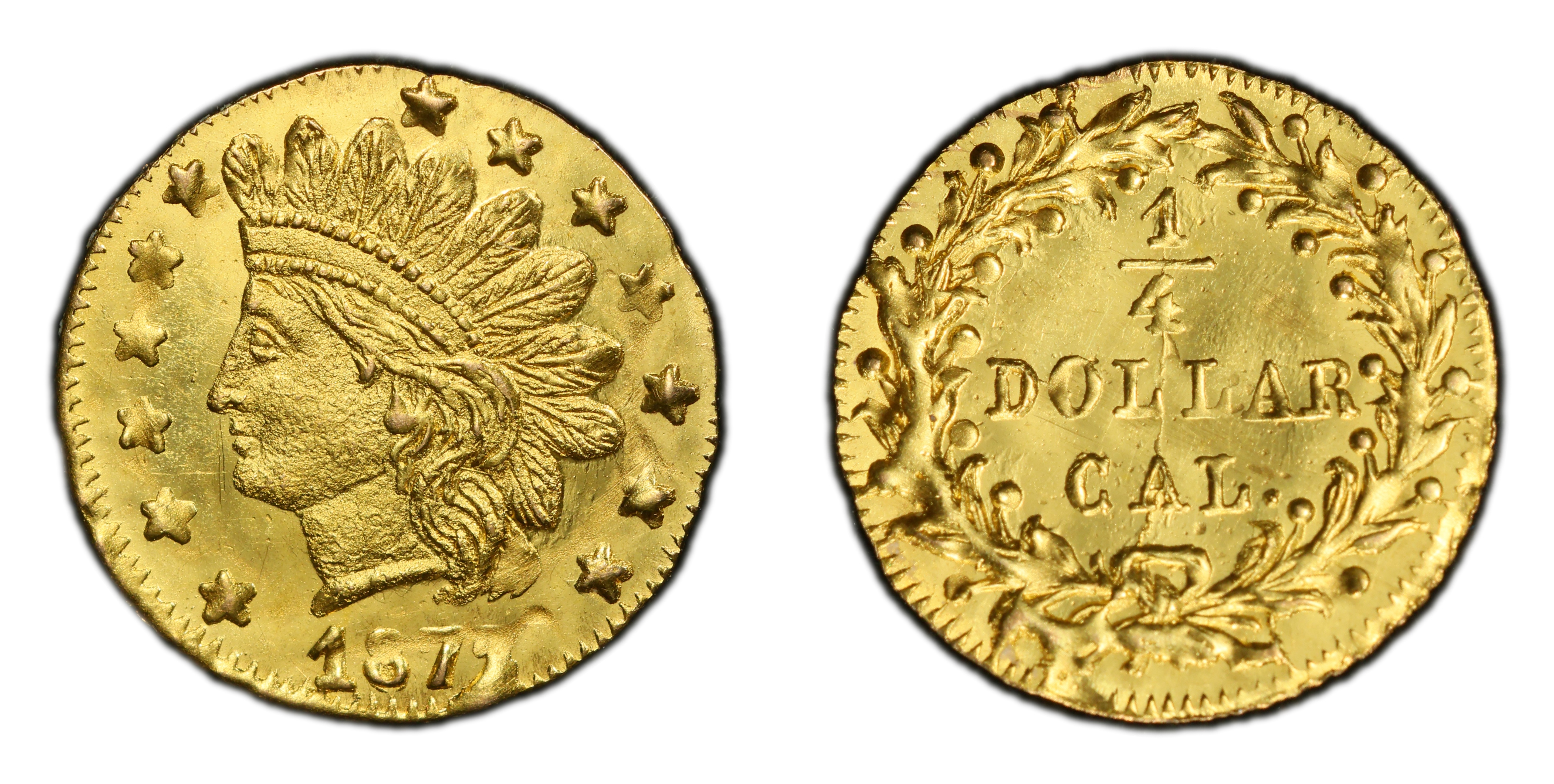
Obverse & Reverse
The 1872/1 G25C BG-869 is a quintessential example of a 'Period Two' California Fractional Gold piece. By the early 1870s, the initial, desperate need for any form of circulating coinage that characterized the Gold Rush's peak had subsided with the establishment of the San Francisco Mint in 1854. However, a chronic shortage of small denomination federal coinage persisted on the West Coast, creating a niche market that private jewelers continued to fill. These Period Two pieces, unlike their heavier Period One predecessors, were unabashedly token-like in nature. They were typically underweight for their stated value and served a dual purpose: facilitating minor transactions in a commerce still starved for small change, and acting as popular, easily transportable souvenirs for tourists and settlers wishing to send a piece of the 'Golden State' back East. The anonymous minters of BG-869 were likely San Francisco-based manufacturing jewelers who produced these tiny gold pieces using hand-operated presses. The '1872/1' designation signifies an overdate, where a die from 1871 was re-punched with the new '2' digit, a common cost-saving measure among private minters. This specific variety is well-documented due to its consistent and identifiable die characteristics, including a prominent reverse die crack. These pieces did not circulate in the same official capacity as federal coins but were generally accepted in local trade out of necessity and custom. Their existence reflects the lingering economic peculiarities of post-Gold Rush California and the transition of private coinage from a vital necessity to a commercial enterprise blending utility with novelty.
Associated EventPost-Gold Rush Economic Expansion
Reason For MintingTo alleviate a persistent shortage of small denomination coinage in California and to serve as popular souvenirs.
Minter HistoryThe specific maker of BG-869 is unknown, which is common for 'Period Two' issues. These coins were produced by various manufacturing jewelers in San Francisco who did not always apply a specific hallmark. Their business model relied on turning a profit by striking coins with a gold value slightly less than their face value, catering to both the need for small change and the burgeoning tourist trade.
Historical SignificanceThis coin is significant as a physical artifact of the unique economic conditions of 1870s California. It represents the later phase of private coinage in the United States, where the lines between quasi-currency and souvenir tokens blurred. The overdate and characteristic die flaws provide numismatists with a clear link to the specific manufacturing practices of the era's anonymous private minters.
BG-869
Denomination25 Cents
Minting Period1872
Assayer/MinterAnonymous
Geographic OriginSan Francisco, California
Obverse DescriptionA beaded border encircles an Indian Head facing left, a design reminiscent of contemporary federal coinage but stylistically distinct. The portrait features feathers in the hair. Thirteen stars encircle the portrait, representing the original colonies. The date '1872', with a clear '2' punched over a '1', is positioned below the bust.
Obverse Inscription1872/1
Reverse DescriptionA beaded border encircles a wreath composed of two branches tied with a bow at the bottom. The wreath is open at the top. Inside the wreath, the denomination '25 CENTS' is inscribed in two lines, with a small star or dot below. The legend 'CALIFORNIA GOLD' appears at the top, outside the wreath.
Reverse InscriptionCALIFORNIA GOLD 25 CENTS
CompositionGold
Stated Fineness Actual FinenessTypically 0.800 to 0.900, though not standardized.
Weight0.25 grams
Diameter10.30 mm
EdgePlain
Unknown
Survival Estimate150-200
Rarity ScaleLow R-4
The BG-869 is highly popular due to its clear 1872/1 overdate, its attractive Indian Head design, and its status as an authentic, historically significant artifact of the post-Gold Rush era. The known die characteristics make it a rewarding variety to study and attribute.
Key VarietiesThe primary variety is the 1872/1 overdate business strike. No original proof strikings are known. However, examples are frequently found with highly reflective, proof-like (PL) or deep mirror proof-like (DMPL) surfaces, which were struck from freshly polished dies and command significant premiums. These are not true Proofs but rather early state business strikes.
Authentication TipsA key diagnostic for genuine BG-869 coins is a prominent vertical die crack running through the center of the reverse, often through the 'N' of 'CENTS'. The die state is often advanced, with multiple cracks and a small obverse rim break near the '2' of the date. The overdate itself should be carefully examined for the correct style and placement of the digits. Modern replicas are common; they often have a soapy, indistinct appearance, incorrect weight, and may feature a bear on the reverse, a motif not used on genuine denominated pieces.
Shopping ConsiderationsA premium quality example for its grade will exhibit a sharp strike, particularly on the details of the feathers and the stars on the obverse, and the lettering on the reverse. Given their small size, many were weakly struck. Look for original, undisturbed surfaces with attractive luster. Many surviving examples have been cleaned or damaged from use in jewelry; avoiding these issues is paramount. The presence of proof-like or DMPL surfaces adds significant value and eye appeal. The visibility and clarity of the overdate are also key value factors.
A coin's grade is its condition, rated on a 1-70 scale. For rare coins, this is the most critical factor in determining value, as a tiny difference in preservation can mean a huge difference in price.
Relevant Grade TypesOriginal period issues were business strikes intended for circulation and as souvenirs. They are found in Circulated (1-58) and Mint State (MS, 60-70) grades. No true Proof (PR/PF) examples were struck during the original period of issue. However, special collector designations of Proof-Like (PL) and Deep Mirror Proof-Like (DMPL) are often awarded to business strikes made from early states of polished dies, and these are highly sought after.
Mint State CharacteristicsIn uncirculated grades, the quality is determined by the sharpness of the strike, the quality of the luster, and the presence of marks. BG-869 is often found well-struck, but weakness on the high points of the hair and feathers is not uncommon. Luster can range from soft and satiny to deeply reflective on PL/DMPL examples. Due to the softness of the gold and the way these pieces were handled, small contact marks in the fields are common and should be expected.
Circulated Wear PatternsWear first appears on the high points of the design: the cheek, brow, and the feathers of the Indian Head on the obverse. On the reverse, the highest points of the wreath's leaves and the letters of the denomination will show the first signs of friction. In lower grades (VF and below), the stars on the obverse will begin to lose their definition and merge with the field.
Key Factors For ValueThe primary value drivers for this coin are grade and surface preservation. An uncirculated piece with original luster will be worth many times more than a circulated or cleaned example. The presence and quality of proof-like surfaces (PL/DMPL) add a substantial premium. Strong strike detail, particularly on the overdate and the Indian's portrait, is highly desirable. Eye appeal, encompassing attractive original color and minimal distracting marks, is crucial. Certification by a top-tier grading service (PCGS or NGC) is essential for market acceptance, and a CAC sticker will add a further premium, confirming quality for the grade.
PCGS Price Guide
| Grade | Price | Population |
|---|---|---|
| 50 | $190.00 | 1 |
| 50+ | $195.00 | N/A |
| 53 | $200.00 | 1 |
| 53+ | $205.00 | N/A |
| 55 | $210.00 | N/A |
| 55+ | $215.00 | N/A |
| 58 | $225.00 | 1 |
| 58+ | $245.00 | N/A |
| 60 | $300.00 | N/A |
| 61 | $315.00 | 2 |
| 62 | $325.00 | 19 |
| 62+ | $355.00 | N/A |
| 63 | $400.00 | 40 |
| 63+ | $435.00 | N/A |
| 64 | $525.00 | 44 |
| 64+ | $575.00 | 1 |
| 65 | $900.00 | 11 |
| 65+ | $950.00 | N/A |
| 66 | $1,250.00 | 2 |