1871 G25C BG-813 (Regular Strike)
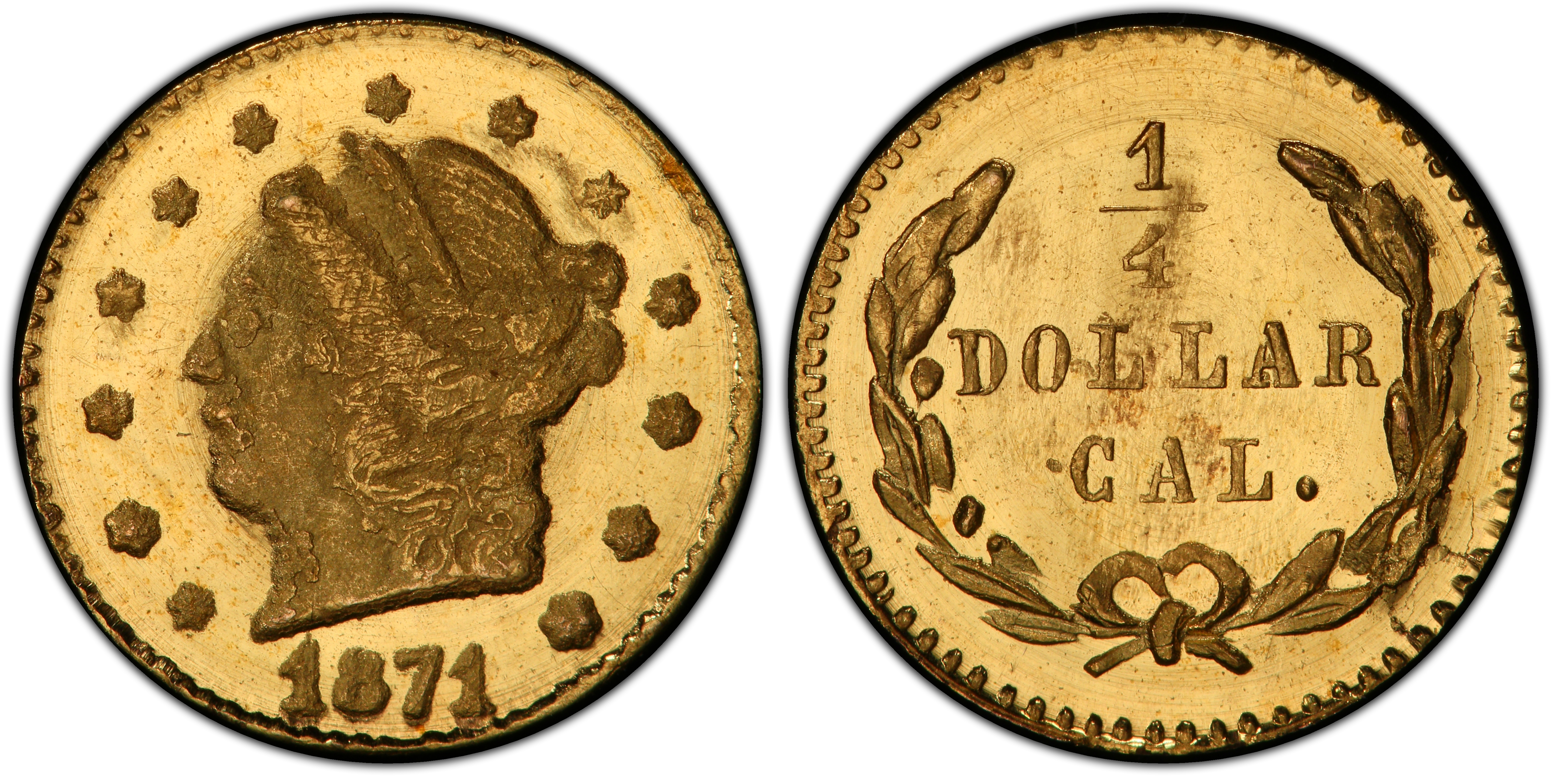
Obverse & Reverse
The 1871 Liberty Head 25 Cents, cataloged as Breen-Gillio 813, emerges from the second great phase of California's private gold coinage, known as 'Period Two' (1858-1882). Unlike the 'Period One' issues, born of necessity to alleviate a critical shortage of small change during the initial Gold Rush, the coins of this later era served a profoundly different purpose. By 1871, the San Francisco Mint was in full operation, and the completion of the Transcontinental Railroad in 1869 had fully integrated California's economy with the rest of the nation, stabilizing the supply of federal coinage. The raison d'être for fractional gold had shifted from commerce to commemoration and curiosity. These pieces were primarily 'jeweler's issues,' created by skilled artisans in San Francisco to be sold as souvenirs, keepsakes, and affordable gifts. They were tangible, miniature mementos of the Golden State, popular with tourists, visitors, and residents who wished to send a piece of California's famed wealth back East. The Coinage Act of 1864 had technically outlawed private coinage, but its enforcement was lax until the early 1880s, allowing this cottage industry to flourish. The BG-813 was therefore not intended for vigorous circulation in the manner of its predecessors. Instead, it was a commercial product, valued more for its novelty and connection to the Gold Rush legend than for its intrinsic worth, which was often less than its stated face value. Its existence speaks to a mature post-Gold Rush California, an economy diversifying into tourism and trade, where the romance of the '49er era was already being packaged and sold.
Associated EventCalifornia Gold Rush aftermath and tourism boom
Reason For MintingPrimarily struck for use as souvenirs and in jewelry, not to alleviate a coinage shortage as earlier issues had.
Minter HistoryThe specific minter or jeweler responsible for the BG-813 variety is unknown, a common trait for many 'Period Two' fractional gold pieces. Production was often decentralized among various San Francisco jewelers who created their own proprietary dies. These artisans, many of whom were of French or German origin, operated small-scale workshops and did not typically mark their products with identifiable initials or symbols during this period. Their business was in creating novelties, and attribution of specific dies to specific makers is one of the great challenges in the field.
Historical SignificanceThe BG-813 is a numismatic artifact representing the commercialization of the Gold Rush myth. It marks the transition of California fractional gold from a necessary medium of exchange to a nostalgic souvenir, reflecting California's economic maturation and the growing national fascination with the West. It is a product of a legally gray area, existing between the decline of pioneer necessity and the eventual federal enforcement against private coinage.
BG-813
Denomination25 Cents
Minting Period1871
Assayer/MinterUnknown private minter
Geographic OriginSan Francisco, California
Obverse DescriptionA small, classic Liberty Head design facing left, reminiscent of James B. Longacre's federal gold dollar. The hair is tied in a bun secured by a beaded cord. A coronet is inscribed with the word 'LIBERTY'. The portrait is encircled by 13 six-pointed stars, with the date '1871' positioned below the truncation of the neck.
Obverse InscriptionLIBERTY / 1871
Reverse DescriptionThe central device is the denomination '1/4 DOLLAR' and 'CAL.' contained within a simple wreath composed of two branches tied by a bow at the bottom. The wreath contains four berries, two on each side. A key diagnostic is a period after CAL. The fraction line is straight.
Reverse Inscription1/4 DOLLAR CAL.
CompositionGold
Stated Fineness Actual FinenessVariable, but typically lower than the 0.900 fineness of federal issues, consistent with its status as a jeweler's piece.
Diameter9.20 mm
EdgePlain
Unknown
Survival Estimate201-500 (per R-3 rating)
Rarity ScaleR-3 (Scarce)
The BG-813 is sought after by specialists in California fractional gold for its specific date and well-defined design characteristics. Its appeal lies in its affordability relative to rarer 'Period One' issues while still being a genuine artifact from the post-Gold Rush era. The known die characteristics, particularly the rusted obverse, provide a fascinating study in die degradation and minting technology of the time.
Key VarietiesThe primary variety is the regular business strike. A key diagnostic for advanced specialists is the presence of die rust on the obverse, particularly in the fields. Some auction catalogs have noted examples struck from a 'heavily rusted obverse die,' indicating a later die state. No proof or presentation strikings are known or believed to exist from the original period of issue.
Authentication TipsGenuine BG-813 examples will exhibit a sharp, albeit sometimes uneven, strike from manually operated presses. The fraction bar on the reverse is straight, and there is a distinct period after 'CAL'. Crucially, look for microscopic evidence of die rust (a fine, granular texture in the fields) on the obverse, a known characteristic of this variety. Counterfeits are common; they are often overly thick, soapy in appearance, have the wrong 'feel,' or are merely gold-plated base metal. All Period One and Two fractionals must have a denomination (e.g., 'DOLLAR' or 'CENTS'); pieces that say 'CALIFORNIA GOLD' without a denomination are modern tokens.
Shopping ConsiderationsA premium quality BG-813 will exhibit a sharp strike, especially on the delicate lettering of 'LIBERTY' and the reverse inscriptions. Look for examples with minimal contact marks and clean surfaces that retain some original mint luster, often appearing prooflike or semi-prooflike. The presence of the characteristic die rust is not necessarily a negative; in fact, a well-struck example showing this diagnostic can be desirable as it confirms the attribution. Avoid coins that have been harshly cleaned, polished, or show evidence of being removed from jewelry, such as solder marks or rim damage, which are common problems for this series.
A coin's grade is its condition, rated on a 1-70 scale. For rare coins, this is the most critical factor in determining value, as a tiny difference in preservation can mean a huge difference in price.
Relevant Grade TypesOriginal period issues of BG-813 were business strikes intended for sale as souvenirs, not general circulation. They are found in both Circulated (1-58) and Mint State (MS, 60-70) grades. Due to their nature as keepsakes, high-grade examples are more common than for the earlier, heavily-circulated 'Period One' issues. No Proof (PR/PF) examples were struck during the original minting period, and no later-date restrikes are known.
Mint State CharacteristicsUncirculated examples often display a slightly reflective, prooflike surface as the dies were typically polished. The strike can be inconsistent; a sharp strike on the stars and the word 'LIBERTY' on the coronet is a sign of superior quality. Due to the small size and manual striking process, weakness on the highest points of Liberty's hair is common. The fields, particularly on the obverse, may exhibit a fine granularity characteristic of the known rusted die state. Luster is typically bright and satiny.
Circulated Wear PatternsWear first appears on the highest points of the design: the hair above Liberty's eye and ear, the cheek, and the coronet. The delicate beads on the hair bun are also quick to flatten. On the reverse, the leaves and berries of the wreath will show initial friction and begin to merge. In lower circulated grades (Fine and below), the word 'LIBERTY' on the coronet becomes illegible and the stars lose their sharpness.
Key Factors For ValueFor the BG-813, value is driven primarily by grade and surface quality. A sharply struck coin with clean, lustrous surfaces commands a significant premium. Eye appeal is paramount; coins with rich, original gold toning are highly prized over those that are bright but appear washed-out from cleaning. The presence of a CAC sticker will add a premium, as it confirms both the grade and the superior quality for that grade. While die rust is a diagnostic, heavy or distracting rust that impairs the design's beauty may be viewed less favorably than a piece from an earlier die state.
PCGS Price Guide
| Grade | Price | Population |
|---|---|---|
| 50 | $200.00 | 1 |
| 50+ | $205.00 | N/A |
| 53 | $210.00 | N/A |
| 53+ | $215.00 | N/A |
| 55 | $220.00 | 8 |
| 55+ | $230.00 | N/A |
| 58 | $240.00 | 11 |
| 58+ | $250.00 | N/A |
| 60 | $260.00 | 2 |
| 61 | $275.00 | 14 |
| 62 | $300.00 | 38 |
| 62+ | $310.00 | N/A |
| 63 | $345.00 | 52 |
| 63+ | $355.00 | N/A |
| 64 | $400.00 | 39 |
| 64+ | $435.00 | N/A |
| 65 | $675.00 | 20 |
| 65+ | $800.00 | N/A |
| 66 | $975.00 | 4 |
| 66+ | $1,350.00 | 1 |
| 67 | $2,500.00 | 1 |
| 68 | N/A | N/A |