1875 G50C BG-1036 (Regular Strike)
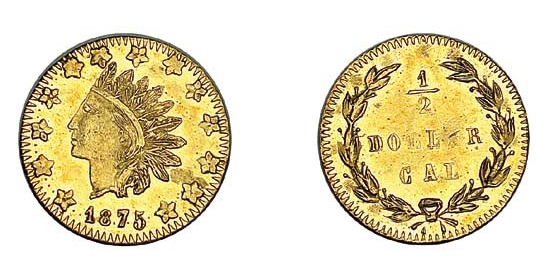
Obverse & Reverse
The 1875 50 Cents, cataloged as BG-1036 in the Breen-Gillio reference, is a quintessential example of a 'Period Two' California Fractional Gold piece. By the mid-1870s, the initial, desperate need for small-denomination coinage that characterized the California Gold Rush (1849-1856) had largely subsided. The establishment and robust output of the U.S. Branch Mint in San Francisco in 1854 had supplied the region with ample federal coinage for commerce. Consequently, the purpose of these minuscule gold pieces shifted dramatically. The first period issues, though often underweight, were genuinely intended to circulate and alleviate a severe shortage of small change. In contrast, the second period issues, struck from 1859 to 1882, were produced almost exclusively as souvenirs and keepsakes. Jewelers in San Francisco, many of whom remain anonymous, found a ready market for these charming gold tokens among tourists, locals sending gifts back East, and collectors. The pieces embodied the romance and allure of the Gold Rush, a tangible, glittering memento of California's fabled wealth. Despite the Private Coinage Act of 1864, which made such private issues illegal, the law was not strictly enforced against these small, denominated tokens until the early 1880s. This legal gray area allowed for their continued production. The BG-1036 was struck in this environment, not to pay for a shave or a drink, but to be tucked away in a pocketbook as a symbol of the Golden State. Its very existence speaks to a maturing California economy where the focus was shifting from raw survival and commerce to tourism and the creation of a regional identity.
Associated EventCalifornia Gold Rush (Later Souvenir Period)
Reason For MintingPrimarily created to be sold as souvenirs and keepsakes to tourists and locals, rather than to alleviate a coinage shortage.
Minter HistoryThe specific minter or jeweler who produced the BG-1036 variety is unknown, a common trait for many 'Period Two' issues. Unlike some earlier producers who marked their coins with initials (e.g., 'FD' for Frontier, Deviercy & Co.), many later manufacturers operated anonymously, producing a wide variety of designs to appeal to the souvenir trade.
Historical SignificanceThe BG-1036 represents the evolution of California Fractional Gold from a necessary medium of exchange to a commercial collectible. It is a numismatic artifact of California's burgeoning tourism industry and the romantic mythology that grew around the Gold Rush, demonstrating a continued market for gold novelties long after their practical necessity had vanished.
N/A
Denomination$0.50
Minting Period1875
Assayer/MinterUnknown Private Minter
Geographic OriginSan Francisco, California
Obverse DescriptionFeatures a crude but charming depiction of a Native American head facing left, often referred to as an 'Indian Head'. The portrait wears a feathered headdress. The field is typically surrounded by 13 five-pointed stars, representing the original colonies. The date, 1875, is positioned below the bust.
Obverse Inscription1875
Reverse DescriptionThe central motif is a wreath composed of two olive or laurel branches, tied together at the bottom with a bow. Within the wreath, the denomination '50 CENTS' is inscribed. The legend 'CALIFORNIA GOLD' typically encircles the wreath, though placement and exact wording can vary between dies.
Reverse Inscription50 CENTS CALIFORNIA GOLD
CompositionGold
Stated Fineness Actual Fineness EdgePlain
Unknown
Survival EstimateFewer than 10 believed to exist. The combined NGC and PCGS population reports show only a handful of examples graded.
Rarity ScaleR-7 (4 to 6 known)
The BG-1036 is highly sought after due to its extreme rarity and classic 'Indian Head' design. As a 'Period Two' issue, it is part of the larger, popular California Fractional Gold series, which attracts collectors due to its direct connection to the Gold Rush era. Its minuscule size and historical charm make it a fascinating collectible.
Key VarietiesNo major varieties of the BG-1036 are known. All original examples are considered business strikes, although many were struck on polished planchets giving them a 'prooflike' appearance. No true Proofs were created during the original minting period, and there are no known authorized restrikes or patterns associated with this specific Breen-Gillio number.
Authentication TipsAuthentication is critical. Genuine pieces must have a stated denomination (e.g., '50 CENTS' or 'HALF DOL'). Replicas often have a bear on the reverse or lack a denomination entirely. Look for the characteristic crude strike of a jeweler's issue; often, parts of the design may be weakly struck due to the thinness of the planchet and hammer-striking process. Counterfeits are often too perfect, too thick, or have a soapy, cast-like appearance. The Breen-Gillio reference is the indispensable guide for die diagnostics. Due to its high rarity and value, purchasing examples certified by PCGS or NGC is strongly recommended.
Shopping ConsiderationsA premium quality example for this issue is defined by a sharp strike, particularly on the details of the headdress and the lettering of the denomination. Look for original, undisturbed surfaces with prooflike or satiny luster. Many examples are weakly struck, so a coin with bold details commands a significant premium. Common problems include cleaning, jewelry mounting (removed solder or tooling), and bending due to the thinness of the planchets. Carefully examine the rims for evidence of having been previously set in a bezel. Eye appeal is paramount; a coin with attractive reddish-gold toning and minimal distracting marks is highly desirable.
A coin's grade is its condition, rated on a 1-70 scale. For rare coins, this is the most critical factor in determining value, as a tiny difference in preservation can mean a huge difference in price.
Relevant Grade TypesOriginal period issues were business strikes, often produced with a single hammer blow, and are found in Circulated (1-58) and Mint State (MS, 60-70) grades. No true Proof (PR/PF) examples of this variety were struck during the original period. While many Period Two issues were struck on polished planchets and exhibit prooflike (PL) surfaces, these are a characteristic of the business strike manufacturing process and are not a separate striking type like a true Proof coin. No later-date Proof restrikes are known to exist for BG-1036.
Mint State CharacteristicsAn uncirculated BG-1036 typically displays a soft, satiny luster, though many are found with highly reflective, prooflike fields from being struck on polished planchets. The strike is a key variable; even high-grade examples can show some weakness in the center of the obverse or reverse. The high points of the design are prone to light contact marks due to the softness of the gold. A superior MS example will have minimal marks, strong luster, and the best possible strike for the variety.
Circulated Wear PatternsWear first appears on the highest points of the design. On the obverse, this includes the cheek and the feathers of the headdress. On the reverse, the high points of the letters in 'CENTS' and the leaves in the wreath will show the first signs of friction. In lower grades (VF and below), the finer details of the feathers will merge and the legends will begin to soften and fade into the fields.
Key Factors For ValueExtreme rarity is the primary value driver. Given the tiny surviving population, any example is valuable. Beyond that, surface preservation is critical; a coin with original, uncleaned 'skin' and luster is far more valuable than a cleaned or polished one. Strike quality is the next major factor; a sharply struck specimen can be worth multiples of a weakly struck one in the same grade. Finally, superior eye appeal, characterized by smooth, prooflike surfaces and attractive original color, will always command a premium. A CAC sticker for this issue would be a significant value-add, confirming quality for the assigned grade.
PCGS Price Guide
| Grade | Price | Population |
|---|---|---|
| 60 | $8,000.00 | N/A |
| 61 | $8,500.00 | 1 |
| 62 | $9,000.00 | 1 |
| 62+ | $10,000.00 | N/A |
| 63 | $12,500.00 | N/A |
| 63+ | $15,000.00 | N/A |
| 64 | $22,500.00 | N/A |
| 65 | N/A | N/A |