1852 25C BG-799U, PL (Regular Strike)
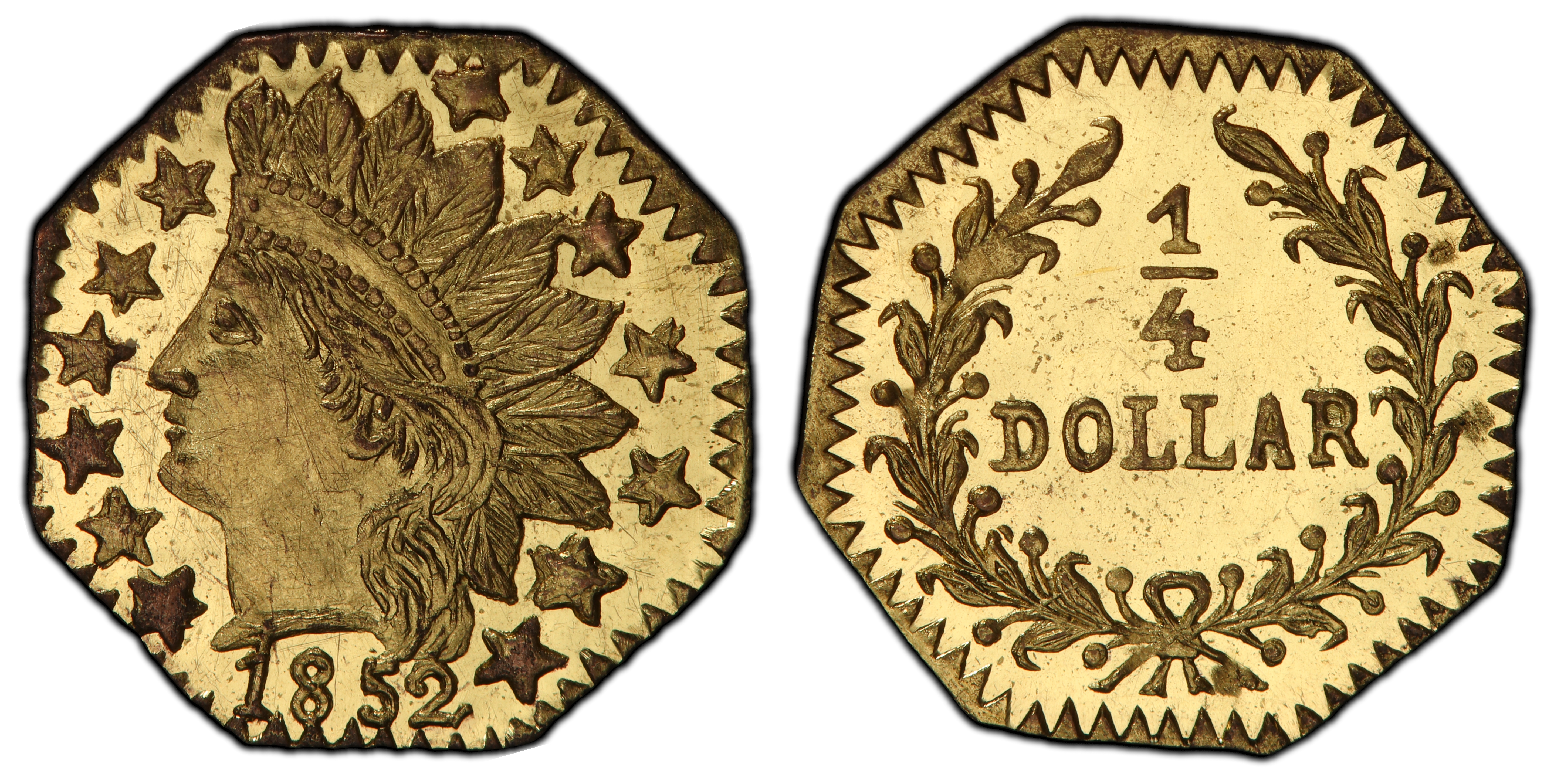
Obverse & Reverse
The 1852 25C BG-799U is a fascinating artifact born from the economic chaos of the California Gold Rush. Following the discovery of gold at Sutter's Mill in 1848, a massive influx of prospectors and merchants flooded into California, creating a vibrant but chaotic economy. While gold dust and large-denomination private assayer coins served for major transactions, a severe shortage of small-denomination federal coinage paralyzed daily commerce. Buying a drink, a meal, or other small necessities with a pinch of gold dust was imprecise and fraught with potential for conflict. This acute need for circulating change spurred private enterprise to fill the void. San Francisco jewelers and metallurgists began striking their own small-denomination gold coins in 1852, creating what are now known as California Fractional Gold pieces. These were not legal tender, but rather tokens of convenience whose acceptance relied on the reputation of the issuer and the desperate need for a medium of exchange. The BG-799U is classified as a 'Period One' issue (1852-1857), a time when these fractionals were genuinely intended for circulation. They were produced using relatively primitive methods, often hand-struck with a sledgehammer, which resulted in coins of varying strike quality and frequent die rotations, a characteristic common to the BG-799U variety. Their diminutive size made them easy to lose, and their intrinsic value, though often less than their face value, led many to be melted down over the years. By 1854, the establishment of the San Francisco Mint began to alleviate the coin shortage, and the utility of these private fractionals waned. Many later issues became popular as souvenirs and jewelry items rather than circulating currency. The BG-799U, however, represents the earliest and most historically significant period, a tangible piece of the Gold Rush's unique economic landscape.
Associated EventCalifornia Gold Rush
Reason For MintingTo alleviate a severe shortage of small-denomination coinage for daily commerce in Gold Rush-era California.
Minter HistoryThe specific minter for the BG-799U variety is unknown. Like many Period One California Fractional Gold pieces, it is anonymous. Research by numismatists like Walter Breen and Ronald J. Gillio has attributed some varieties to specific jewelers or firms (such as Frontier, Deviercy & Co. or Antoine Louis Nouzillet), but BG-799U remains unattributed, a common fate for these often clandestinely produced necessity coins.
Historical SignificanceAs a Period One issue, the BG-799U is a direct monetary artifact of the California Gold Rush, representing a private solution to a government failure in supplying adequate currency for a burgeoning frontier economy. Its existence demonstrates the ingenuity and entrepreneurial spirit that characterized the era.
BG-799U
Denomination25 Cents
Minting Period1852
Assayer/MinterUnknown
Geographic OriginSan Francisco, California
Obverse DescriptionAn Indian Head portrait facing left, with a feathered headdress. The portrait is encircled by 13 five-pointed stars, representing the original colonies. The date '1852' is below the bust.
Obverse Inscription1852
Reverse DescriptionA simple wreath composed of two branches tied with a bow at the bottom. The denomination '1/4' is in the center, though it is often weakly struck.
Reverse Inscription1/4
CompositionGold
Stated Fineness Actual FinenessVaries, but Period One issues are generally of a higher gold content than later 'souvenir' issues, typically ranging from .800 to .900.
Weight0.25 grams
Diameter9.50 mm
EdgePlain
Unknown
Survival Estimate31-75 (Based on R-5 rating)
Rarity ScaleR-5
This coin is highly sought after as a representative of the earliest, most historically pure phase of California Fractional Gold. Its octagonal shape, Indian Head design, and high rarity (R-5) make it a classic and desirable type for specialists in pioneer gold.
Key VarietiesThe primary variety is the regular strike BG-799U. No official patterns, proofs, or restrikes from the original period are known to exist. The most significant variation noted by grading services is the surface characteristic: many specimens exhibit highly reflective, Prooflike (PL) or Deep Mirror Prooflike (DMPL) fields, which command a premium. Die state is also a factor, with many examples showing significant die rotation.
Authentication TipsGenuine examples are struck in gold, not brass or gold-plated base metals. Look for a sharp, albeit sometimes uneven, strike from hammered dies, not the soft, mushy details of a cast counterfeit. The die work, particularly the stars and feathers, should match known genuine examples. Be wary of incorrect weight or diameter. This specific variety is known for having rotated dies, so this is not necessarily an indicator of a fake but rather a diagnostic feature. Unusually perfect surfaces or the presence of a bear on the reverse are tell-tale signs of a modern replica or souvenir token, not a genuine Period One fractional.
Shopping ConsiderationsFor this issue, a premium quality example is defined by several factors. A sharp strike is paramount, especially on the high points of the Indian's cheek, the headdress feathers, and the '1/4' on the reverse, which are often weak. Original, lustrous surfaces are highly prized; many survivors are cleaned or have been used as jewelry. Look for coins with original 'skin' and avoid those with harsh cleaning lines, polishing, or evidence of being removed from a bezel. The presence of Prooflike or Deep Mirror Prooflike surfaces significantly increases value and eye appeal. Given the crude manufacturing, minor planchet flaws are common and may not detract significantly unless they are distracting. A CAC sticker on a certified example provides third-party confirmation of premium quality for the grade.
A coin's grade is its condition, rated on a 1-70 scale. For rare coins, this is the most critical factor in determining value, as a tiny difference in preservation can mean a huge difference in price.
Relevant Grade TypesAll original BG-799U issues were business strikes intended for circulation and are found in Circulated (1-58) and, more commonly, Mint State (MS, 60-70) grades today due to their novelty and tendency to be saved. No true Proofs were struck during the original minting period. However, because fresh dies were often polished, many high-grade examples come with Prooflike (PL) or Deep Mirror Prooflike (DMPL) surfaces, which are special designations for business strikes and are highly desirable.
Mint State CharacteristicsUncirculated examples of BG-799U are defined by their luster, but strike can be highly variable. A sharp strike is rare and commands a premium. Luster is typically satiny and frosty, though many exhibit glassy, reflective fields qualifying for PL/DMPL designations. Due to the primitive production, even high-grade Mint State coins can display minor planchet imperfections or a slightly uneven strike across the surface. Contact marks, while present, are often light due to the coins being saved rather than heavily circulated.
Circulated Wear PatternsWear first appears on the highest points of the design. On the obverse, look for friction on the Indian's cheekbone, the eyebrow, and the tips of the headdress feathers. On the reverse, the wreath's highest leaves and the fractional denomination '1/4' will show the first signs of flattening. In lower grades (VF and below), the stars will begin to lose their points and merge with the fields, and the date will become less distinct.
Key Factors For ValueBeyond the numerical grade, value is driven by three key factors: strike, surface quality, and eye appeal. A fully struck coin with crisp details on the portrait and wreath is far more valuable than a weakly struck counterpart of the same grade. Original, uncleaned surfaces are essential; a coin with even light cleaning will be worth significantly less. Finally, eye appeal, which includes attractive original gold toning and the presence of desirable PL or DMPL surfaces, can add a substantial premium. The degree of die rotation can also be a point of interest for specialists. A CAC sticker confirms superior quality and adds a premium.
PCGS Price Guide
| Grade | Price | Population |
|---|---|---|
| 65 | $1,750.00 | 1 |
| 65+ | $2,250.00 | N/A |
| 66 | $2,750.00 | 1 |