1869 G50C BG-1021 (Regular Strike)
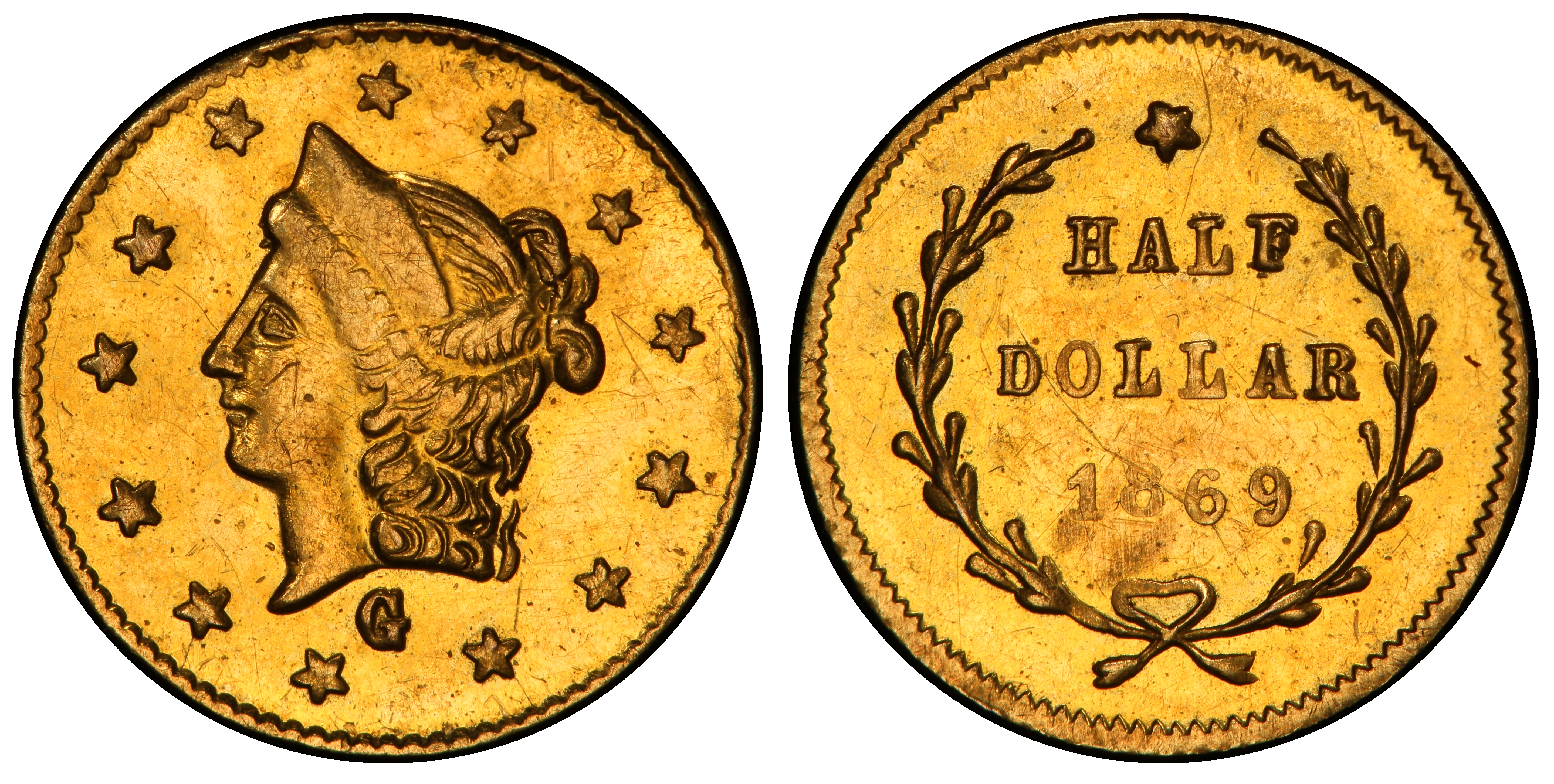
Obverse & Reverse
The 1869 G50C BG-1021 is a product of the second period (1858-1882) of California Fractional Gold production. By 1869, the acute shortage of small denomination coinage that characterized the Gold Rush's peak years had largely subsided, thanks to the output of the San Francisco Mint, which opened in 1854. Consequently, the purpose of these diminutive gold pieces shifted from utilitarian currency to souvenirs and novelty items. San Francisco jewelers, many of whom were accomplished engravers and metallurgists, recognized a robust market among tourists, merchants, and locals who wished to send a tangible piece of the 'Golden State' back East or keep it as a keepsake. These 'Period Two' issues were not intended to circulate in the same way as their 'Period One' (1852-1857) predecessors. The Private Coinage Act of 1864 had officially made such private minting illegal, but enforcement by the Secret Service was lax in California until the early 1880s. This legal gray area allowed firms like Robert B. Gray & Co. to continue production. Unlike the earlier issues which were often close to their stated value in gold content, Period Two pieces were frequently debased, containing less gold than their 50-cent face value would imply. They were novelties, not fiduciary instruments. The craftsmanship, however, could be quite high, as dies were often prepared with great skill. The BG-1021 is an example of the popular 'Liberty Head' motif, mimicking the design of official U.S. gold coinage, a practice that lent the pieces an air of legitimacy and familiarity, making them more attractive as souvenirs. The 'G' marking on related varieties from this era is the primary evidence numismatists use to attribute this piece to Robert B. Gray & Co., a prominent San Francisco jeweler who was active in this trade. The extreme rarity of the BG-1021 variety today suggests a very limited original production, likely struck to fulfill a small order or as a brief test of a specific die pairing.
Associated EventPost-Gold Rush Economic Period
Reason For MintingPrimarily created as a souvenir or keepsake of California for tourists and locals, rather than to alleviate a coinage shortage.
Minter HistoryRobert B. Gray & Co. was a San Francisco-based jewelry and watchmaking firm active during the mid-to-late 19th century. Numismatic scholarship, particularly the work of Breen and Gillio, attributes many Period Two fractional gold pieces marked with a 'G' to this company. The firm was a successor to the business of Antoine Nouizillet, another key producer of fractional gold. Gray & Co. produced a variety of denominations and designs, capitalizing on the significant market for gold rush souvenirs. The business was eventually sold to the California Jewelry Co. in 1871.
Historical SignificanceThis coin is a tangible artifact of the transition of California's economy from the chaotic, bullion-based system of the Gold Rush to a more mature state integrated into the national monetary system. It represents the commercialization of the Gold Rush legacy, where the allure of gold was packaged into miniature souvenirs, and highlights a period of ambiguous enforcement of federal private coinage laws.
N/A
Denomination50 Cents
Minting Period1869
Assayer/MinterRobert B. Gray & Co. (Attributed)
Geographic OriginSan Francisco, California
Obverse DescriptionA beaded border encloses a Liberty Head facing left, modeled after the contemporary U.S. gold dollar. The portrait is somewhat crude in its rendering, typical of many jeweler's issues. Thirteen stars encircle the bust, often appearing unevenly spaced or weakly struck.
Obverse Inscription[NONE]
Reverse DescriptionA decorative wreath of leaves and berries, tied with a bow at the bottom, encircles the denomination. The date '1869' is positioned within the wreath, above the denomination. The letter 'G' for the minter is not present on this specific variety, but its style and period of issue link it to other 'G' marked pieces.
Reverse Inscription1/2 DOLLAR 1869
CompositionGold
Stated Fineness Actual FinenessVariable, often lower than federal standards, sometimes as low as 14-karat gold.
Weight0.25 grams
Diameter11.00 mm
EdgePlain
Unknown, but presumed to be extremely small.
Survival EstimateFewer than 15
Rarity ScaleR-6+ (Very Rare)
The BG-1021 is highly sought after due to its extreme rarity and connection to the popular California Fractional Gold series. As a 'Period Two' issue, it tells the story of the souvenir trade that grew out of the Gold Rush. Its simple, classic Liberty Head design appeals to type collectors, while its rarity presents a significant challenge for the advanced specialist.
Key VarietiesBG-1021 is a specific die marriage and is considered a single variety. No major sub-varieties, patterns, or official restrikes are known to exist for this specific variety. The broader series of 1869 50-cent pieces includes other BG numbers with slight variations in die design and placement of elements, such as BG-1020, which is more common.
Authentication TipsGenuine BG-1021 pieces were struck, not cast. Look for sharp, albeit sometimes weakly executed, details. The fields may be semi-prooflike from polished dies. The planchets are typically very thin and can have planchet striations (parallel lines from the drawing process). Common counterfeits are often cast, showing pitting or a soapy texture, or are brass tokens with incorrect luster. Replicas frequently feature a bear on the reverse, a design never used on genuine 19th-century issues. Verify that the reverse explicitly states 'DOLLAR' or an abbreviation; many fakes say 'CALIFORNIA GOLD' or 'CHARM' instead.
Shopping ConsiderationsFor a premium quality example of BG-1021, a buyer should prioritize sharpness of strike, particularly on Liberty's hair details and the numerals of the date. Given the crude manufacturing, perfectly struck specimens are virtually nonexistent, so a relatively bold strike for the issue commands a significant premium. Look for original, undisturbed surfaces with some remaining luster; many survivors have been cleaned, polished, or used in jewelry. Attractive, reddish-gold toning is highly desirable. Avoid examples with significant rim bumps, scratches, or evidence of being mounted, as these issues are common and severely impact value and appeal.
A coin's grade is its condition, rated on a 1-70 scale. For rare coins, this is the most critical factor in determining value, as a tiny difference in preservation can mean a huge difference in price.
Relevant Grade TypesOriginal examples of BG-1021 were business strikes produced for commercial sale as souvenirs. They are found in Circulated (1-58) and, more commonly, Mint State (MS, 60-70) grades, as many were preserved as keepsakes. No true Proof (PR/PF) examples were struck during the original period of issue. Some high-grade pieces may exhibit prooflike surfaces due to the use of polished dies, but these are designated as PL business strikes, not Proofs.
Mint State CharacteristicsUncirculated examples are defined by their luster, which can range from satiny to semi-prooflike. The strike is a critical factor; they are often weakly struck in the centers, with Liberty's hair above the eye and the wreath details being particularly susceptible. Due to the softness of the gold and rudimentary handling, even high-grade Mint State examples will typically show scattered microscopic marks or planchet flaws. A premium MS coin will have minimal marks, a strong strike for the variety, and pleasing luster.
Circulated Wear PatternsWear first appears on the highest points of the design. On the obverse, friction will dull the luster on Liberty's cheek, the hair just above the ear, and the tips of the coronet. On the reverse, the high points of the wreath's leaves and the numerals of the date will show initial flatness. In lower grades (VF and below), the individual hair strands will merge, and the legend and date will become soft and lose their sharp edges.
Key Factors For ValueFor the BG-1021, rarity is the primary value driver. Beyond that, a coin's value is determined by a combination of grade and eye appeal. A sharply struck example with clean, original surfaces will command a massive premium over a weakly struck or cleaned piece of the same grade. Luster quality—either satiny or prooflike—is a major factor in eye appeal. The presence of a CAC sticker, indicating premium quality for the grade, adds a significant premium for a rarity of this caliber.
PCGS Price Guide
| Grade | Price | Population |
|---|---|---|
| 45 | $325.00 | 1 |
| 45+ | $330.00 | N/A |
| 50 | $340.00 | N/A |
| 50+ | $350.00 | N/A |
| 53 | $360.00 | 1 |
| 53+ | $365.00 | N/A |
| 55 | $385.00 | 3 |
| 55+ | $400.00 | N/A |
| 58 | $475.00 | 3 |
| 58+ | $500.00 | N/A |
| 60 | $550.00 | 2 |
| 61 | $600.00 | 1 |
| 62 | $775.00 | 6 |
| 62+ | $925.00 | N/A |
| 63 | $1,300.00 | 1 |
| 63+ | $1,550.00 | N/A |
| 64 | $2,250.00 | 1 |