1876 25C BG-799F, DMPL (Regular Strike)
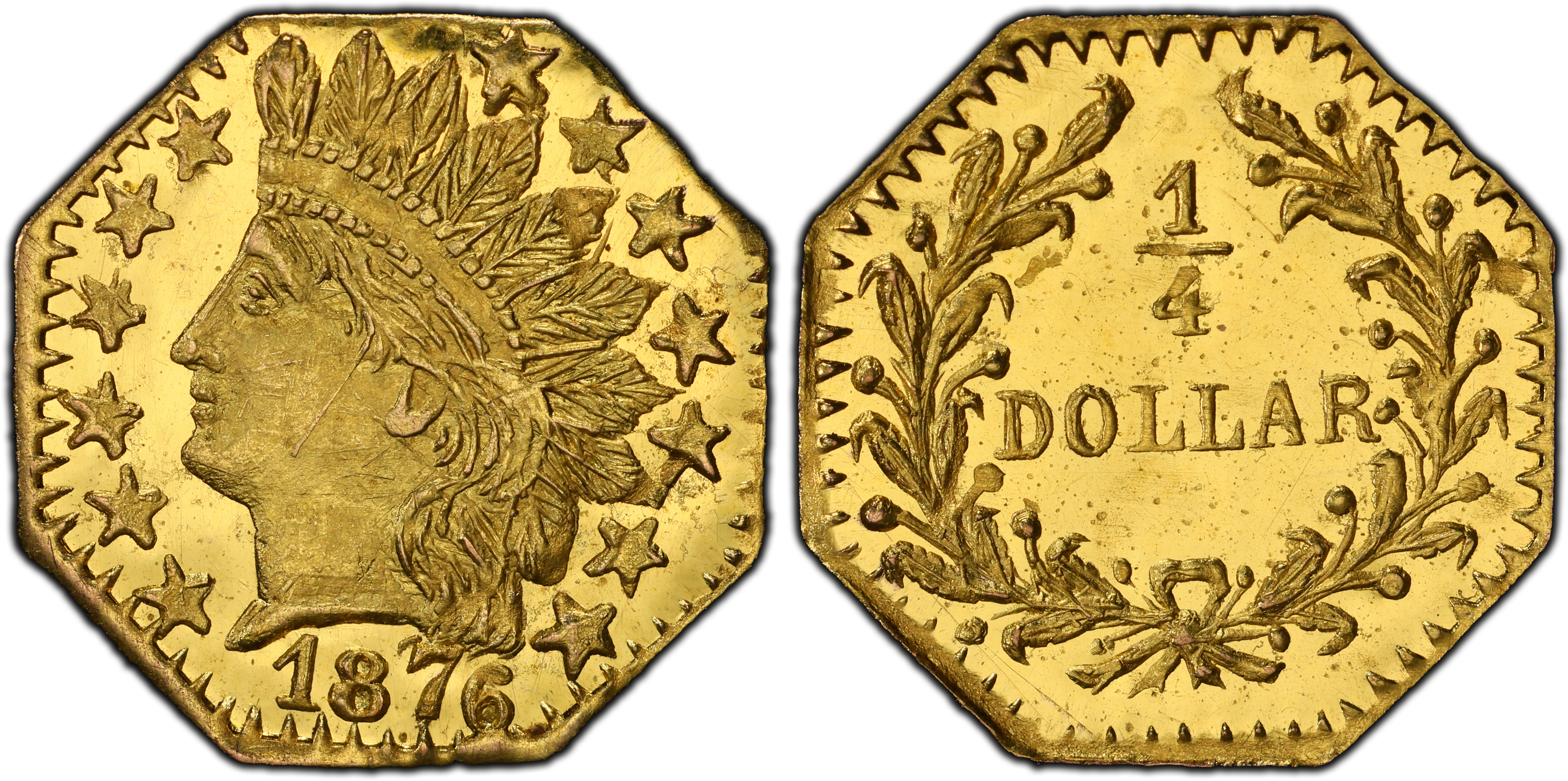
Obverse & Reverse
The 1876 25-cent piece, cataloged as Breen-Gillio 799F, is a fascinating product of the latter phase of California's private minting era, known as 'Period Two' or the 'Jewelers' Issue' period (1858-1882). By the mid-1870s, the initial, desperate need for circulating small change that drove the creation of the first fractional gold pieces in the early 1850s had long since been met by the San Francisco Mint. These later issues were produced not as essential currency but as charming mementos and souvenirs of the now-legendary Gold Rush. Enterprising jewelers, primarily in San Francisco, catered to a burgeoning tourist trade and a national fascination with the 'Wild West' by striking these miniature gold coins. While the Coinage Act of 1864 had made private coinage illegal, the law was not aggressively enforced against these small, low-value pieces until later. The minter of the BG-799 series, Christopher Ferdinand Mohrig, operated in this legally gray environment. His timing, however, proved unfortunate. On August 10, 1876, just as the nation was celebrating its centennial, U.S. Secret Service agents arrested Mohrig for violating the 1864 Act. His coining equipment, dies, and remaining inventory of fractional gold pieces were confiscated and subsequently destroyed. This abrupt end to his operation is the primary reason for the rarity of his 1876-dated issues, including the BG-799F. These coins were never intended for widespread circulation; their intrinsic value was significantly less than their face value, a common trait of Jewelers' Issues. Instead, they were keepsakes. The DMPL (Deep Mirror Prooflike) designation on select survivors indicates they were struck with freshly polished dies, creating a beautiful contrast between mirrored fields and frosted devices, an aesthetic flair clearly aimed at collectors and tourists rather than merchants. The BG-799F represents the final, dramatic chapter of one of the last private minters of California Fractional Gold, a piece of numismatic history frozen at the very moment federal enforcement brought the era to a close.
Associated EventPost-Gold Rush 'Jewelers' Issue' Period
Reason For MintingPrimarily struck as a souvenir or keepsake of the California Gold Rush for the tourist and collector market.
Minter HistoryChristopher Ferdinand Mohrig was a San Francisco-based jeweler and one of the more prolific private minters of California Fractional Gold during the 1870s. He is credited with producing a wide range of varieties, cataloged in the Breen-Gillio reference from BG-790 through BG-799V. His work is characteristic of the 'Period Two' issues, often featuring Indian Head motifs and intended for the souvenir trade. His career in coining came to an abrupt halt on August 10, 1876, when he was arrested by the Secret Service. The confiscation and destruction of his dies and stock ensures that his 1876-dated pieces are genuinely scarce and represent his final, unwilling contribution to the series.
Historical SignificanceThis coin is significant not as a circulating medium but as an artifact from the end of America's private coinage era. It represents the transition of fractional gold from necessity money to commercial souvenir and is a tangible link to the crackdown by federal authorities that finally suppressed these private issues. Its rarity is a direct result of law enforcement action, making it a numismatic story of defiance and finality.
N/A
Denomination25 Cents
Minting Period1876
Assayer/MinterChristopher Ferdinand Mohrig
Geographic OriginSan Francisco, California
Obverse DescriptionAn Indian Head portrait facing left, wearing a feathered headdress. The portrait is surrounded by 13 six-pointed stars, representing the original colonies. The date '1876' is positioned below the bust.
Obverse Inscription1876
Reverse DescriptionThe reverse features the denomination '1/4 DOLLAR' enclosed within a continuous wreath of leaves and berries. The wreath is tied with a bow at the bottom.
Reverse Inscription1/4 DOLLAR
CompositionGold
Stated Fineness Actual FinenessVariable, typical for Period Two issues, often less than 14-karat.
Weight0.25 grams
Diameter9.50 mm
EdgePlain
Unknown; very small due to the minter's arrest in 1876.
Survival Estimate13-30 coins known.
Rarity ScaleR-6 (Low R-6)
Sought for its high rarity, connection to the final chapter of private fractional gold minting, the specific story of its minter's arrest, and its attractive Indian Head design. DMPL examples are especially prized for their exceptional eye appeal.
Key VarietiesThe BG-799 designation encompasses several die marriages. The 'F' in BG-799F refers to a specific die pair and its state of wear, a distinct variety from others like BG-799A, C, or D. No official restrikes or patterns of Mohrig's 1876 issues are known to exist, as his dies were confiscated and destroyed by the Secret Service, making any surviving examples original products of his illicit 1876 operation.
Authentication TipsGenuine examples exhibit a sharp, if sometimes uneven, strike from hand-operated presses. The details of the wreath and feathers should match published plate coins for the BG-799F die state. The gold often has a brassy hue typical of lower-fineness jeweler's issues. Many crude, modern replicas exist; these are often gold-plated brass, feel lightweight, and have mushy, poorly defined details. Authentication by a major grading service (PCGS or NGC) is highly recommended for this series.
Shopping ConsiderationsA premium quality example for this variety, especially a DMPL, is defined by the depth and clarity of its mirrored fields and the resulting cameo contrast with the frosted devices. Look for an example with minimal distracting marks, as any contact mark or hairline is magnified by the reflective surfaces. Strike quality can be variable; a well-centered strike with full feather and wreath detail commands a significant premium. Some BG-799F examples are known to have been struck with rotated dies, a fascinating feature that adds to their appeal. Avoid coins that have been harshly cleaned, as this destroys the original surfaces and any prooflike qualities. Also be wary of tooling or other alterations designed to mimic sharper details.
A coin's grade is its condition, rated on a 1-70 scale. For rare coins, this is the most critical factor in determining value, as a tiny difference in preservation can mean a huge difference in price.
Relevant Grade TypesOriginal 1876 issues are classified as business strikes, although they were produced with a collector/souvenir focus. They are found in both Circulated (1-58) and, more commonly for this rare issue, Mint State (MS, 60-70) grades. No true Proofs (PR/PF) were struck during the original period of issue. The DMPL (Deep Mirror Prooflike) designation is an attribute applied to Mint State coins struck from highly polished dies, creating a distinct cameo appearance. These are not a separate issue but are the finest quality strikes of the regular run and are highly prized.
Mint State CharacteristicsUncirculated examples of BG-799F are defined by their luster. A standard MS coin will have a soft, satiny luster. A DMPL example will exhibit profound, watery, or mirror-like reflectivity in the fields. Due to the small size and private minting process, strikes can be inconsistent. A well-struck piece will show sharp details in the feathers of the headdress and the leaves of the wreath. Contact marks, even small ones, are common and can be very distracting on DMPL surfaces.
Circulated Wear PatternsOn circulated examples, wear first appears on the highest points of the design: the cheek and brow of the Indian portrait, the upper feathers of the headdress, and the high points of the wreath leaves on the reverse. In lower grades (VF and below), the date and stars will begin to lose their sharpness, and the fine details of the wreath will merge.
Key Factors For ValueFor the BG-799F, value is driven by three main factors. First is rarity, which is inherently high. Second is grade (condition), with Mint State examples carrying a huge premium. Third, and most critical for this variety, is surface quality and eye appeal. A certified DMPL example will trade for multiples of a standard Mint State coin. The degree of cameo contrast, the absence of distracting marks, and the sharpness of the strike are paramount. Coins with original, untouched surfaces and a strong visual 'wow' factor are the most desirable. A CAC sticker on a DMPL coin would signify elite quality for the grade and add a substantial premium.
PCGS Price Guide
| Grade | Price | Population |
|---|---|---|
| 67 | N/A | 1 |