1874 G25C BG-876 (Regular Strike)
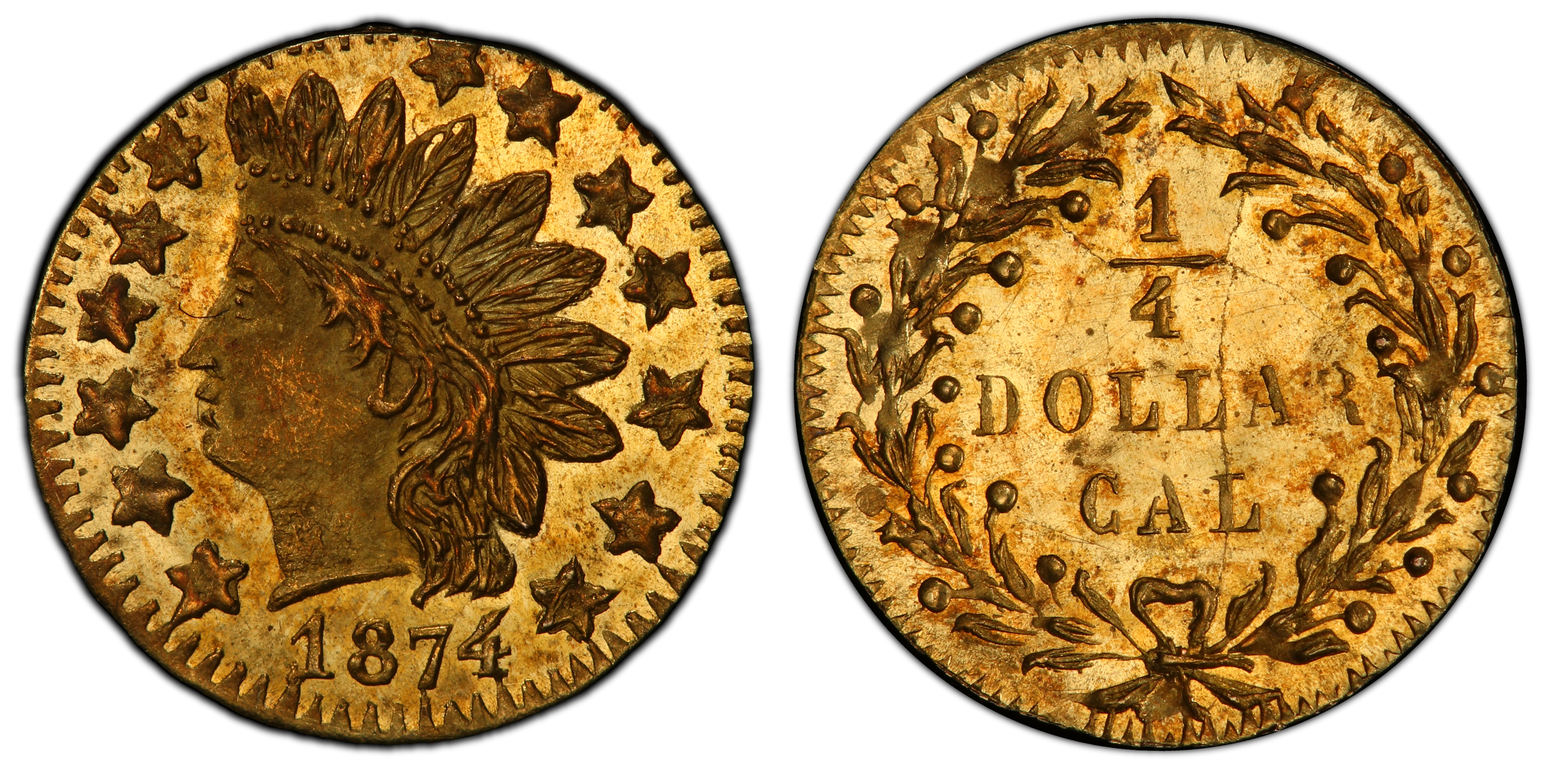
Obverse & Reverse
The 1874 G25C BG-876 is a quintessential example of 'Period Two' California Fractional Gold. By the mid-1870s, the initial frenzy of the Gold Rush had subsided, but California's economy remained dynamic and distinct from the rest of the nation. A chronic shortage of small-denomination federal coinage persisted on the West Coast, a problem that had plagued the region since the 1850s. While the San Francisco Mint produced federal gold and silver, the smallest circulating coins, particularly for transactions under a dollar, were scarce. This void created a sustained market for privately issued small gold pieces. Unlike the 'Period One' issues (1852-1857), which were intended to and often did circulate as a necessary medium of exchange, the Period Two pieces, struck from 1859 to 1882, occupied a more complex niche. They were produced by jewelers and metallurgists, such as Robert B. Gray & Co., who capitalized on the demand for small change while also marketing them as souvenirs and keepsakes of the Golden State. The Coinage Act of 1864 had prohibited private coinage, but enforcement was lax, and these tiny gold pieces continued to be made, skirting the law by being technically 'tokens' but often carrying designs and denominations mimicking federal coinage. The BG-876, with its Indian Head motif, clearly emulated the popular design of the U.S. Indian Head Cent. These pieces were machine-struck, resulting in better overall quality than the earlier hammered examples. Their gold content, however, was typically below their face value, making them a profitable venture for their manufacturers. They were tolerated in local commerce out of necessity and novelty but were eventually supplanted by the increased availability of federal coinage and stricter enforcement of anti-counterfeiting and private coinage laws by the early 1880s. Today, they are collected as a fascinating epilogue to the private coinage era of the American West.
Associated EventPost-Gold Rush Economic Growth in California
Reason For MintingTo alleviate a persistent shortage of small change in California and to be sold as popular souvenirs.
Minter HistoryThe specific minter of BG-876 is unknown, as was common for many Period Two California Fractional Gold pieces. They were generally produced by various manufacturing jewelers located in San Francisco who had the equipment to strike small tokens. These makers often remained anonymous to avoid potential legal issues related to the 1864 law against private coinage. Their primary business was jewelry, and the creation of these gold 'charms' or 'tokens' was a lucrative sideline.
Historical SignificanceThe BG-876 represents the persistence of private minting in the American West long after the initial Gold Rush boom. It is a tangible link to the unique economic conditions of 19th-century California and the transition of fractional gold from a circulating medium of necessity to a commercial souvenir item. The series to which it belongs documents a fascinating chapter of numismatic history where private enterprise continued to fill a gap left by the federal government.
N/A
Denomination25 Cents (Quarter Dollar)
Minting Period1874
Assayer/MinterUnknown Private Jeweler
Geographic OriginSan Francisco, California
Obverse DescriptionA stylized head of Liberty facing left, wearing a feathered headdress. The portrait is often referred to as an 'Indian Head.' Thirteen stars encircle the portrait along the rim.
Obverse Inscription(No lettering)
Reverse DescriptionThe denomination '1/4' is enclosed within a wreath of two olive branches tied with a bow at the bottom. The word 'DOLLAR' and the date '1874' appear within the wreath, above and below the fraction, respectively. Some sources note the 'CALIFORNIA GOLD' inscription outside the wreath, but for this specific variety it is typically contained or associated with the wreath design.
Reverse Inscription1/4 DOLLAR 1874
CompositionGold
Stated Fineness Actual FinenessVariable, typically between .500 and .800 fine, and sometimes lower. The gold value was intentionally less than the face value.
Weight0.25 grams
Diameter9.80 mm
EdgePlain
Unknown
Survival Estimate76-125 known
Rarity ScaleR-4
This coin is highly collectible due to its direct connection to the California Gold Rush era, its miniature and intricate Indian Head design, and its status as a privately minted gold piece. It is one of the more available and thus more affordable genuine California Fractional Gold pieces, making it a popular entry point for collectors.
Key VarietiesThe BG-876 itself is a specific die marriage. Within the broader 1874 25C series, there are numerous other Breen-Gillio varieties featuring different dies, dates, and design details (e.g., BG-875). No special collector issues like proofs or restrikes from the original minting period are known for this variety.
Authentication TipsGenuine examples have a characteristic soft, satiny luster and a relatively sharp strike from a steam press, unlike modern cast or electrotype copies. Look for die markers specific to the BG-876 marriage if possible. Counterfeits are rampant; many are gold-plated brass and feel light or have incorrect dimensions. Authentic pieces often have parallel striations on the fields from the planchet preparation process. Any piece that appears overly glossy, soapy, or has a granular texture should be viewed with extreme suspicion. Professional authentication is highly recommended.
Shopping ConsiderationsA premium quality example for its grade will exhibit a sharp, well-centered strike, especially on the details of the headdress and the numerals in the date. Original, uncleaned surfaces are paramount; many have been harshly cleaned or polished over the years, significantly reducing their value. Look for examples with minimal distracting contact marks. The natural gold toning can range from a bright yellow-gold to a deeper reddish-orange hue; attractive, original toning commands a premium. Check carefully for evidence of having been mounted in jewelry, such as rim damage or solder marks.
A coin's grade is its condition, rated on a 1-70 scale. For rare coins, this is the most critical factor in determining value, as a tiny difference in preservation can mean a huge difference in price.
Relevant Grade TypesAll original 1874 G25C BG-876 coins were struck as business strikes for potential commerce or sale as souvenirs. They are found in Circulated (1-58) and, more commonly, Mint State (MS, 60-70) grades due to their novelty nature leading many to be saved. No proofs were struck during the original period of issue, and no later-date restrikes are known to exist for this specific variety.
Mint State CharacteristicsUncirculated examples of BG-876 typically exhibit a soft, satiny luster rather than a deeply prooflike or frosty one. The strike can be variable, with weakness sometimes seen on the highest points of the feathers and the date. Due to the softness of the gold and their small size, even high-grade Mint State examples will often show minor contact marks or 'ticks' from handling and storage with other pieces. A well-struck piece with clean fields and minimal marks is considered exceptional.
Circulated Wear PatternsWear first appears on the high points of the design. On the obverse, check the cheek of the Indian Head and the tips of the feathers in the headdress. On the reverse, the highest points of the wreath's leaves and the numerals of the fraction '1/4' will show initial friction and flattening. In lower grades (VF and below), the finer details of the feathers will merge and the legends will become soft.
Key Factors For ValueThe primary drivers of value are grade and surface quality. An example with original, uncleaned 'skin' is far more desirable than a cleaned or polished piece of the same grade. Strike quality is a major factor; a sharply struck coin with full details will command a significant premium over a softly struck one. Eye appeal, encompassing attractive toning and a lack of distracting marks, plays a crucial role. Third-party certification by PCGS or NGC is standard and essential for market acceptance, with a CAC sticker adding a further premium for coins deemed superior for their grade.
PCGS Price Guide
| Grade | Price | Population |
|---|---|---|
| 55 | $225.00 | 3 |
| 55+ | $235.00 | N/A |
| 58 | $250.00 | 5 |
| 58+ | $275.00 | N/A |
| 60 | $300.00 | 1 |
| 61 | $325.00 | 2 |
| 62 | $350.00 | 16 |
| 62+ | $375.00 | N/A |
| 63 | $400.00 | 27 |
| 63+ | $450.00 | N/A |
| 64 | $550.00 | 42 |
| 64+ | $650.00 | N/A |
| 65 | $850.00 | 16 |
| 65+ | $1,000.00 | N/A |
| 66 | $1,250.00 | 2 |
| 66+ | $1,500.00 | N/A |
| 67 | $2,250.00 | N/A |