1871 G25C BG-861, PL (Regular Strike)
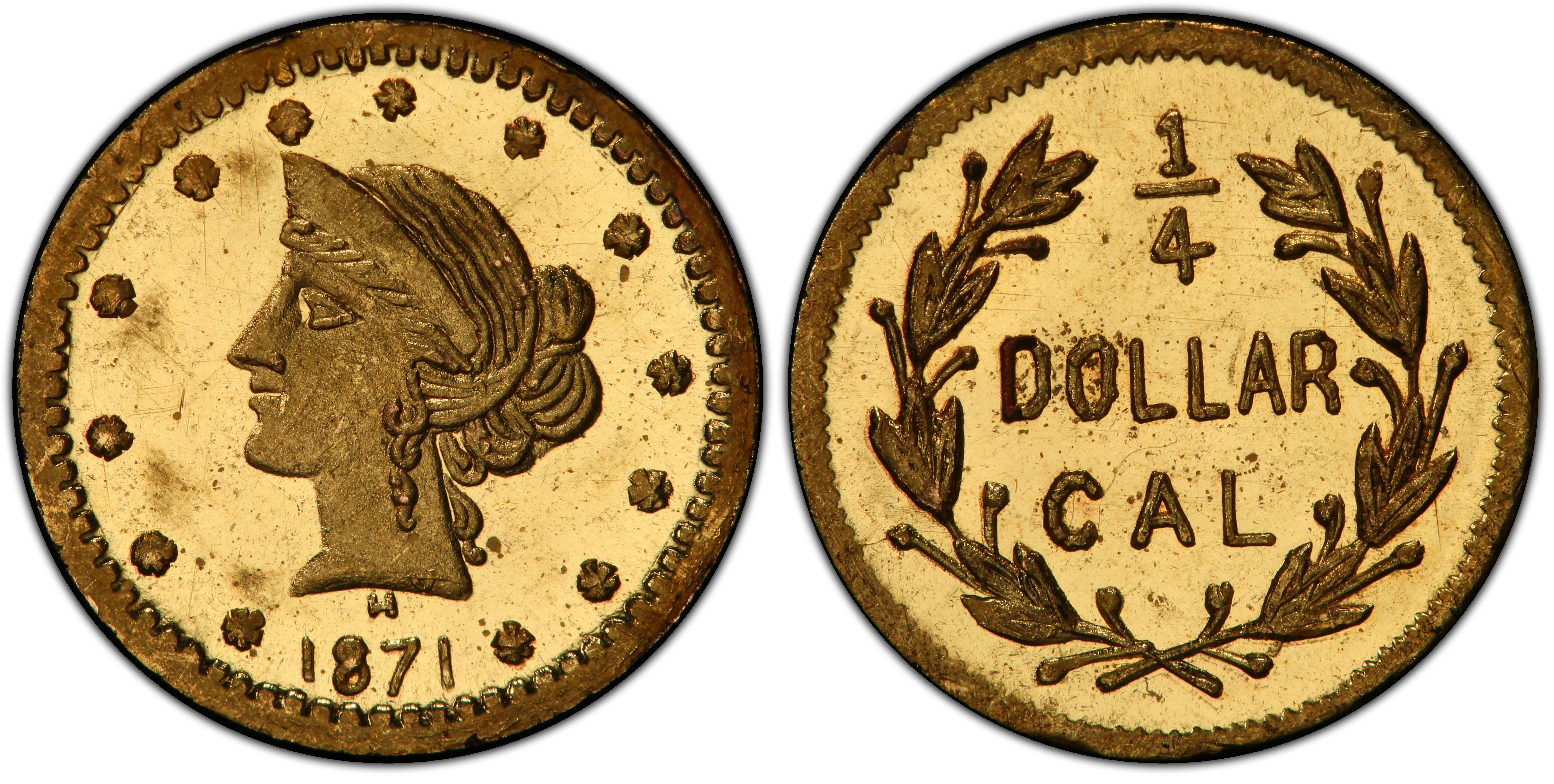
Obverse & Reverse
The 1871 BG-861 25 Cent piece emerges from the second major phase of California's private gold coinage, a period numismatists designate as 'Period Two' (1859-1882). Unlike the earlier 'Period One' issues (1852-1857), which were struck out of a genuine necessity for circulating small change amidst the chaos of the early Gold Rush, Period Two pieces served a dual purpose. By the 1870s, the U.S. Mint in San Francisco was in full operation, alleviating much of the initial coin shortage. However, commerce was still expanding, and the public retained a fascination with the iconic gold pieces of the '49ers. Enterprising jewelers in San Francisco, many of French origin, recognized a lucrative market for small, gold souvenirs. These pieces, while denominated, were primarily intended as keepsakes, charms for watch fobs, and mementos of a visit to the romanticized West. The Coinage Act of 1864 had technically made private coinage illegal, but enforcement by the Secret Service was lax until 1883. This legal gray area allowed for the continued production of these denominated 'jeweler's issues.' The BG-861 was struck in this environment. It was not intended to be a primary medium of exchange but would have been accepted in small transactions, valued more for its novelty and connection to California's golden identity than its intrinsic worth, which was significantly less than its face value. These tiny coins represent a fascinating transition from utilitarian necessity to commercial nostalgia, capturing the enduring allure of the Gold Rush long after its peak.
Associated EventPost-Gold Rush Economic Expansion in California
Reason For MintingPrimarily produced for the souvenir and jewelry trade, capitalizing on the romanticism of the Gold Rush, while also serving as occasional small change.
Minter HistoryThe specific minter for the BG-861 die pair is unknown, which is typical for many Period Two issues. Research by Walter Breen and Ronald Gillio suggests these pieces were the work of various manufacturing jewelers centered in San Francisco. Firms like Frontier & Deviercy, Antoine Nouizillet, and Robert B. Gray & Co. were prominent in this era. They often used common die punches, leading to stylistic similarities across different issues. These craftsmen were skilled metallurgists and engravers who created a wide variety of designs to appeal to a tourist and novelty market, a departure from the more uniform, circulation-focused issues of Period One.
Historical SignificanceThe BG-861 is a tangible artifact of 'Period Two' of the California Fractional Gold series, representing a shift from utilitarian coinage to commercial souvenirs. Its existence illustrates a legal gray area in U.S. monetary law and the enduring economic and cultural legacy of the Gold Rush, demonstrating how private enterprise adapted to create numismatic novelties for a burgeoning tourist trade in San Francisco.
N/A
Denomination25 Cents
Minting Period1871
Assayer/MinterUnknown, likely a San Francisco jeweler
Geographic OriginSan Francisco, California
Obverse DescriptionA Liberty Head facing left, her hair tied in a bun. She is encircled by 13 six-pointed stars representing the original colonies. The date, 1871, is below the truncation of the bust.
Obverse Inscription1871
Reverse DescriptionThe denomination '1/4' is at the center, enclosed within a wreath of two olive branches tied with a bow at the bottom. A small 'G' (for Gold) is located above the bow, inside the wreath.
Reverse Inscription1/4 G
CompositionGold
Stated Fineness Actual FinenessVariable, typically 14 to 22 karats for Period Two issues, but often debased and below their stated face value.
Diameter10.50 mm
EdgePlain
Unknown
Survival Estimate31-75 (per Breen-Gillio)
Rarity ScaleR-5- (Very Scarce)
This variety is sought after by specialists in the extensive California Fractional Gold series. Its appeal lies in its specific Breen-Gillio catalog number, the high-grade examples that often survive due to their souvenir nature, and the challenge of collecting the nearly 600 known varieties. The 'PL' (Proof-Like) designation adds significant appeal, indicating an early strike from fresh dies with reflective surfaces.
Key VarietiesThe BG-861 itself is a specific die variety. Within the broader 1871 25 Cents series, there are numerous other BG-numbered varieties with differences in obverse and reverse designs, star counts, and lettering. No special collector restrikes from the original dies are known; however, the entire field of California Fractional Gold is plagued by modern, unofficial replicas, which are typically gold-plated brass and often feature designs never used in the 19th century, such as bears.
Authentication TipsAuthentic Period Two pieces must have a denomination (e.g., '1/4', 'DOLLAR', or 'CENTS'). Replicas often say 'CALIFORNIA GOLD' without a denomination or feature a bear on the reverse—no genuine pieces do. Genuine examples are often weakly struck in areas due to being hand-hammered on thin planchets. The fabric should be carefully examined; many genuine pieces have a slightly uneven, soft gold appearance. Compare the coin to high-resolution images of certified BG-861 specimens, paying close attention to the exact shape and position of the date, stars, and wreath elements.
Shopping ConsiderationsFor a premium quality BG-861, especially a PL example, seek a specimen with sharp details on Liberty's hair and the leaves of the wreath. Mirrored fields with minimal distracting marks are essential for the PL designation. Original, undisturbed surfaces with a deep, reddish-gold luster are highly desirable. Avoid coins that have been cleaned, which imparts a sterile, washed-out look, or those that have been mounted in jewelry, evidenced by solder marks, scratches, or rim damage. Third-party certification from PCGS or NGC is virtually mandatory for ensuring authenticity and accurate grading in this heavily counterfeited series.
A coin's grade is its condition, rated on a 1-70 scale. For rare coins, this is the most critical factor in determining value, as a tiny difference in preservation can mean a huge difference in price.
Relevant Grade TypesOriginal 1871 BG-861 pieces were business strikes, although many were saved as souvenirs and never circulated. They are found in Circulated grades (AG-3 to AU-58) and, more commonly for this period, Mint State grades (MS-60 to MS-70). The 'PL' or Proof-Like designation is given to high-grade business strikes that exhibit deeply mirrored surfaces from being struck with fresh, highly polished dies. No true Proofs were struck during the original minting period; the PL designation is the closest approximation and carries a significant premium.
Mint State CharacteristicsUncirculated examples of BG-861 are characterized by their luster, which can range from satiny to deeply proof-like on PL specimens. The strike can be inconsistent; look for sharpness on the highest points of Liberty's hair and the wreath's bow. Due to the softness of the gold and the rudimentary production methods, even high-grade Mint State coins can display small planchet flaws or minor die polishing lines, which are considered characteristic rather than impairments.
Circulated Wear PatternsWear first appears on the high points of Liberty's hair, cheek, and the strands of the bow on the reverse. On moderately circulated examples, the finer details of the hair and wreath leaves will become indistinct. In lower grades (VF and below), the stars and legends will show significant flattening and may begin to merge with the fields.
Key Factors For ValueFor the BG-861, the primary value drivers are grade and surface quality. A certified Mint State coin commands a significant premium over a circulated one. The 'PL' designation dramatically increases value. Eye appeal is paramount: a coin with original, uncleaned surfaces and a sharp, well-centered strike will be worth far more than a similarly graded but dull or weakly struck piece. A CAC sticker, indicating premium quality for the grade, adds another layer of value and is highly sought after by discerning collectors.
PCGS Price Guide
| Grade | Price | Population |
|---|---|---|
| 66 | $3,500.00 | 1 |