1859 G25C BG-702, PL (Regular Strike)
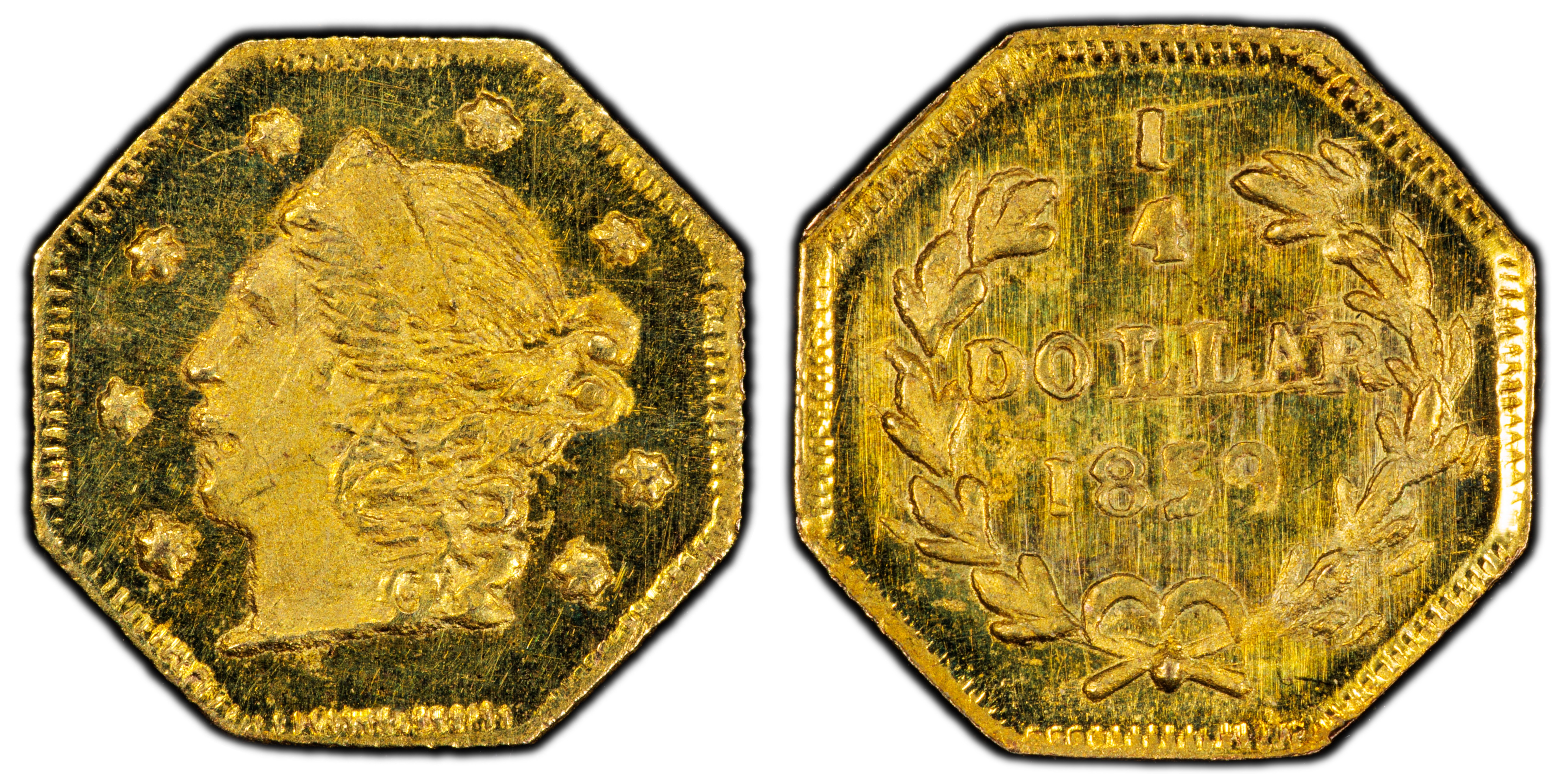
Obverse & Reverse
The 1859 G25C BG-702 octagonal 25-cent piece emerges from the second major phase of California fractional gold production, a period numismatically distinct from the initial utilitarian issues of the early 1850s. By 1859, the acute shortage of small change that plagued the early Gold Rush had been largely resolved by the output of the official San Francisco Mint, which began striking silver coins in 1855. The impetus for creating these minuscule gold pieces shifted from necessity to novelty. San Francisco was transitioning from a chaotic boomtown into a more established metropolis and a burgeoning tourist destination. Enterprising jewelers, many of French origin like Pierre Frontier and Eugene Deviercy, recognized a new market: souvenirs. Visitors and residents alike desired small, affordable keepsakes of the California gold phenomenon that could be easily sent back East or to Europe. Consequently, these 'Period Two' (1859-1882) issues, often termed 'jeweler's issues,' were struck not as a circulating medium of exchange but as charming mementos. The BG-702, attributed to Frontier, Deviercy & Co., is a quintessential example of this era. Unlike their Period One predecessors, which aimed for a reasonable approximation of face value in gold content, Period Two pieces were notoriously lightweight and often of a lower fineness. Their legality was dubious, existing in a gray area until an 1864 federal law explicitly prohibited private coinage, though enforcement remained lax until the early 1880s. The BG-702 was likely produced using the hammer-striking method common for these pieces, resulting in variability in strike quality. Its distinctive octagonal shape was a popular feature, echoing the larger, iconic $50 slugs produced by Augustus Humbert. Today, the BG-702 is not just a collectible coin but a tangible artifact of a maturing San Francisco, symbolizing the commercial pivot from fulfilling miners' practical needs to catering to a romanticized fascination with the Gold Rush itself.
Associated EventCalifornia Gold Rush
Reason For MintingPrimarily struck to be sold as souvenirs and keepsakes for a growing tourist trade in San Francisco, rather than to alleviate a coin shortage.
Minter HistoryPierre Frontier and Eugene Deviercy were French jewelers operating in San Francisco. Their firm, Frontier, Deviercy & Co., was a prominent producer of 'Period Two' California fractional gold. They were previously associated with another jeweler, Alexandre Dubois, and their partnerships evolved over time. Like other jewelers of the era, they leveraged their metallurgical skills to manufacture these small gold tokens for the lucrative souvenir market, capitalizing on the romantic allure of the Gold Rush.
Historical SignificanceThe BG-702 is significant as a prime example of a 'Period Two' or 'jeweler's issue' of California fractional gold, illustrating the shift in their purpose from utilitarian currency to commercial souvenirs. It represents the maturation of the San Francisco economy and the romantic fascination with the Gold Rush that persisted long after the initial frenzy.
BG-702
Denomination$0.25
Minting Period1859
Assayer/MinterFrontier, Deviercy & Co.
Geographic OriginSan Francisco, California
Obverse DescriptionA Liberty Head, facing left, with hair tied in a bun. The portrait is somewhat crude, typical of the jeweler's issues. The head is surrounded by 13 six-pointed stars, often weakly struck. The date, 1859, appears below the bust.
Obverse Inscription1859
Reverse DescriptionThe denomination '1/4' is centered within a continuous wreath of leaves and berries. The legend 'CALIFORNIA GOLD' encircles the wreath along the upper border of the octagonal planchet. The 'R' in GOLD is often weakly struck. A key diagnostic for this variety is that the wreath and the 'R' in DOLLAR (from a reused punch) are widely repunched.
Reverse InscriptionCALIFORNIA GOLD 1/4
CompositionGold
Stated Fineness Actual FinenessPeriod Two issues were often debased, with fineness ranging from 14 to 22 carats (.583 to .917 fine), but a specific analysis for BG-702 is not widely published.
EdgePlain
Unknown
Survival Estimate76-125 known (Some sources cite R-3, suggesting 201-500 known)
Rarity ScaleR-4
The BG-702 is sought after for its connection to the romantic era of the California Gold Rush, its popular octagonal shape, and its specific attribution to known San Francisco jewelers. As a 'Period Two' issue, it tells the story of the commercialization of the gold dream. The known die characteristics, such as die rust and repunching, offer collectors specific features to hunt for.
Key VarietiesThe primary variety is the regular business strike with a plain edge, as requested. The Breen-Gillio reference does not list significant die varieties for BG-702 beyond the known repunching, nor are there any known patterns, trial pieces, or later-date restrikes associated with this specific catalog number.
Authentication TipsAuthenticity is paramount with fractional gold. Genuine BG-702 specimens often exhibit a distinctive fabric from having been struck from heavily rusted dies, resulting in finely granular or rough-textured fields. Look for evidence of the widely repunched wreath and the 'R' in 'DOLLAR' (a ghosted letter from a reused punch, sometimes faint) on the reverse. The style of the Liberty head and lettering should match known genuine examples; counterfeits often have incorrect details, are cast instead of struck (showing porosity), or are simply gold-plated tokens with incorrect weight and feel.
Shopping ConsiderationsA premium quality example for its grade will show a relatively sharp strike for the issue, especially on the central Liberty portrait and the '1/4' on the reverse. Given that these were struck from rusted dies, finding a piece with minimal granularity and good 'eye appeal' is a major plus. Look for original, uncleaned surfaces, which may display attractive reddish-gold or olive-gold toning. Avoid examples that have been harshly cleaned, polished, or used as jewelry, which will often show rim damage, solder marks, or excessive scratches. Pay close attention to the stars on the obverse and the wreath details on the reverse, as these are often the first areas to show weakness or wear.
A coin's grade is its condition, rated on a 1-70 scale. For rare coins, this is the most critical factor in determining value, as a tiny difference in preservation can mean a huge difference in price.
Relevant Grade TypesOriginal 1859 BG-702 issues were business strikes intended for sale as souvenirs, not circulation, but are graded along the same continuum. They are found in Circulated grades (About Good-3 to About Uncirculated-58) and, more commonly for this type, in Mint State (MS-60 to MS-70). No Proof (PR/PF) examples were struck during the original period of issue, and no later-date Proof restrikes are known to exist for this variety.
Mint State CharacteristicsUncirculated examples are defined by the presence of original mint luster. For the BG-702, this luster is often satiny but can be somewhat subdued due to the characteristic die rust, which imparts a granular texture to the surfaces. A superior Mint State coin will have a sharp strike on Liberty's portrait, though some softness on the peripheral stars and wreath is common and often acceptable. Small, scattered contact marks are typical due to the softness of the gold and the way these pieces were handled in bulk by their makers.
Circulated Wear PatternsOn circulated examples, wear first appears on the highest points: Liberty's cheek, hair bun, and eyebrow. On the reverse, the high points of the wreath leaves and the fraction '1/4' will show friction and loss of detail first. In lower grades (VF and below), the date and stars will become progressively weaker and may merge with the fields.
Key Factors For ValueThe primary drivers of value are grade and surface quality. An example with original, lustrous, and uncleaned surfaces will command a significant premium over a cleaned or polished coin of the same grade. Strike quality is also key; a sharply struck piece from fresh dies (though still showing the characteristic rust texture) is highly desirable. Eye appeal, including attractive original toning, plays a significant role. Finally, certification by a top-tier service like PCGS or NGC is essential for market acceptance, and a CAC sticker indicating premium quality for the grade adds a further, often substantial, premium.
PCGS Price Guide
| Grade | Price | Population |
|---|---|---|
| 65 | $950.00 | 2 |
| 65+ | $1,150.00 | N/A |
| 66 | $1,500.00 | N/A |
| 66+ | $1,750.00 | N/A |
| 67 | $2,250.00 | N/A |