1875 G50C BG-1037 (Regular Strike)
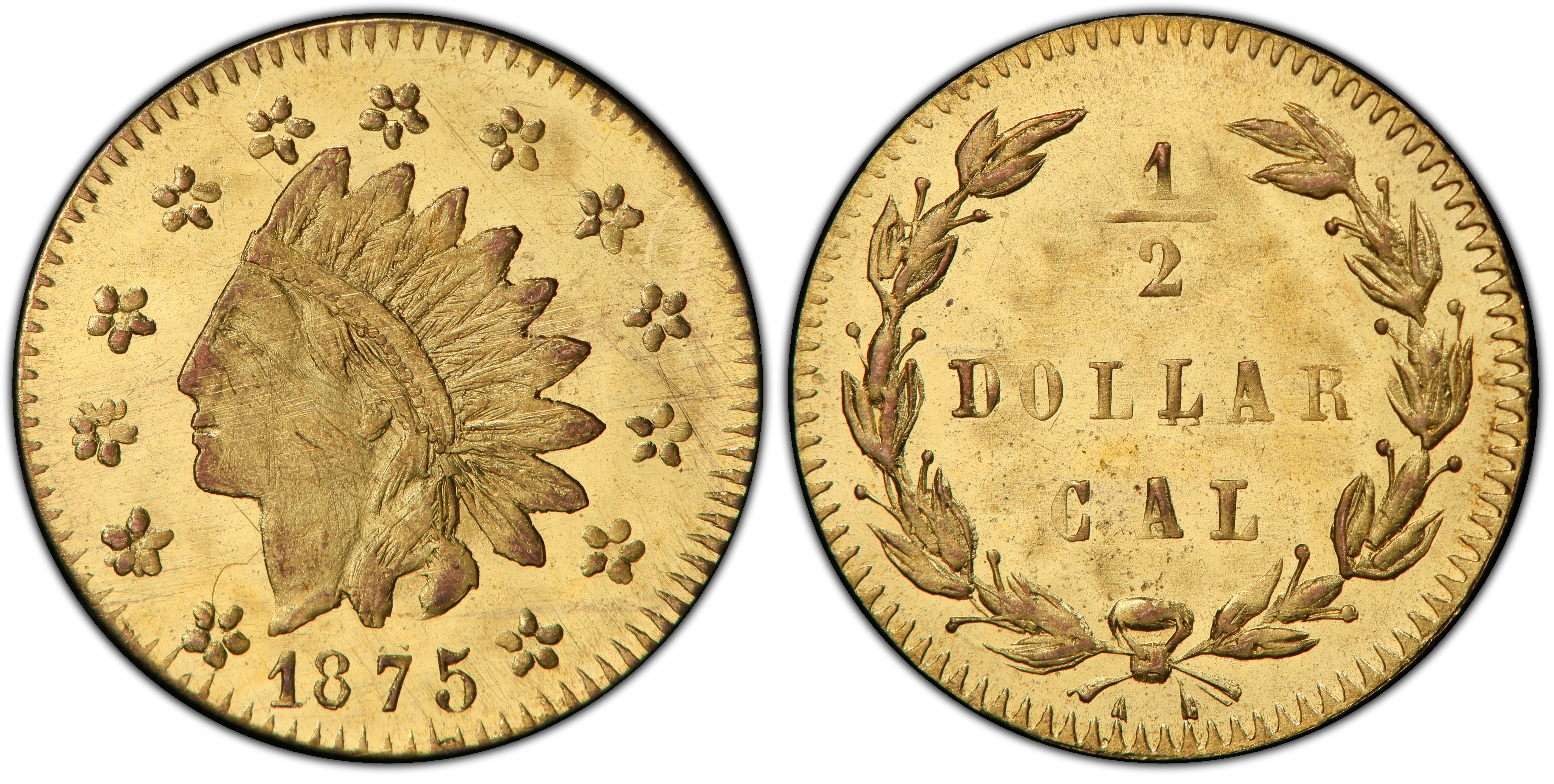
Obverse & Reverse
The 1875 BG-1037 50 Cents represents a fascinating chapter in American economic history, belonging to 'Period Two' (1859-1882) of California Fractional Gold production. By the mid-1870s, the initial fervor of the Gold Rush had subsided, but California's economy remained robust and distinct from the rest of the nation. The primary driver for these minuscule gold coins was a persistent, localized shortage of small-denomination federal coinage. While the U.S. Mint produced silver coins, their circulation in the West was inconsistent. Gold dust, the de facto currency of the early gold fields, was impractical for small, everyday transactions. Entrepreneurs, primarily jewelers and metalworkers in San Francisco, stepped in to fill this commercial void. Unlike the earlier 'Period One' issues, which more closely mimicked federal coinage and had a higher intrinsic value relative to their face value, Period Two pieces like the BG-1037 were often underweight. The Coinage Act of 1864 had officially outlawed private coinage, but enforcement on the remote West Coast was lax, allowing this practice to continue for nearly two more decades. These later issues were produced more as commercial tokens or conveniences rather than true circulating currency intended to be melted for their bullion. They were tolerated because they served a vital purpose in facilitating daily trade for items like newspapers, drinks, or small services. The BG-1037, with its simple Indian Head design, was a product of this environment—a utilitarian, privately-made piece of money that addressed a real economic need, operating in a gray area of legality and reflecting the independent spirit of post-Gold Rush California.
Associated EventPost-California Gold Rush Economic Expansion
Reason For MintingTo alleviate a chronic shortage of small-denomination coinage for everyday commercial transactions in California.
Minter HistoryThe specific minter of BG-1037 is unknown, a common trait for Period Two fractional gold. Research by Walter Breen, Ronald J. Gillio, and Robert D. Leonard, Jr. attributes most of these 'Jeweler's Issues' to a variety of San Francisco-based craftsmen. These individuals were not large-scale private minters like their Period One predecessors but were skilled artisans who possessed the equipment to strike small planchets. They often operated anonymously or with simple identifying marks, producing coins on demand to meet local business needs. Their primary business was jewelry, and coin striking was a profitable sideline that also provided a service to the community.
Historical SignificanceThe BG-1037 is significant as a tangible artifact of a persistent, localized monetary system that operated parallel to official U.S. currency. It demonstrates the continued economic isolation and unique needs of the American West long after the initial Gold Rush. As a Period Two issue, it represents the evolution of fractional gold from quasi-official coinage to commercial tokens, struck under a cloud of questionable legality yet deemed necessary by the local population. Its existence highlights the federal government's limited ability to enforce monetary policy across the vast nation during the 19th century.
BG-1037
DenominationG50C (50 Cents)
Minting Period1875
Assayer/MinterUnknown Private Minter (Attributed to San Francisco Jewelers)
Geographic OriginSan Francisco, California
Obverse DescriptionA small, crudely rendered bust of a female figure representing Liberty, facing left, wearing a Native American-style feathered headdress. The portrait is surrounded by thirteen stars, which are often weakly struck or indistinct. The date '1875' appears below the bust.
Obverse Inscription1875
Reverse DescriptionThe central device is a simple wreath, open at the top. Within the wreath, the denomination is expressed as '1/2' with 'CAL.' below it.
Reverse Inscription1/2 CAL.
CompositionGold
Stated Fineness0.9
Actual FinenessVaries, but typically lower than stated for Period Two issues.
EdgePlain
Unknown
Survival Estimate76 to 200 (based on R-4 rarity)
Rarity ScaleR-4
The BG-1037 is sought after for its affordability relative to other California gold issues and its direct connection to the post-Gold Rush era. As a dated Period Two variety, it is a collectible piece of Americana that tells the story of daily life and commerce in 19th-century San Francisco. The small size and charmingly rustic design make it a popular entry point into the complex and fascinating world of fractional gold.
Key VarietiesThe primary reference, 'California Pioneer Fractional Gold' by Breen and Gillio (revised by Leonard), does not list major, distinct varieties for the BG-1037 die marriage itself. The series as a whole contains hundreds of die varieties (BG numbers), but BG-1037 refers to a specific pairing. No special collector issues like Proofs or restrikes from the original minting period or later are known to exist for this variety.
Authentication TipsAuthentication requires comparison to known genuine examples, ideally using the photographic plates in the Breen-Gillio-Leonard reference book. Genuine pieces are struck, not cast, and should exhibit die characteristics consistent with the BG-1037 variety. They are typically very thin, about the thickness of a business card. Many counterfeits and modern replicas exist; fakes are often thicker, have mushy details, incorrect luster, and may lack the 'CAL.' inscription or show a bear motif, which is not found on genuine Period One or Two pieces. Genuine pieces almost always state a denomination (e.g., '1/2', 'DOL.', 'CENTS'), whereas many souvenir tokens do not.
Shopping ConsiderationsA premium quality example for its grade will exhibit a sharp strike, particularly on the date and the feathers of the headdress, which are often weak. Look for pleasing, original surfaces with some remnant luster; many surviving examples have been cleaned or handled improperly, appearing dull or hazy. Avoid specimens that are bent, holed, or have been used in jewelry, as this significantly impairs value. Eye appeal is paramount; coins with a smooth, problem-free surface and a bold strike command significant premiums over weakly struck or damaged counterparts. Given the prevalence of counterfeits, purchasing examples certified by a major third-party grading service (PCGS or NGC) is strongly recommended.
A coin's grade is its condition, rated on a 1-70 scale. For rare coins, this is the most critical factor in determining value, as a tiny difference in preservation can mean a huge difference in price.
Relevant Grade TypesAll original 1875 BG-1037 coins were struck as business strikes intended for commerce and are found in Circulated (1-58) and Mint State (MS, 60-70) grades. Due to their use in daily transactions, most survivors are circulated. No Proof (PR/PF) examples were struck by the private minters during this period. Any piece described as a 'Proof' would be a modern creation or a misattribution of a business strike with reflective surfaces (Prooflike or PL).
Mint State CharacteristicsUncirculated examples of BG-1037 are scarce. A typical Mint State specimen often displays a soft, satiny luster rather than a hard, frosty one. The strike is a key determinant of quality; many were weakly struck, so a coin with fully realized details in the headdress, stars, and wreath is highly desirable. Due to the softness of the gold and rudimentary production methods, even uncirculated pieces can show minor planchet flaws or light contact marks from handling and storage.
Circulated Wear PatternsWear first appears on the highest points of the design. On the obverse, this includes Liberty's cheek, the upper feathers of the headdress, and the hair above the ear. On the reverse, the high points of the wreath show initial friction. In lower grades (VG and below), the date and the individual letters in 'CAL.' will become faint and begin to merge with the fields.
Key Factors For ValueThe primary drivers of value for a BG-1037 are grade and surface quality. An example with original, uncleaned surfaces commands a significant premium over one that has been harshly cleaned or polished. Sharpness of the strike is critical; a well-struck coin is far more valuable than a weakly struck one of the same grade. Eye appeal, encompassing factors like attractive original color and smooth fields, is also key. Finally, certification by PCGS or NGC is standard for the market, and a sticker from CAC (Certified Acceptance Corporation) indicating premium quality for the grade can add a substantial premium.
PCGS Price Guide
| Grade | Price | Population |
|---|---|---|
| 50 | $235.00 | 3 |
| 50+ | $250.00 | N/A |
| 53 | $275.00 | 1 |
| 53+ | $300.00 | N/A |
| 55 | $325.00 | 5 |
| 55+ | $350.00 | N/A |
| 58 | $375.00 | 13 |
| 58+ | $425.00 | N/A |
| 60 | $475.00 | 2 |
| 61 | $525.00 | 2 |
| 62 | $560.00 | 20 |
| 62+ | $600.00 | N/A |
| 63 | $700.00 | 22 |
| 63+ | $875.00 | N/A |
| 64 | $1,150.00 | 7 |
| 64+ | $1,400.00 | N/A |
| 65 | $1,800.00 | 1 |
| 66 | N/A | N/A |