1859 G50C BG-1002, PL (Regular Strike)
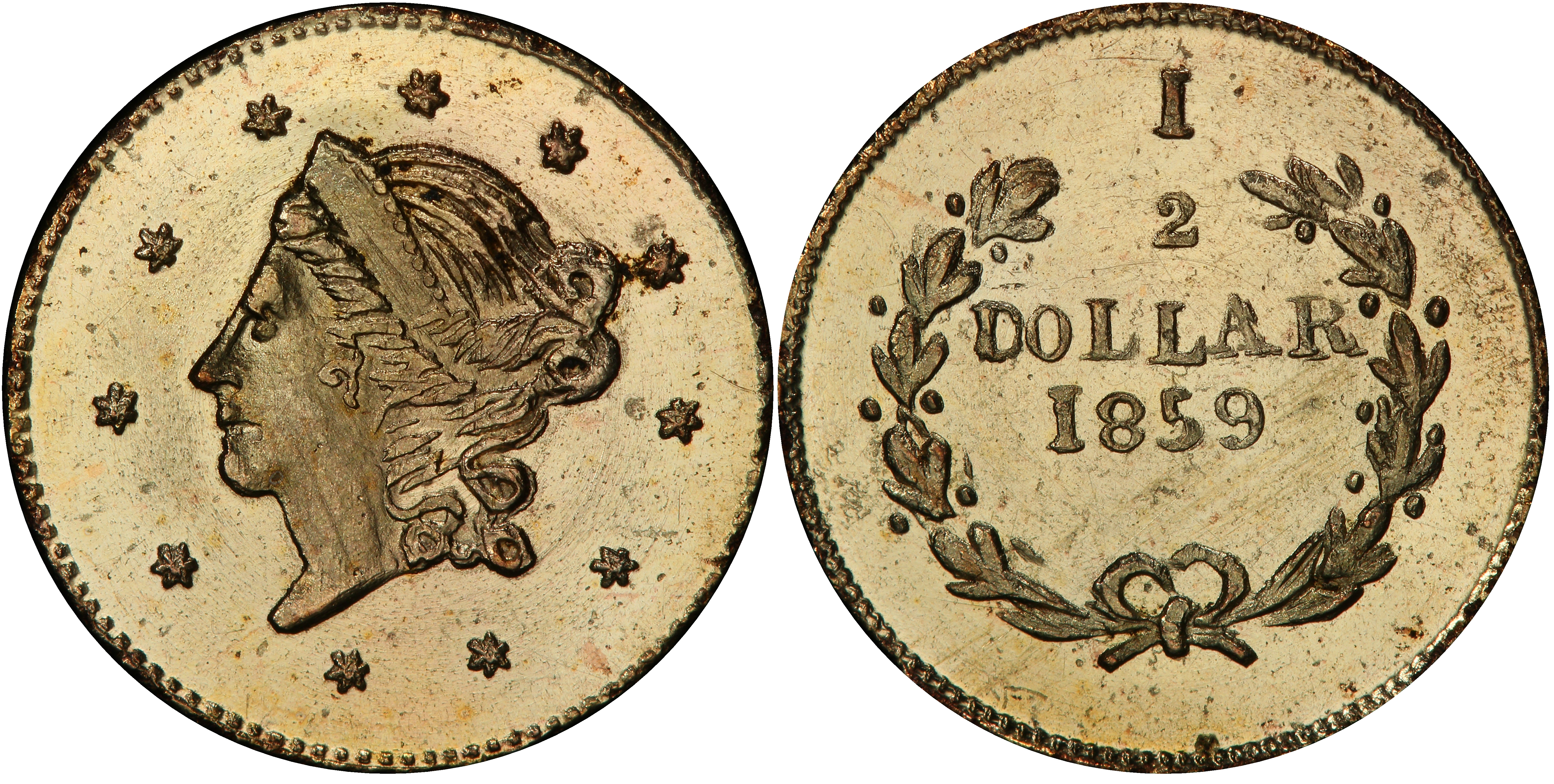
Obverse & Reverse
The 1859 BG-1002 50 Cent piece represents a fascinating and pivotal chapter in the history of California Fractional Gold. It is a quintessential 'Period Two' (1859-1882) issue, a series defined by a fundamental shift in purpose from utilitarian currency to commercial souvenir. By 1859, the acute shortage of small change that had plagued California in the early Gold Rush years had largely subsided. The establishment and robust output of the U.S. Branch Mint in San Francisco in 1854 had supplied the region with ample federal silver and gold coinage, rendering the privately minted 'Period One' necessity coins largely obsolete. However, the allure of California gold had not faded; rather, it had transformed. San Francisco was a burgeoning metropolis, a destination for tourists, merchants, and fortune-seekers captivated by the romanticism of the Gold Rush. Jewelers and shrewd entrepreneurs like Pierre Frontier and Eugene Deviercy recognized a new market: creating miniature gold coins not for the cash-starved miner, but for the visitor wanting a keepsake, the gentleman wishing for a watch fob charm, or the lady desiring a piece of unique jewelry. These Period Two pieces, often of lower fineness and lighter weight than their stated value would imply, were brilliantly marketed novelties. The BG-1002 was struck using the hammer method, a primitive technique where dies were struck by hand, resulting in significant variability in strike quality even within the same die state. This particular variety, attributed to the prolific firm of Frontier, Deviercy & Co., was one of many designs they produced to cater to this burgeoning souvenir trade. While they did not circulate in the traditional sense, their commercial success was undeniable, becoming a staple of the San Francisco jewelry trade and serving as tangible, gleaming mementos of the Golden State's mythos long after the richest gold placers were exhausted.
Associated EventCalifornia Gold Rush (Post-Boom Souvenir Period)
Reason For MintingPrimarily struck to satisfy a growing commercial demand for gold rush souvenirs and jewelry items rather than to alleviate a shortage of circulating coinage.
Minter HistoryPierre Frontier and Eugene Deviercy were French immigrants and prominent manufacturing jewelers in San Francisco, active from roughly 1853 to 1864. Their firm, Frontier, Deviercy & Co., was one of the most significant and prolific producers of California Fractional Gold, particularly during the souvenir-driven Period Two. They created a wide array of denominations and designs, often characterized by competent but sometimes crude die work. Their business capitalized on the romantic appeal of the Gold Rush, positioning these tiny gold pieces as affordable and desirable keepsakes for a local and tourist market.
Historical SignificanceThe BG-1002 is historically significant not as a coin of circulation, but as a socio-economic artifact. It marks the transition of private California gold from a practical necessity to a commercial novelty, reflecting the maturation of the Californian economy and the successful branding of the Gold Rush narrative for a popular audience. Its existence is a testament to the ingenuity of private entrepreneurs in adapting to changing market conditions.
N/A
Denomination50 Cents
Minting Period1859
Assayer/MinterFrontier, Deviercy & Co.
Geographic OriginSan Francisco, California
Obverse DescriptionA fairly large bust of a female figure representing Liberty, facing left. She wears a coronet or diadem in her hair, which is tied in a bun at the back. The portrait is encircled by thirteen six-pointed stars, typically unevenly spaced. The date, 1859, is positioned below the truncation of the neck.
Obverse Inscription1859
Reverse DescriptionThe denomination '50 CENTS' is centrally located, arranged in two horizontal lines. This is enclosed within a delicate wreath composed of two branches tied together with a ribbon or bow at the bottom. The wreath's elements are often simply rendered.
Reverse Inscription50 CENTS
CompositionGold (often of debased or variable fineness)
Stated Fineness Actual FinenessVariable, often below the standard for federal coinage of the era (.900 fine). Period Two pieces are known to range from .500 to .800 fine.
Weight0.78 grams
Diameter11.40 mm
EdgePlain
Unknown
Survival Estimate75-125
Rarity ScaleR-5
The BG-1002 is highly sought after as a representative issue of the popular Period Two fractional gold series. Its appeal lies in its direct connection to the famous San Francisco jewelers Frontier, Deviercy & Co., its classic Liberty Head design, and its relative scarcity. Collectors appreciate the challenge of finding well-struck, problem-free examples.
Key VarietiesThe primary variation within BG-1002 is the die state. Die State I shows a clean, early striking. Die State II is the most frequently identified and is characterized by a series of bold, easily visible die cracks on the obverse, particularly around Liberty's coronet and the stars. No known patterns, restrikes, or special collector issues were made for this specific BG number.
Authentication TipsAuthenticity is paramount. Genuine examples must have a denomination; pieces without 'CENTS' or 'DOL' are tokens. Compare the coin to high-resolution images of certified examples. The style of the Liberty portrait and the font used for the denomination are key. Specifically for late die states, look for the characteristic obverse die cracks around the coronet. Counterfeits are often soapy in appearance, have incorrect weights, or may display a 'bear' motif, which is a fantasy element never used on genuine fractional gold. The fabric of the planchet should show the characteristic luster of hammered gold, not modern casting or striking.
Shopping ConsiderationsA premium quality example for this issue is defined by sharpness of strike, surface preservation, and eye appeal. Look for a bold strike on the high points of Liberty's hair and the details of the reverse wreath. Many examples are weakly struck, so a sharp one commands a significant premium. Original, lustrous surfaces are highly desirable; avoid pieces that have been harshly cleaned, polished, or used in jewelry (evidenced by solder marks or rim damage). The presence of attractive, original reddish-gold toning enhances eye appeal. For the later die state, the prominence and clarity of the die cracks can be a point of interest for variety specialists.
A coin's grade is its condition, rated on a 1-70 scale. For rare coins, this is the most critical factor in determining value, as a tiny difference in preservation can mean a huge difference in price.
Relevant Grade TypesAll original 1859 BG-1002 pieces were struck as business strikes, though they were not intended for widespread circulation. They are found in Circulated grades (AU-58 and below) and, more commonly, in Mint State (MS, 60-70) grades due to their nature as souvenirs. Some high-grade examples exhibit reflective, proof-like (PL) surfaces from being struck with polished dies on polished planchets to increase their novelty appeal. No true Proofs were struck during the original period of issue, and no later-date restrikes are known.
Mint State CharacteristicsUncirculated examples of BG-1002 often display a soft, satiny luster characteristic of hammered gold. Strike quality varies dramatically; a key determinant of grade and value is the sharpness of the central devices. It is common to see weakness in Liberty's hair details and the leaves of the reverse wreath. Planchets were often unrefined, so minor natural striations or laminations may be present and should not be confused with damage. High-grade PL examples will have mirror-like fields, which are very susceptible to minute hairlines and contact marks.
Circulated Wear PatternsAlthough not intended for heavy circulation, some examples show wear from handling. Wear first appears on the highest points: the hair above Liberty's eye and ear, the cheek, and the coronet. On the reverse, the highest points of the wreath leaves and the numerals of the denomination will show friction and loss of detail first. In lower grades (VF and below), the stars on the obverse and the finer details of the wreath would begin to merge with the fields.
Key Factors For ValueThe primary value drivers for an 1859 BG-1002 are: 1) Grade and surface quality – an original, lustrous, mark-free surface is paramount. 2) Strike – a sharply struck specimen is much rarer and more valuable than a weakly struck one. 3) Eye Appeal – coins with attractive, original toning and clean surfaces command strong premiums. 4) Certification – third-party grading by PCGS or NGC is essential for authenticity and liquidity. A CAC sticker on a certified coin indicates premium quality for the grade and often results in a higher market value.
PCGS Price Guide
| Grade | Price | Population |
|---|---|---|
| 64 | $900.00 | N/A |
| 64+ | $950.00 | N/A |
| 65 | $1,100.00 | N/A |
| 65+ | $1,350.00 | N/A |
| 66 | $1,750.00 | N/A |
| 66+ | $2,000.00 | N/A |
| 67 | $2,750.00 | 1 |