1871 G25C BG-771, PL (Regular Strike)
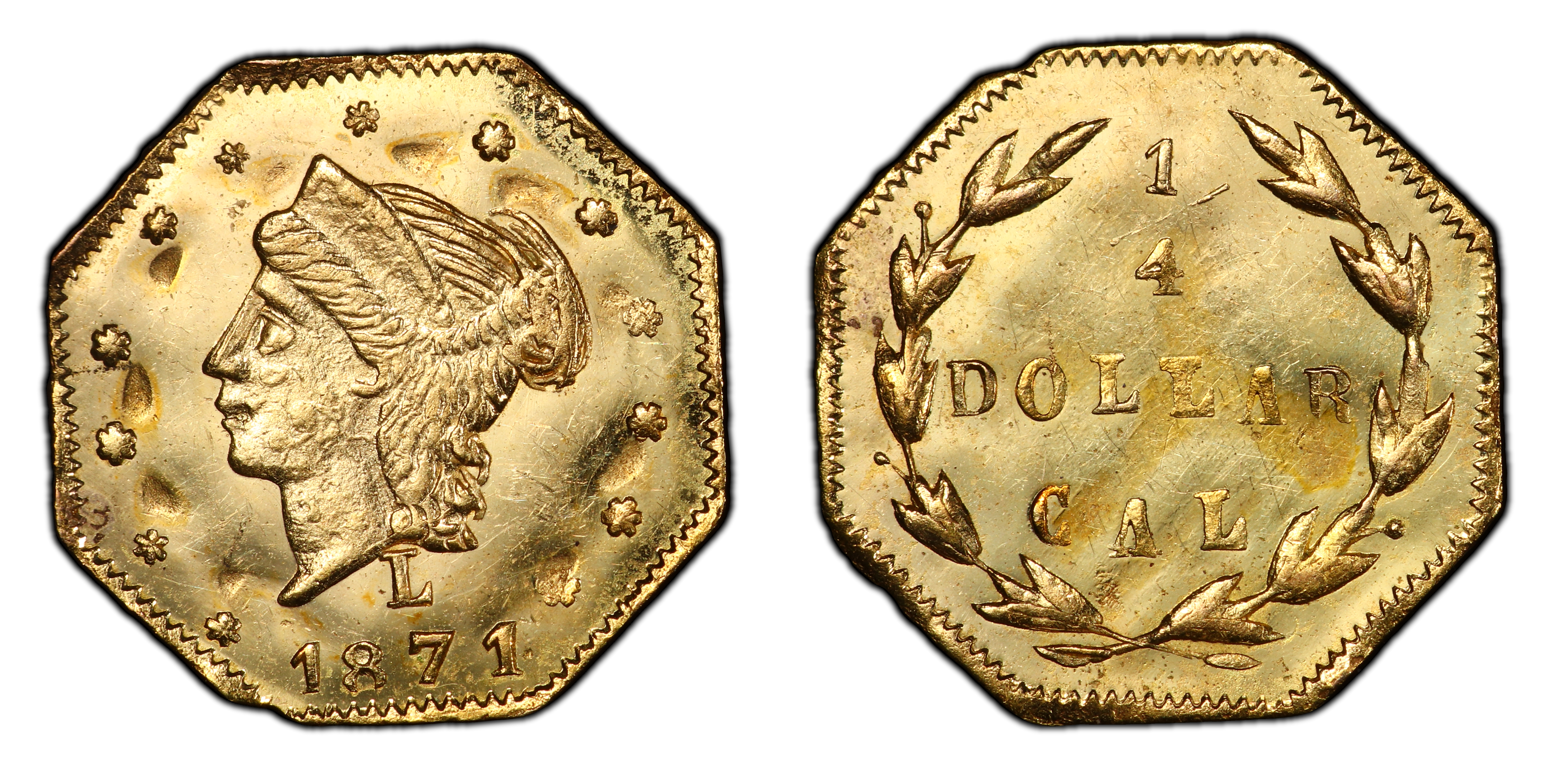
Obverse & Reverse
The 1871 BG-771 25 Cents is a quintessential example of a 'Period Two' California Fractional Gold piece. These fascinating and diminutive coins were born not from the initial frenzy of the Gold Rush, but from its mature aftermath. By the 1870s, the California economy was more developed, and the acute shortage of small change that prompted the 'Period One' issues (1852-1857) had been largely resolved by the output of the San Francisco Mint. However, a robust market for gold souvenirs and novelties had emerged, fueled by tourism and a national fascination with the West. Local jewelers in San Francisco stepped in to fill this demand, creating a wide variety of small-denomination gold pieces. Unlike their predecessors, which were intended to and often did circulate, these 'jeweler's issues' were primarily created for sale as keepsakes. The Coinage Act of 1864 had made the private issuance of coins illegal, but enforcement was inconsistent, and production of these pieces continued until the Secret Service finally cracked down in the early 1880s. The BG-771, like its contemporaries, was produced with a lower intrinsic gold value than its face value would suggest, solidifying its status as a token or souvenir rather than a true coin meant for commerce. They were often crudely manufactured using a hammer press, where a top die was struck with a sledgehammer into a planchet resting on a bottom die. This method resulted in inconsistent strike quality, with many pieces showing weakness in some areas and better definition in others. The anonymity of the minter is typical for this period, as many jewelers produced these pieces without specific hallmarks to avoid legal scrutiny. Today, these tiny gold pieces are not just collectibles but tangible artifacts of a unique economic and cultural period in American history, representing the transition of Gold Rush California from a raw frontier to a place of myth and tourism.
Associated EventPost-Gold Rush Economic Development and Tourism
Reason For MintingPrimarily struck to be sold as souvenirs and keepsakes to tourists and collectors, capitalizing on the romanticism of the California Gold Rush.
Minter HistoryThe specific minter for the BG-771 die marriage is unknown. It is attributed to the class of private manufacturers, mostly San Francisco jewelers, who produced fractional gold pieces from 1859 to 1882. Prominent minters of this period included firms like Deriberpe & Nouizillet and Frontier & Deviercy, but many varieties from this era remain anonymous, their creators lost to history.
Historical SignificanceThe BG-771 represents the second phase of private gold coinage in California, where the purpose shifted from fulfilling a commercial need for small change to satisfying a growing demand for souvenirs. Its existence highlights the cultural impact of the Gold Rush and the legal gray area in which private minters operated for two decades after the practice was officially outlawed.
BG-771
Denomination25 Cents
Minting Period1871
Assayer/MinterUnknown Private Minter
Geographic OriginSan Francisco, California
Obverse DescriptionA crudely rendered Liberty Head faces left, her hair tied in a bun. She wears a plain coronet, and the portrait is surrounded by thirteen five-pointed stars, typically unevenly spaced and weakly defined.
Obverse Inscription[No Inscription]
Reverse DescriptionThe denomination '1/4' appears in the center, enclosed by a wreath of two branches tied with a bow at the bottom. The word 'CALIFORNIA' is inscribed above the wreath along the upper octagonal border, and the date '1871' is below the bow.
Reverse InscriptionCALIFORNIA 1/4 1871
CompositionGold
Stated Fineness Actual FinenessVariable, typically between 14k and 22k.
Weight0.25 grams
Diameter9.80 mm
EdgePlain
Unknown
Survival Estimate31-75 coins known
Rarity ScaleLow R-6
This coin appeals to collectors of territorial gold and Gold Rush-era exonumia. Its small size, octagonal shape, and status as a scarce 'Period Two' issue make it a desirable type coin. The challenge of finding well-struck, problem-free examples adds to its allure.
Key VarietiesNo major varieties of BG-771 are known from the original minting period. As a 'jeweler's issue' created after the main commercial need had passed, no official patterns or restrikes were made. Modern replicas and fantasy pieces exist and should be carefully distinguished from genuine items.
Authentication TipsAuthenticity is paramount with fractional gold. Genuine BG-771 pieces often exhibit a somewhat crude, hand-struck appearance with softness in the stars and parts of the wreath. The surfaces may show prooflike or semi-prooflike reflectivity from polished dies, but the strike is rarely uniform. Look for characteristic die markers if a known example can be referenced. Counterfeits are widespread; many are underweight, have a soapy or cast appearance, incorrect design details (especially the shape of the numerals in the date), or a suspicious 'bear' motif on the reverse, which is a fantasy element never used on genuine fractional gold.
Shopping ConsiderationsA premium quality example for its grade will show an unusually sharp strike for the issue, particularly on Liberty's hair and the leaves of the wreath. Seek out pieces with original, uncleaned surfaces that may have a slight reddish-gold or greenish-gold patina. Luster is a key value component; coins with prooflike (PL) or semi-prooflike fields are highly prized. Avoid examples that have been holed, used as jewelry, harshly cleaned, or show evidence of tooling or repairs, as these problems dramatically reduce value. Given the prevalence of counterfeits, purchasing examples certified by a top-tier grading service like PCGS or NGC is strongly recommended.
A coin's grade is its condition, rated on a 1-70 scale. For rare coins, this is the most critical factor in determining value, as a tiny difference in preservation can mean a huge difference in price.
Relevant Grade TypesAll original BG-771 pieces are considered business strikes, as they were made for sale, though not necessarily for circulation. They are found in Circulated grades (AU-58 and below, though heavy circulation is uncommon) and, more frequently, in Mint State (MS, 60-70) grades. The term 'Prooflike' (PL) is a designator added to Mint State coins that exhibit mirrored fields from polished dies, a common characteristic of this series. No true Proofs were struck during the original period of issue.
Mint State CharacteristicsUncirculated examples are defined by their luster. A typical BG-771 will have semi-prooflike fields, but the strike is often weak, particularly on the highest points of the design. Expect to see softness in the stars, the details of Liberty's hair, and the bow on the reverse wreath. Bag marks are less common due to their intended purpose as souvenirs, but small handling marks are frequently seen. A truly choice Mint State coin will pair exceptional luster with a strike that is sharper than the norm for the variety.
Circulated Wear PatternsFor circulated examples, wear first appears on the high points of Liberty's cheek, coronet, and the bun of her hair. On the reverse, the highest points of the wreath and the fraction '1/4' will show initial friction and flattening. In lower grades (VF and below), the stars on the obverse and the letters in 'CALIFORNIA' will begin to merge with the fields.
Key Factors For ValueFor the BG-771, value is driven by three main factors: 1) Surface Preservation: An example with original, lustrous, and uncleaned surfaces will command a significant premium over a cleaned or damaged piece. 2) Strike Quality: Given the typically weak strikes, a coin with sharp details on the central devices is highly desirable and commands a substantial premium. 3) Eye Appeal: Coins with attractive prooflike surfaces and pleasing, original color are sought after. A CAC sticker for this issue indicates a premium quality piece for the grade and will increase its value.
PCGS Price Guide
| Grade | Price | Population |
|---|---|---|
| 64 | $2,000.00 | 1 |